
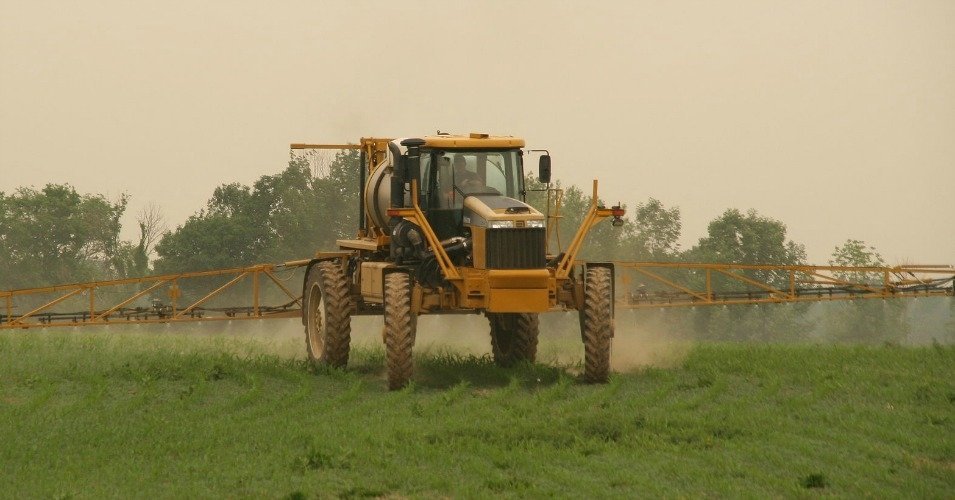
© Wikimedia CommonsSelf-propelled row-crop sprayer applying pesticide to post-emergent corn.
There's plenty of press coverage and consumer awareness when it comes to genetically engineered food and crops, and the environmental hazards of pesticides and animal drugs. But the fertilizer industry? Not so much—even though it's the largest segment of corporate agribusiness ($175 billion in annual sales), and a major destructive force in polluting the environment, disrupting the climate, and damaging public health.
Learning the facts about chemical fertilizers and the companies who produce them will give you yet another reason to boycott chemical/GMO/factory farmed foods and choose organic and grassfed animal products instead. Remember, organic standards established by the U.S. Department of Agriculture (USDA) prohibit the use of chemical fertilizers, pesticides, GMOs, or animal drugs.
Here's a list of underreported facts that raise disturbing environmental and regulatory questions about Monsanto's Evil Twin—the chemical fertilizer industry.
1) Chemical Fertilizer is the Largest Industry in Global Agribusiness
According to the ETC group, a watchdog organization that researches the socioeconomic and ecological impacts of industrial agriculture and GMOs, the world's seven dominant pesticide, GM, and seed companies (including Monsanto, DuPont, Dow, Bayer, and Syngenta) represent a $93 billion market. The global, energy-intensive chemical fertilizer industry is almost twice as large, at $175 billion.
Like most of the other multinational players in Big Food Inc., the fertilizer industry has secretive, vertical or "cartel" like qualities that obscure operations and make regulation difficult. Increasingly, seed and GMO companies, farm equipment producers, pesticide/herbicide makers and crop and soil data producers work in each others' interest seamlessly and behind the scenes, according to ETC.
As ETC points out: "With combined annual revenue of over $385 billion, these companies call the shots. Who will dominate the industrial food chain? And what does it mean for farmers, food sovereignty and climate chaos?"
Industrially mined phosphorus and potash, along with synthetic nitrogen, are major components of the fertilizer industry. Up to 85 percent of the world's known phosphate rock reserves are located in Morocco. About 70 percent of potash comes from former Soviet states and Canada.
2) Fracking Has Made U.S. a Huge Nitrogen Fertilizer Producer
In recent years, U.S. production of nitrogen fertilizer has boomed thanks to the falling price of natural gas used in its production. The reason for the cheap gas of course is fracking—the process of extracting gas from rock formations by bombarding them with pressurized water spiked with toxic chemicals. Unfortunately, fracking releases large amounts of climate disrupting methane and toxic chemical laden fracking liquids which can permanently pollute underground aquifers.
Comment: Despite years of obfuscation by the EPA and denial of the obvious by the O&G industry, there have been a multitude of studies confirming fracking routinely pollutes underground water supplies.
That's bad for the environment—but good for fertilizer companies. Thanks to low natural gas prices, after decades of importing nitrogen fertilizer from the Middle East, the number of U.S. nitrogen fertilizer plants is growing. The three leading domestic producers—Koch Industries, Orascom Construction Industries and CF Industries—are reaping the benefits.
Who's driving demand for all this nitrogen fertilizer? Monsanto.
Between 2005 and 2010, U.S. growers of genetically engineered corn, largely for GMO animal feed and ethanol, increased their nitrogen fertilizer use by one billion pounds. New nitrogen fertilizer plants are being situated close to the corn and soybean growers to feed demand more efficiently. "It is a highly concentrated and oligopolistic-type industry," says Glen Buckley, a fertilizer industry consultant who spent 30 years working at CF Industries, based in Deerfield, Ill.
3) Koch Industries Is a Fertilizer Leader
In 2010, Koch Industries was named "the world's third-largest maker and marketer of nitrogen fertilizer," according to the Wichita Eagle. Koch, which along with Monsanto is one of the most hated corporations in the U.S., is infamous for its support of extreme right-wing politicians and climate deniers. Koch Industries is part of a large system "of buying, leasing, upgrading and expanding fertilizer manufacturing, trading and distribution facilities worldwide." It controls over 65 terminals "where it wholesales nitrogen fertilizer to co-ops and grain elevators for sale to farmers, as well as selling to the chemical industry," reported the Eagle.
Not surprisingly, Koch's fertilizer unit, called Koch Agronomics, has drawn the ire of environmentalists. Pollution is "strictly monitored and legally permitted by federal, state and local governments," Steve Packebush, president of Koch Fertilizer and vice president for nitrogen for Koch Industries told the Eagle. But how strict are those guidelines, really?
4) Chemical Fertilizer "Enforcement" Is Often Self-Monitoring
The Environmental Protection Agency (EPA) acknowledges the severe harm nitrogen fertilizer does to waterways, including to marine life and humans. Yet the agency's "enforcement" of harmful excessive farm runoff sounds a lot like an honor system.
Asked how National Pollutant Discharge Elimination System (NPDES) permits, which allow farming operations to discharge nitrogen, are "enforced," the EPA says, "The permit will require the facility to sample its discharges and notify EPA and the state regulatory agency of these results. In addition, the permit will require the facility to notify EPA and the state regulatory agency when the facility determines it is not in compliance with the requirements of a permit. EPA and state regulatory agencies also will send inspectors to companies in order to determine if they are in compliance with the conditions imposed under their permits."
Self-monitoring by private industry is of course a government trend across the board. In the late 1990's the government rolled out the Hazard Analysis Critical Control Point (HACCP) program which took away the majority of those "pesky" federal meat inspectors' duties and allowed Big Meat to self-police its own slaughterhouses. Sometimes U.S. meat inspectors were openly defied and laughed at. HACCP was quickly dubbed Have a Cup of Coffee and Pray. Meat inspectors identified greater amounts of feces and contamination in meat soon after the program was instituted. Since then, self-policing by food producers has only been expanded.
5) Nitrogen Fertilizer Pollutes the Environment and Drinking Water
As most people know, nitrogen runoff from non-organic farms and feedlots into waterways causes hypoxic conditions—lack of oxygen—which regularly kill fish in shocking quantities.
Two-thirds of the U.S. drinking water supply is contaminated at high levels with carcinogenic nitrates or nitrites, almost all from excessive use of synthetic nitrogen fertilizer. Some public wells have nitrogen at such a high level that it is dangerous and even deadly for children to drink the tap water.
Nitrogen fertilizer is also the greatest contributor to the infamous "dead zones" in the Gulf of Mexico, the Chesapeake Bay, the coasts of California and Oregon, and 400 other spots around the world. Since very little synthetic nitrogen fertilizer was used before 1950, all of the damage we see today occurred in the last 60 years.
Excessive nitrates in drinking water, common in the corn-growing areas of the U.S, are known to cause deadly "blue baby" syndrome in infants, and have been linked to cancer in adults. In combination with herbicide residues such as Syngenta's atrazine, nitrates become even more toxic, potentially causing brain damage and hormone disruption.
In some rural areas, fertilizer pollution levels are 10 times beyond so-called "allowable levels," although golf courses and homeowner fertilizer and pesticide use in urban areas also contribute to the problem. Last fall, the Des Moines Water Works sued three neighboring farming counties over their nitrate discharges but, reported the Associated Press, "the litigation has provoked intense criticism from Iowa's powerful agricultural industry, which argues that farmers are already taking voluntary measures to control them."
6) Nitrogen Fertilizers Harm Workers and Communities
Anhydrous ammonia, a nitrogen compound compressed into a clear, colorless liquid for easy application, is extremely dangerous to workers and neighboring communities. It poses explosion and fire hazards as well as respiratory risks.
"It [Anhydrous ammonia] must be stored and handled under high pressure, requiring specially designed and well-maintained equipment," says the University of Minnesota's extension site. "In addition, to ensure their safety, workers must be adequately educated about the procedures and personal protective equipment required to safely handle this product."
In 2013, an anhydrous ammonia explosion and fire at the West Fertilizer Company storage near Waco, Texas, killed 15 and injured 160, and caused 150 buildings to be razed. (At the time, Governor Rick Perry was in Chicago recruiting businesses to relocate in Texas, where safety regulations were more lax and would not cut into their profits.)
In 2006, railroads asked to be relieved of their common carrier obligation to haul fertilizer products like anhydrous ammonia or to be protected by a liability cap. Accidents like last year's in South Carolina, where people within a 1.5- mile radius of a derailed train carrying ammonium nitrate and anhydrous ammonium were evacuated, occur regularly.
Yet the Fertilizer Institute trade group says "The historically high safety record of anhydrous ammonia transport by rail has been achieved over the years by the fertilizer industry, the railroads and tank car manufacturing and leasing companies working in a close cooperative effort."
Read the rest of the article here.





Hello all
Interesting article.
Please follow this link.
[Link]
Then open the PDF titled ......SOS:Save Our Soils.
This will bring into perspective most things in the parent article.
Happy reading and please comment.