
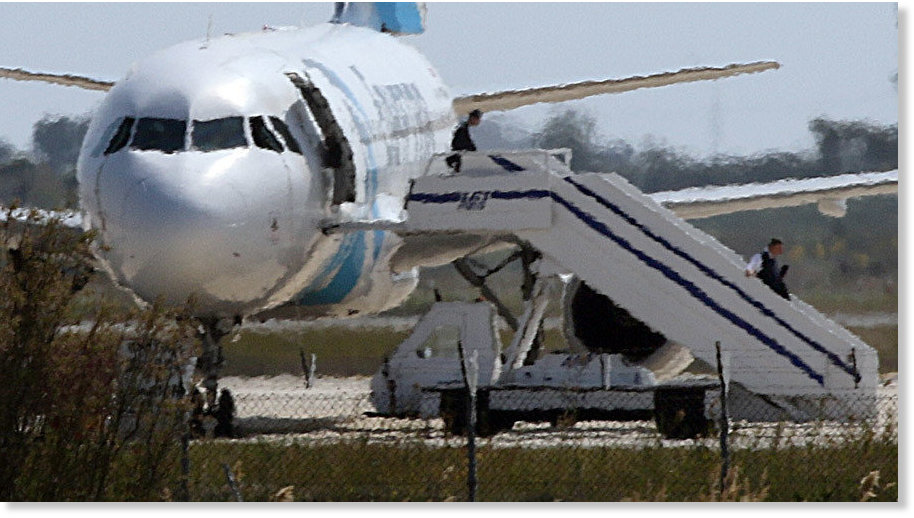
© Yiannis Kourtoglou / ReutersUnidentified people leave the hijacked Egyptair Airbus A320 at Larnaca Airport in Larnaca, Cyprus, March 29, 2016
Egypt Air flight MS181 was hijacked on its way from Alexandria to Cairo and forced to land in Larnaca in Cyprus on Tuesday. According to the Cypriot Foreign Ministry, the hijacker, Seif Eldin Mustafa, was arrested and all the passengers on the plane were released.
RT: The hijacker released all the passengers from the plane. What do you read into that?
Ricardo Baretzky: It is very difficult to say without the exact facts. But I can say this: we should see any type of hijack or attack on any nation as a form of terror attack, whether it is for any personal aim or anything else. Any attack on any nation is a type of terrorist attack today.
RT: You're a security expert. How could this have happened?
RB: First of all, security services at all border controls - not only in Europe, but also in all the neighboring countries, and all the countries that go to Europe or from Europe, Egypt and other countries in the northern part of Africa or West Africa, those airports and border patrols need to understand that security measures have to be on an international level. And what has happened over the last few years? We have seen a shift between international level security measures dropping in some areas in Africa and not stepping up the security measures as they should be doing.
RT: It is possible that the hijacker had some sort of inside help?
RB: Case studies show that in the past few years there has been a shift from external threats to internal threats. The probability of this being an internal threat with other people being involved inside is very, very high. We've seen this everywhere in the world, so this is no exception. What is important to understand is: Why is the internal threat becoming so important and why it is spreading so much and so quick? That is a fundamental question we need to ask within the industry.
Comment: It needs to be pointed out that of the many large international airports, particularly in Europe and most curiously in Brussels and Amsterdam, the security of those airports is handled by companies with ties to Western intelligence agencies, specifically Mossad:
Former Israeli Intel Operatives Run Security at Brussels Airport
By way of deception: MH17 sabotaged by Israeli security team at Amsterdam Schiphol airport
Also, from The Dutch, Israel and Airport Security:
IN AN INTERVIEW BY THE DUTCH TV NOS, former Dutch Defense minister Henk Vredeling, proudly - and not understanding his war criminal behavior - gave an example of the Dutch praxis and spoke about the secret weapon transports to Israel's Yom Kippur war in 1973. It was done than the same as now: secret and tax paid. The Israeli secret service Mossad has it's main European transport quarters at Schiphol airport, which they run as a 'state within a state'. No control of the Israelis is ever done. They are untouchables. Their Shin Bet commandos also run the Belgian weapons and other contrabande hub at the airport of Zaventem.It should be clear that the "internal threats" at airports are much more likely to be the intelligence agencies that have the run of the house to further their secret activities than they are random airport employees "going rogue".
ON JANUARY 29, 1999, DUTCH ATTORNEY GENERAL VRAKKING TESTIFIED THAT THE 'EL AL' SECURITY DETACHMENT AT SCHIPHOL AIRPORT WAS A BRANCH OF THE ISRAELI SECRET SERVICE MOSSAD.
A Dutch 'Air Guidance Organization' employee told in a parliamentary hearing that the 'policy' since 1973 was to keep quiet about all El Al activities. Schiphol workers testified that El Al planes were never inspected by customs or the Dutch Flight Safety Board.
Political commentator Marwa Osman told RT: "Sharm El-Sheikh, the airport that is supposed to be the most high-tech airport because it has lots of tourists there, doesn't have the security. So what about Cairo, Alexandria and the other airports in Egypt? When we are talking about the security of airports, we are talking about the security of everyone. If one airport in one state... is not secure, then every other destination will be at risk."RT: What kind of motives had the hijacker had?
RB: The fact that he released the passengers is a kind of good will gesture... We have to see what the motive is and what the outcome would be. What is most important is that they capture alive the people responsible.
RT: What will be the reaction of authorities?
RB: I think that this will create a bit of confusion because it is not normal. And that raises the alarm: why and... what is at stake? These are the questions we have to ask and the question that the officials will struggle to get to grip with because they might never know what the end goal was in this particular event.

Reader Comments
to our Newsletter