
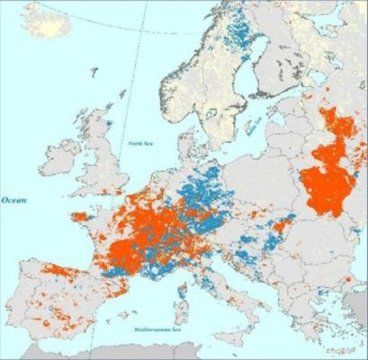
© JRC-EDEA database (EDO). © EU, 2015Areas with the lowest soil moisture content since 1990 in July 2015 (in red) and in July 2003 (in blue).
Satellite imagery and modelling revealed that the drought, caused by prolonged rainfall shortage since April, had already affected soil moisture content and vegetation conditions in June. Furthermore, the areas with the largest rainfall deficits also recorded exceptionally high maximum daily temperatures: in some cases these reached record values.
Another characteristic of this period was the persistence of the thermal anomalies: in the entire Mediterranean region, and particularly in Spain, the heat wave was even longer than that of 2003, with maximum daily temperatures consistently above 30°C for durations of 30 to 35 days (even more than 40 days in Spain).
While sectors such as tourism, viticulture and solar energy benefited from the unusual drought conditions, many environmental and production sectors suffered due to water restrictions, agricultural losses, disruptions to inland water transport, increased wildfires, and threats to forestry, energy production, and human health.
Rainfall is urgently needed in the coming months to offset the negative impacts of the 2015 drought situation. The current seasonal weather forecast envisages more abundant rains for the Mediterranean region in September, but no effective improvement is yet foreseen for parts of western, central and eastern Europe.
Story Source: The above post is reprinted from materials provided by European Commission, Joint Research Centre (JRC). Note: Materials may be edited for content and length.


Comment: Europe has been undergoing a heatwave that has set historic records and there has been a wave of extreme temperatures all over the globe recently: