
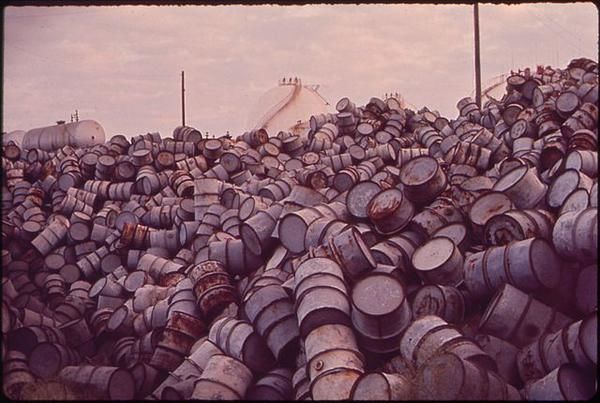
© twitter.comRunnin' on empty...
Although the battery metaphor made headlines in leading newspapers in China, India and Russia, the paper didn't garner "much immediate attention in North America," admits lead author John Schramski, a mechanical engineer and an ecologist.
And that's a shame, because the paper gives ordinary people an elegant metaphor to understand the globe's stagnating economic and political systems and their close relatives: collapsing ecosystems. It also offers a blunt course of action: "drastic" energy conservation.
It, too, comes with a provocative title: "Human domination of the biosphere: Rapid discharge of the Earth-space battery foretells the future of humankind." The battery metaphor speaks volumes and then some.
In the paper, Schramski and his colleagues at the University of Georgia and the University of New Mexico compared the energy state of the Earth to "the energy state of a house powered by a once-charged battery supplying all energy for lights, heating, cooling, cooking, power appliances and electronic communication."
It took hundreds of millions of years for photosynthetic plants to trickle charge that battery. Those plants converted low quality sunlight into high-quality chemical energy stored either in living biomass (forests and plankton) or more lastingly in the dead plants and animals that became oil, gas and coal.
But in just a few centuries humans and "the modern industrial-technological informational society" have spent that stored chemical energy and depleted the Earth-space battery.
Society partly drains the battery by converting forests and grasslands into agricultural fields. It diminishes the battery further by burning fossil fuels to plow fields and build cities. Human engineering of one kind or another has left a mark on 83 per cent of the planet.
In essence, humans depleted the battery to grow exponentially and spend more energy.
"As the battery discharges," the scientists write, the cooling, heating and electronic services provided to the house "become unavailable and the house soon becomes uninhabitable." The Earth is like a dying cell phone at an airport, says Schramski, but with no rechargeable plug in sight.
The problem, say the scientists, is that the battery is not being replenished as quick as it is being drained.
Schramski adds a good point: "Eventually, without sufficient living biomass to run the biosphere, it simply doesn't matter how much oil, solar, nuclear, etc. energy you have, as there is no biosphere left for humans to use it. Biomass is not an interchangeable energy. There is no replacement and we are depleting it rapidly...""


Comment: The laws of thermodynamics governing the trickle-charge and rapid discharge of the earth's battery are universal and absolute; the earth is only temporarily poised a quantifiable distance from the thermodynamic equilibrium of outer space. Although this distance from equilibrium is comprised of all energy types, most critical for humans is the store of living biomass. With the rapid depletion of this chemical energy, the earth is shifting back toward the inhospitable equilibrium of outer space with fundamental ramifications for the biosphere and humanity. Because there is no substitute or replacement energy for living biomass, (Editor's note: especially as species extinction is rapidly and critically accelerating), the remaining distance from equilibrium that will be required to support human life is unknown.
Additional factors for earth's changes are described in Pierre Lescaudron's book: Earth Changes and the Human-Cosmic Connection. We may well be coming into a period that humanity, consequently, reverts to simpler times and methods of survival. Will you be ready?