
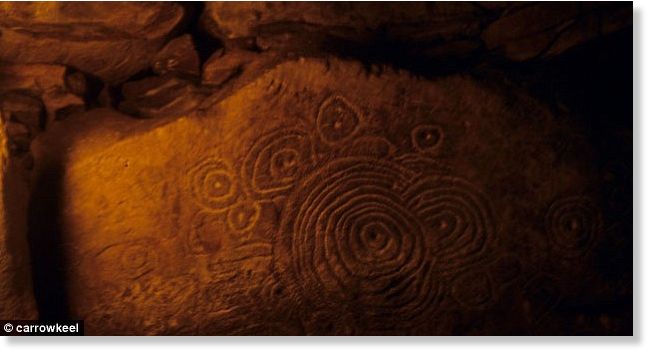
It's thought that ancient Irish people were the first to record a solar eclipse 5,355 years ago. This piece of rock art is said to show the celestial event
Now archaeologists believe that the ancient Irish were the first to record an eclipse 5,354 years ago.
A geometric carving said to depict the phenomenon lies on the wall of a mysterious mound known as Cairn L outside Kells in County Meath, Ireland, where the landscape is covered in Neolithic ruins.
The etching is one of the main focuses of the cairn and is situated at the back of the chamber, which has seven recesses - three on each side and one at the back, Martin Byrne, author of blog carrowkeel explained.

The image of concentric circles is thought to have been scratched into the rock on November 30, 3340BC, which fits with one of the 2 solar eclipses in history tracked by Irish archaeoastronomer Paul Griffin. This image shows a solar eclipse on August 11 1999
This date fits with the 92 solar eclipses in history tracked by Irish archaeoastronomer Paul Griffin, Irish Central reported.
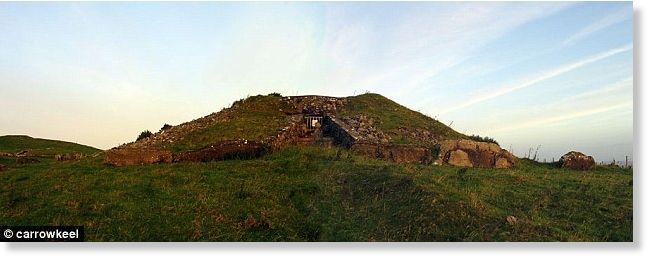
Experts at Astronomy Ireland surmise the carvings were made on stones by Neolithic astronomer priests and that the eclipse was likely viewed from the cairn, which is perched on top of the hill (shown)
Experts at Astronomy Ireland surmise the carvings were made on stones by Neolithic astronomer priests and that the eclipse was likely viewed from the cairn, which is perched on top of the hill.
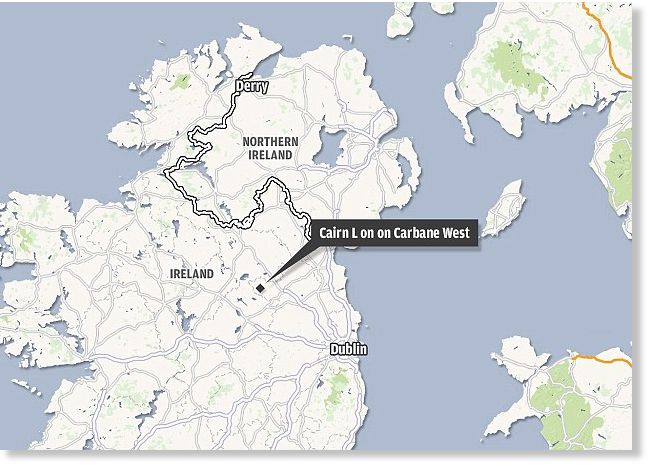
The geometric carving lies on the wall of a mysterious mound known as Cairn L (pictured) outside Kells in County Meath, Ireland, (marked on the map) where the landscape is covered in Neolithic ruins
They cannot be sure, however, if this was intentional or not.
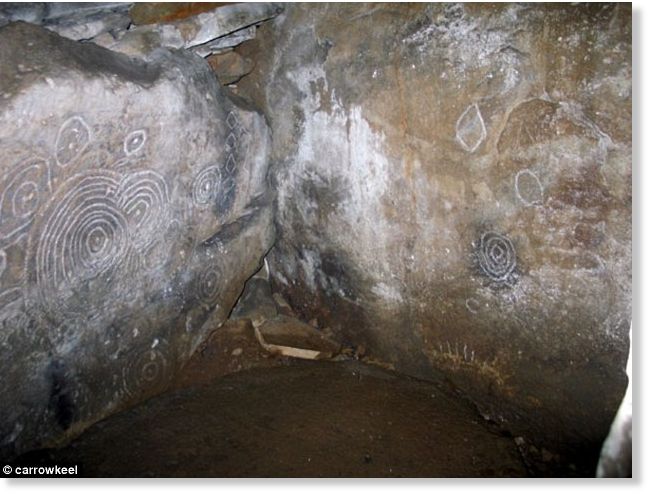
The rock (at the left of this image) is the focus of the cairn and is situated at the back of the chamber, which has seven recesses – three on each side and one at the back
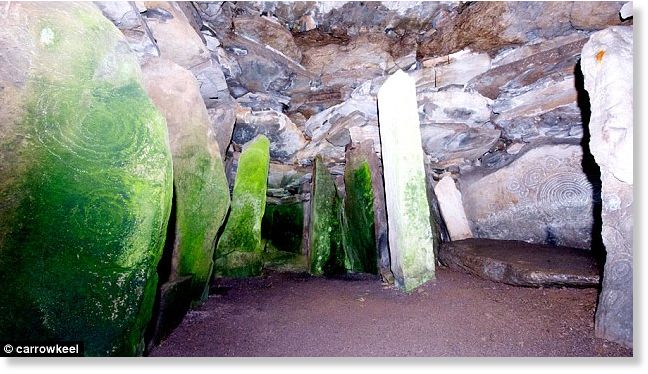
The ancient cairn has other mysterious features, including 18 decorated stones (some shown), one of which is a pillar stone known as ‘The Whispering Stone'
The ancient cairn has other mysterious features, including 18 decorated stones, one of which is a pillar stone known as 'The Whispering Stone'.
The Whispering Stone is a thin limestone pillar around seven ft (2 metres) tall with carvings, and it's possible the cairn was built around it.
When the sun rises, it hits the top of the tall stone and gradually illuminates the carvings at the back of the chamber as it rises.
The back panel, which contains the drawing of the eclipse, is said to be one of the most impressive pieces of Neolithic art in Ireland.
When the sun rises, it hits the top of the whispering stone and gradually illuminates the other carvings in the chamber, which measures 131 feet (40 metres) in diameter.
Other markings seem to resemble doodles, with diamonds perhaps used as measurements.
On the left of the entrance to the chamber, there is a design of 13 'nested arcs' from what may be a 'rising heavenly body'.
The duo suggested it may represent the transit of Venus.
Cairn L is one of the more unusual chambered cairns in Ireland, because of its complex layout and the standing stone inside the main chamber.
Neolithic artifacts such as two stone spheres were discovered when the mound was first excavated in 1865.
The chamber, which is locked to the public, has been reinforced with a concrete roof to protect the ancient etchings.
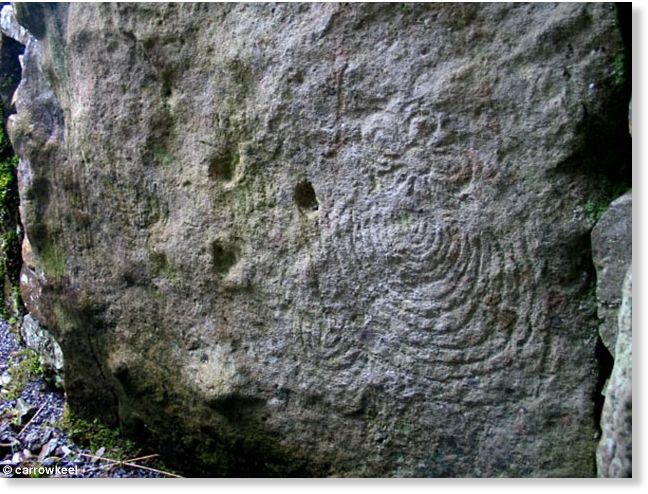
One carving on the left of the entrance to the chamber, shows a design of 13 'nested arcs' from what may be a 'rising heavenly body'. The duo suggested it may represent the transit of Venus (pictured)
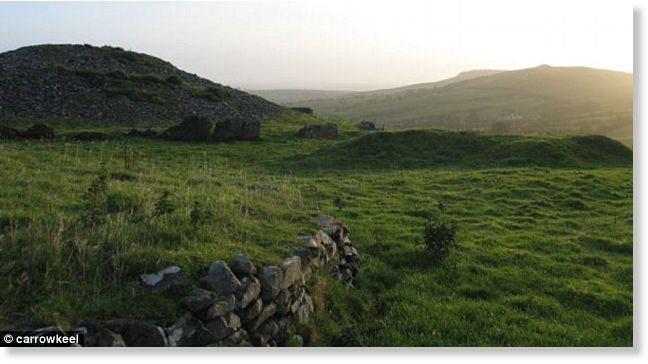
Cairn L (pictured) is one of the more unusual chambered cairns in Ireland, because of its complex layout and the standing stone inside the main chamber
IS 'SIBERIAN STONEHENGE' THE BIRTHPLACE OF ASTRONOMY?
A Russian scientist believes a remote Siberian rock formation may be the first place that humanity began to follow the movements of the heavens.
Sunduki, known as the Siberian Stonehenge, is a series of eight sandstone outcrops on a remote flood plain on the bank of the Bely Iyus river in the republic of Khakassia.
Professor Vitaly Larichev, of the Institute of Archaeology and Ethnography at the Siberian Branch of the Russian Academy of Sciences, claimed two years ago that the 16,000-year-old site was not only a place of huge religious significance in the ancient world, but also its stargazing capital.
Each of the eight peaks are have stones like giant boxes or chests perched on top. The word 'Sunduk' in Russian means 'chest' or 'trunk' which explains how the place got its modern name.
'For many years I tried to unravel these mystery 'chests', said Professor Larichev.
'We don't dig in the ground - we study what ancient people knew about astronomy.
'What I discovered was a surprise even to myself. Comparing maps accumulated over many years of astronomical observations, I came to understand that here in Sunduki, we can see the oldest astronomical observatory, certainly in Asia.
'Its age is about 16,000 years old. The ancient inhabitants of this valley daily observed the sunset, the sunrise and the moon'.
He claims to have found 'numerous ancient solar and lunar observatories around Sunduki'.


Reader Comments
to our Newsletter