
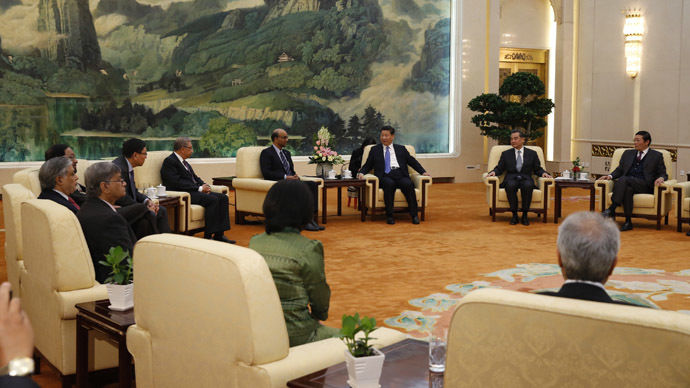
© Reuters/Takaki YajimaChina's President Xi Jinping (3rd R) meets with the guests at the Asian Infrastructure Investment Bank launch ceremony at the Great Hall of the People in Beijing October 24, 2014.
"With the consent of the existing founding members, the Netherlands, Brazil, Finland, Georgia and Denmark officially became founding countries of the AIIB on April 12," the ministry said in a statement on its website, adding that the total number of founders has now reached 46.
The founding members have a priority over others, as they possess the right to establish the rules for the bank's activities.
Applications to join the bank with the rights of founding members were filed by 52 countries, including Russia. The final list of AIIB founding members will be announced April 15.
The United States and Japan are the two big holdouts who have abstained from joining the AIIB. Earlier media reported that China had rejected the request of North Korea; however, the country's Foreign Ministry hasn't confirmed this information, saying that it "doesn't possess any relevant information." Taiwan has applied for membership in the AIIB despite the animosity and lack of formal diplomatic relations between the island and continental China.
Experts consider AIIB a potential competitor to such global financial institutions as the US-led IMF and World Bank. However, IMF chief Christine Lagarde said earlier in March that the IMF and the World Bank would be "delighted" to cooperate with the AIIB. Beijing has repeatedly said that AIIB will be a fine complement to the existing international financial institutions.
In October 2014, 21 countries signed the agreement on establishing the AIIB, which is intended to finance infrastructure projects in the Asia-Pacific Region. The bank plans to rapidly increase its initial subscribed capital of $50 billion to $100 billion.

If new "Founding Members" can be added at will after the actual "founding", then it seems that "founding membership" will likely be available to anyone at any time provided they have sufficient political, diplomatic, and/or economic clout or if it otherwise suits the interests of the existing members.
This certainly raises questions whether the credibility of the AIIB will be any better than, for example, the IMF (currently close to zero). One would have hoped that a truly serious organization would forego the normal double-speak, twisted meanings, and other word games normally played by the already-existing international organizations.