
The Pentagon's inspector general said in the report released Monday that the "kill vehicle," a warhead meant to intercept missiles, fell short of quality standards in 48 specific cases, including issues with software testing, supply chain demands, and design changes, making the kill vehicle "susceptible to quality assurance failures."
The warhead, known as the Exoatmospheric Kill Vehicle (EKV) is built by Raytheon Co. and is part of the Ground-based Midcourse Defense (GMD) system led by Boeing Co. EKVs are launched by a Ground Based Interceptor (GBI), "which is designed to engage high-speed ballistic missile warheads in space,"according to Raytheon. The current procurement cost for each GBI is around $75 million, said Missile Defense Agency Director Vice Admiral James Syring in July 2013.
The inspector general report, the first of two on the EKV, said the US Missile Defense Agency has agreed with concerns over the interceptor warhead and has started to address 44 of the 48 issues identified.
The GMD missile defense system was deployed in 2004 even before it completed testing to be able to counter what the George W. Bush administration claimed was a looming missile threat from North Korea.
The EKV finally conducted its first successful missile intercept in June after years of failed attempts.
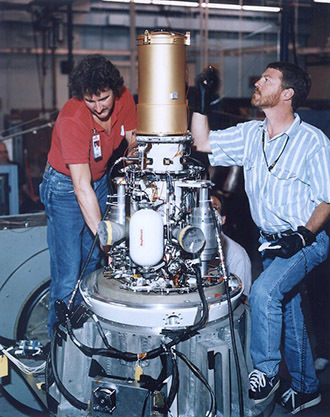
© AFP PhotoThis undated file photo released by the Pentagon shows two unidentified workers with the exoatmospheric kill vehicle (EKV), a missile interceptor that is part of an anti-missile defense system.
"With more than 1,800 unique parts, 10,000 pages of work instructions, and 130,000 process steps for the current configuration, EKV repairs and refurbishments are considered by the program to be costly and problematic and make the EKV susceptible to quality assurance failures," it added.
The Pentagon inspector general wrote that most quality management systems on the weapons program were in compliance, but problems were evident. The report found 15 major and 25 minor quality problems with Raytheon's EKV work. Boeing's work on the entire system had six major and one minor problem.
Most of the issues identified in the report have been corrected, the inspector general said, but Raytheon is still working on four issues.
Raytheon has a $636 million development and sustainment contract to produce the EKV, though the Pentagon is seeking one of the major defense contracting firms to develop a more reliable, second generation EKV, Reuters reported. Weapons giants Boeing, Raytheon and Lockheed Martin Corp. are all in the running.


Comment: The military-industrial complex is one way that psychopathic parasites bilk humanity of their money and energy. From the article, "Missing military-industrial complex money":