
- One of the craters is located in Siberia's Yamal Peninsula in the Taz district and has a diameter of 49ft (15 metres)
- The other was spotted on the Taymyr Peninsula in Kransoyark region and has a diameter of 13ft (four metres)
- They follow the discovery of a larger hole found in Yamal earlier this month at around 230ft (70 metres) in diameter
- Andrei Plekhanov from Scientific Research Center of the Arctic says crater was formed due to rising temperatures
- One theory is that a chunk of ice that is located underground created a hole in the ground when it melted
- Another is that the crater was formed by a mixture of water, salt and gas igniting an underground explosion
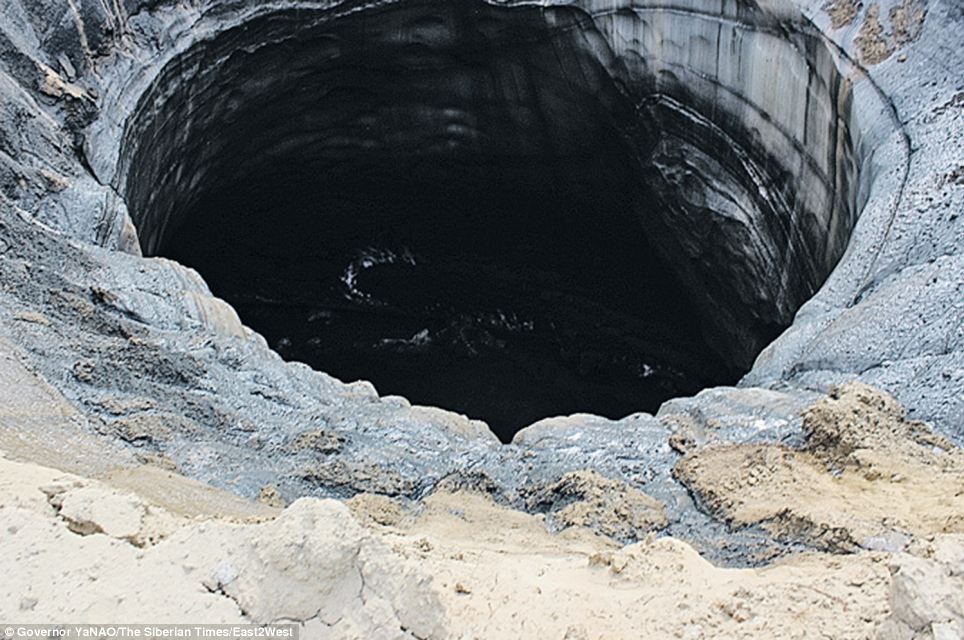
The new Yamal crater (pictured) is in the area's Taz district near the village of Antipayuta and has a diameter of about 49ft (15 metres). According to local residents, the hole formed on 27 September 2013.
Both were spotted by reindeer herders who almost fell in.The original hole received worldwide attention after being identified by helicopter pilots some 20 miles (32km) from a huge gas extraction plant at Bovanenkov. Now the new holes - smaller in diameter but similar in shape - are posing a fresh challenge for Russian scientists.
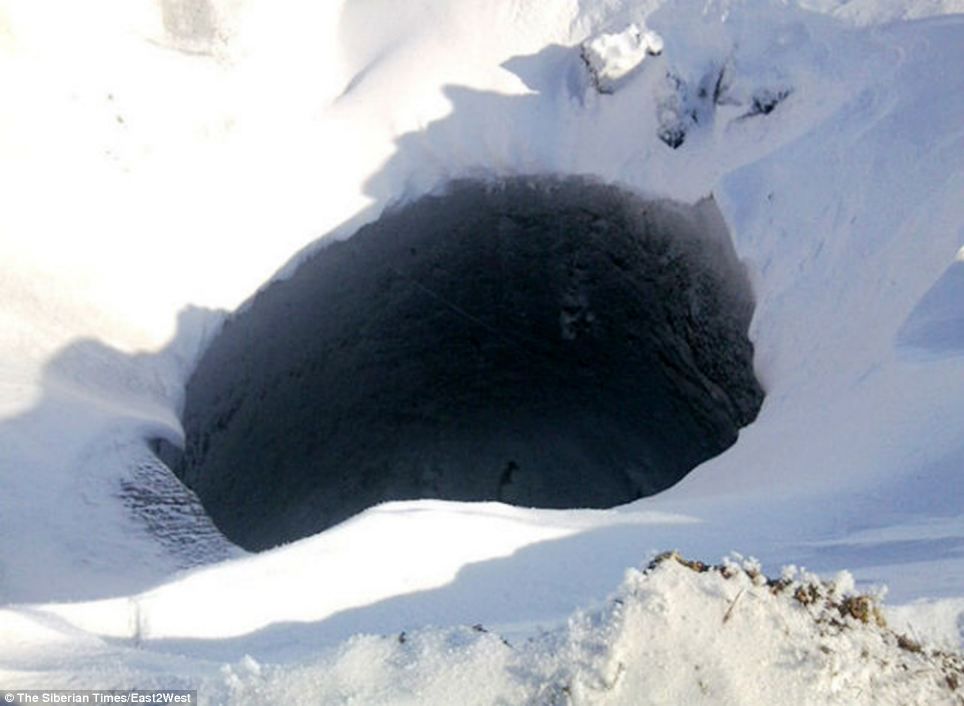
The third crater is in the Taymyr Peninsula and was accidentally discovered by reindeer herders who almost fell into it, in the vicinity of the remote outpost of Nosok. The funnel is a perfectly formed cone, say locals who are mystified over its formation. Its depth is estimated at between 200 to 330ft (60 to 100 metres) and its diameter - more than 13ft (four metres).
The new Yamal crater is in the area's Taz district near the village of Antipayuta and has a diameter of about 49ft (15 metres).A deputy of the regional parliament - or duma - Mikhail Lapsui said: 'I flew by helicopter to inspect this funnel' which he said was formed last year though only now have reports of it reached the outside world.'There is ground outside, as if it was thrown as a result of an underground explosion.
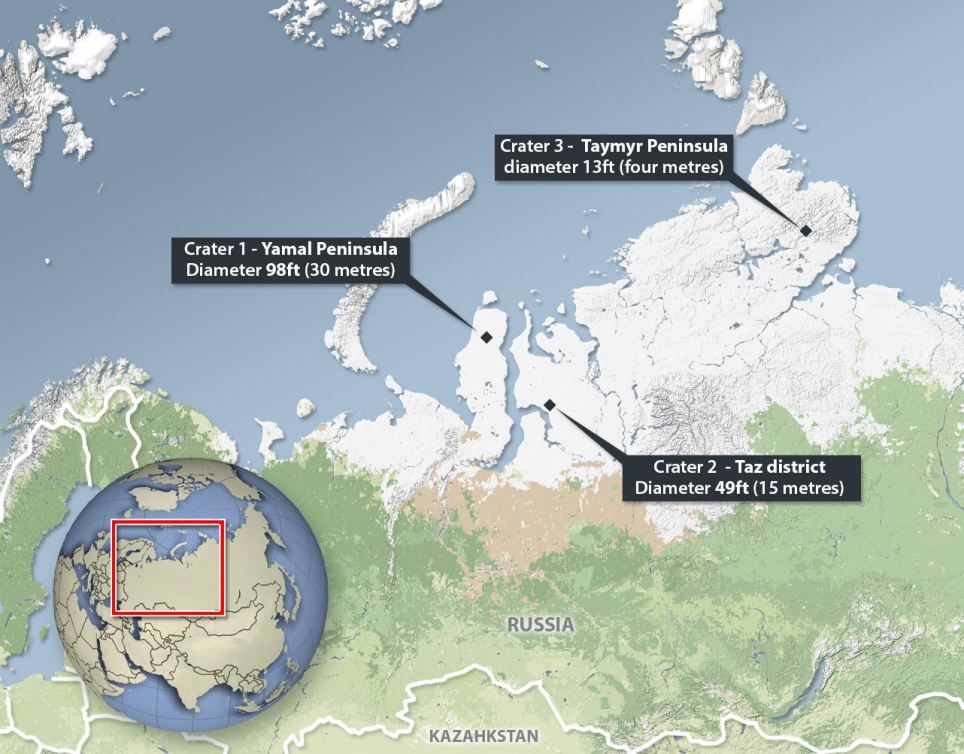
The original crater was found in the Yamal Peninsula, baffling scientists. Now two further craters have been found in the Taz district and Taymyr Peninsula.
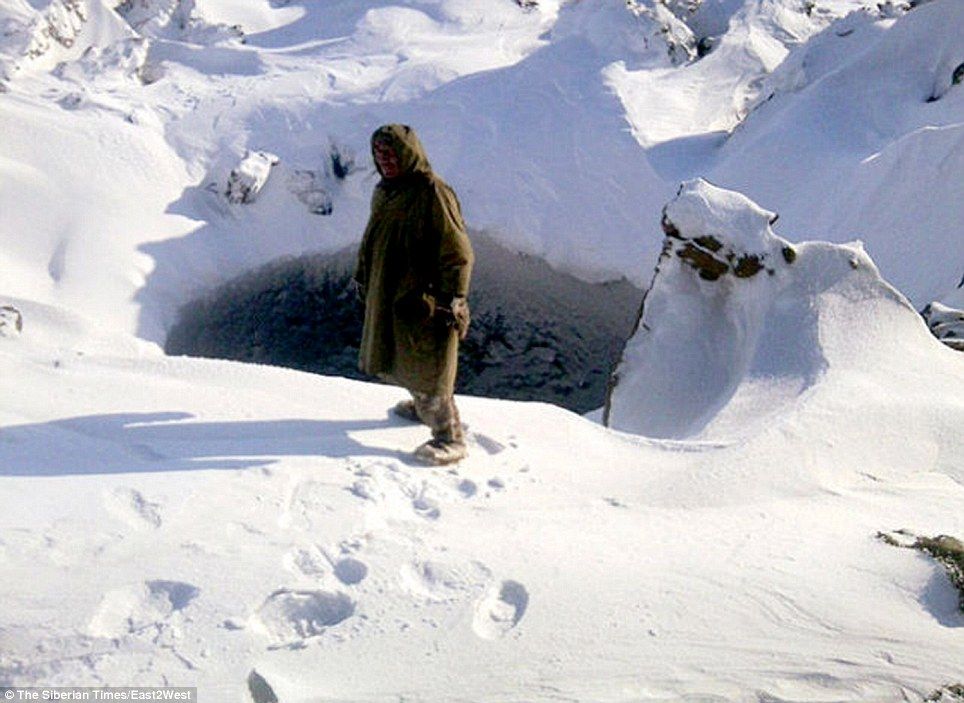
Geologists, ecologists, and historians have not come to a consensus about the origin of the Taymyr hole (pictured), say reports in the region. 'It is not like this is the work of men, but also doesn't look like natural formation,' said one account expressing puzzlement at its creation.
Experts - geologists, ecologists, and historians - have not come to a consensus about the origin of the funnel, say reports in the region.'It is not like this is the work of men, but also doesn't look like natural formation,' said one account expressing puzzlement at its creation.Scientists in Krasnoyarsk region - the second largest in Russia - plan further study of this hole.
The first hole is around 230ft (70 metres) deep and when a group of experts visited it earlier this month, they noted an icy at its bottom.Their footage highlights a darkening around the rim which was earlier seen as evidence of heat possibly from an explosion during the crater's creation.'They found the crater - around up to 300ft (70 metres) deep - has an icy lake at its bottom, and water is cascading down its eroding permafrost walls,' said The Siberian Times.'It is not as wide as aerial estimates which earlier suggested between 164ft and 328ft (50 and 100 metres).'
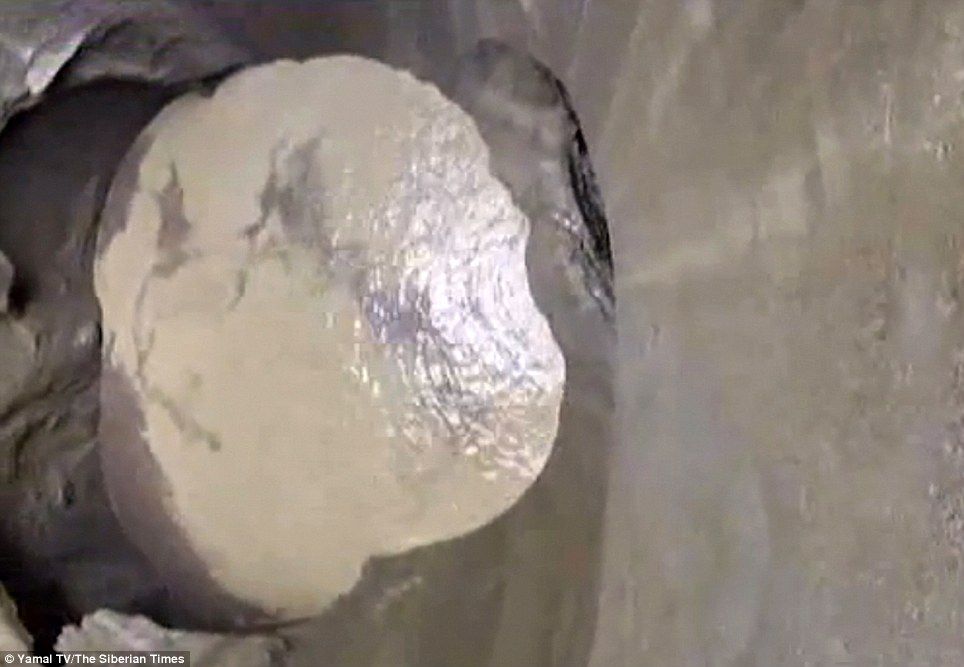
Footage from inside the original crater showed that there is a lake at its base. The two new craters follow the discovery of a larger hole earlier this month around 230ft (70 metres) in diameter. Now the new holes - smaller in diameter but similar in shape - are posing a fresh challenge for Russian scientists.
'As of now our estimates is about 98ft (30 metres). If we try to measure diameter together with soil emission, the so-called parapet, then the diameter is up to 197ft (60 metres).
The structure is so fragile that the scientists could not climb deep into the lake and had to send a camera down instead.One theory is that the feature is a 'pingo,' reports the Sunday Morning Herald.A pingo is a large chunk of ice that is located underground that can create a hole in the ground when it melts.'Certainly from the images I've seen it looks like a periglacial feature, perhaps a collapsed pingo,' Dr Chris Fogwill of the University of New South Wales said.
'This is obviously a very extreme version of that, and if there's been any interaction with the gas in the area, that is a question that could only be answered by going there.'Dr Plekhanov added the hole was most likely the result of a 'build-up of excessive pressure' underground, due to the region's changing temperatures.He said 80 per cent of the crater appeared to be made up of ice and that there were no traces of an explosion.
The discovery eliminates the possibility that a meteorite had struck the region.'Could it be linked to the global warming? Well, we have to continue ourresearch to answer this question,' said Dr Plekhanov.
'Two previous summers - years 2012 and 2013 were relatively hot for Yamal, perhaps this has somehow influenced the formation of the crater.'But we have to do our tests and research first and then say it more definitively.'After the hole was discovered, there was speculation online about the crater indicating 'the arrival of a UFO craft'.Ruling out extra-terrestrial intervention, Dr Plekhanov said: 'We can say for sure that under the influence of internal processes there was an ejection in the permafrost.'I want to stress that was not an explosion, but an ejection, so there was no heat released as it happened.'
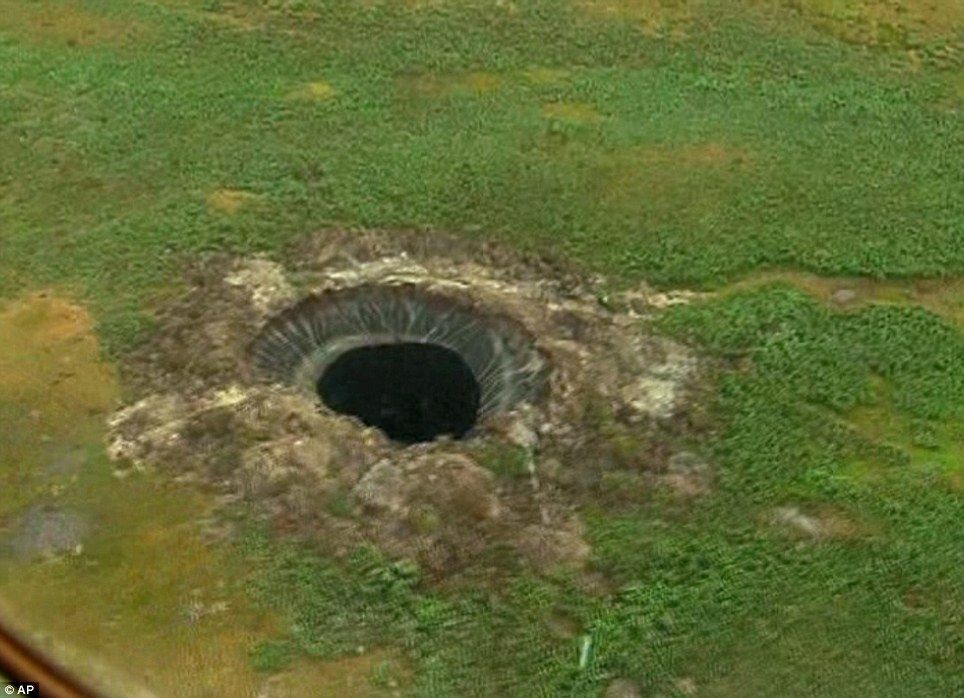
This first giant crater measuring around 262ft and found in far northern Siberia is believed to have been caused by rising temperatures in the area.
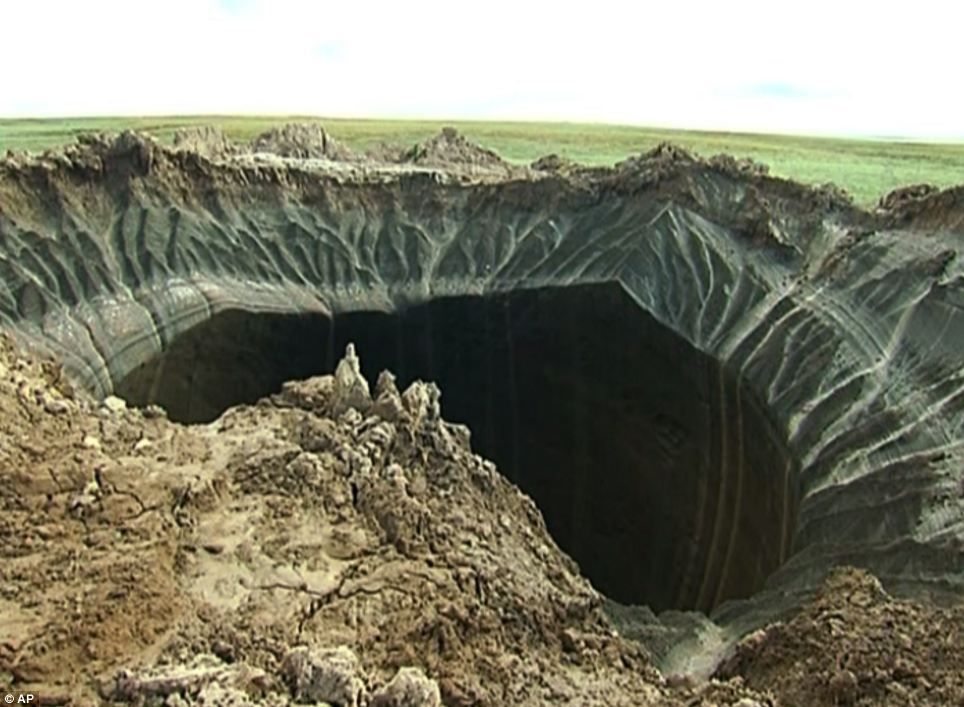
The discovery eliminates the possibility that a meteorite had struck the region in the Yamal Peninsula - the name of which translates as 'the end of the world'.
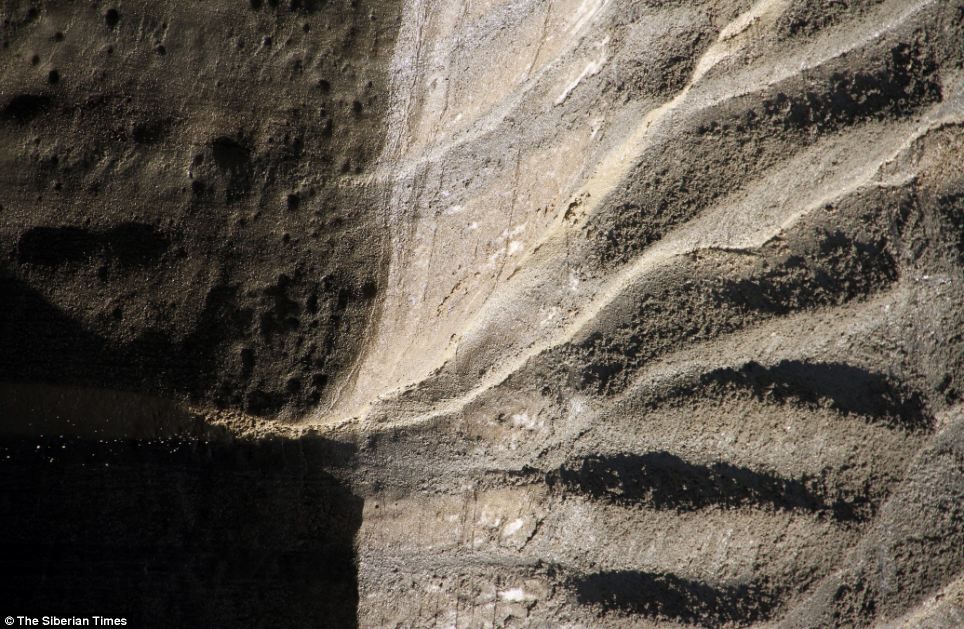
Pictured here is the permafrost, soil below the freezing point of water, near the original crater. Theories on how it formed range from meteorites, stray missiles, a man-made prank, and aliens, to an explosive cocktail of methane or shale gas suddenly exploding.
Global warming may have caused an 'alarming' melt in the under-soil ice, released gas and causing an effect like the popping of a Champagne bottle cork, Ms Kurchatova suggests.
Yamal, a large peninsula jutting into Arctic waters, is Russia's main production area for gas supplied to Europe.Dr Plekhanov said: 'I've never seen anything like this, even though I have been to Yamal many times.'The crater is different from others on Yamal. The experts say the phenomenon maybe a restarting of a process not seen for 8,000 years when the lake-pocked Yamal landscape was formed on what was once a sea.
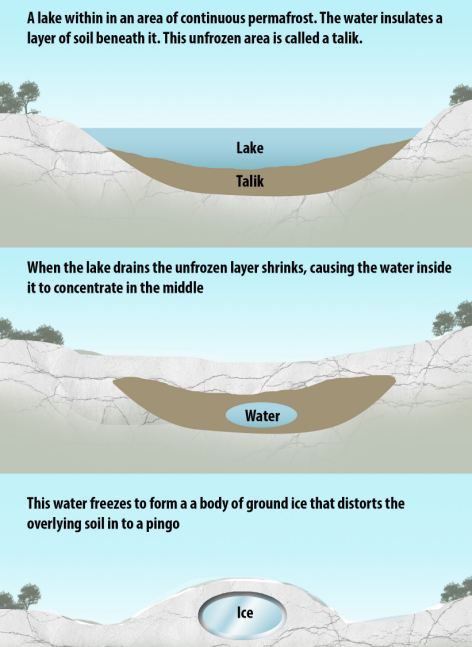
© Dailymail, UKThe predominant theory so far is that the feature is a 'pingo'. This is a large chunk of ice that is located underground that can create a hole in the ground when it melts.
The Main Theories So Far
One of the more popular theories is that the giant hole was caused by a phenomenon known as a pingo.
This is a subsurface accumulation of ice that has been covered by land.
When the ice melts it can leave behind a gaping hole that it once filled.
The other favoured theory is that the hole was caused by an explosion of methane underground.
The Yamal Peninsula is rich in natural gas, with its resources extensively tapped by Russia, and a mixture of water, salt and gas could result in an explosion.
The other theory is that it was caused by a meteorite, but most experts have ruled this possibility out as the phenomenon does not resemble normal impact craters.



Between changes in weather and "climate change." That myth created by the world government gang.