

© Tamara Lyubushkina'There is no doubt that we will restore agricultural facilities, bridges, roads, and power and communications lines - the so-called metal. The issue is to prevent damage to people'.
A state of emergency has been declared in many eastern regions, as the president called for a united effort to combat the worst flooding in more than a century. At least 17,000 have been evacuated so far.
Putin urged regional chiefs to take personal command of combating the wave of flooding, demanding they report direct to him.
'There is no doubt that we will restore agricultural facilities, bridges, roads, and power and communications lines - the so-called metal,' he said.
'The issue is to prevent damage to people and, the main thing, to prevent irretrievable losses.
'Please concentrate on this. The situation is indeed difficult but manageable. It is under control. If we work concertedly - this is the main thing, to work concertedly, - then we will be able to minimize losses and prevent irretrievable losses. I am asking all heads of Russian regions which are facing the problem of floods to deal with these problems personally. Nobody should be forgotten. Nobody should be lost. I mean people living in your regions. Please report to me every day, or immediately if the situation changes quickly'.
Putin's envoy in the Far East Viktor Ishayev said damage to the economy of the region was 'catastrophic', with major damage to farmland, crops and cattle herds. The number of settlements hit is more than 120, with key cities like Khabarovsk among those where warnings were sounded.
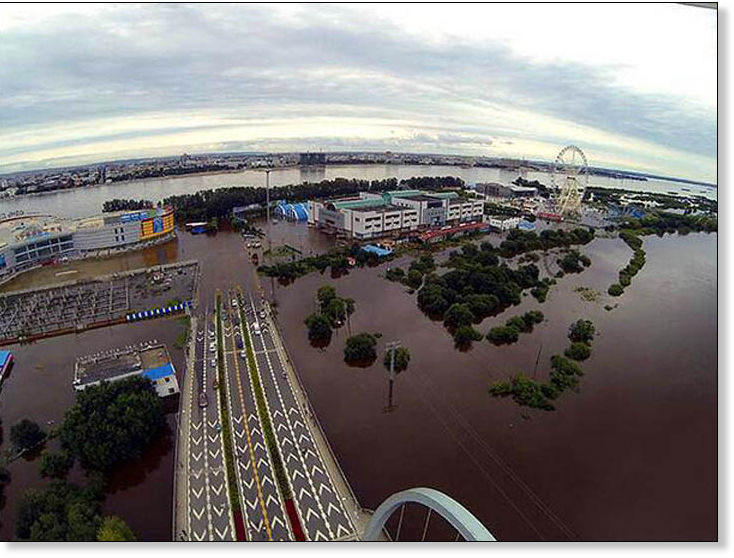
© Pavel Koshelenko, Yuri Tsyganchuk
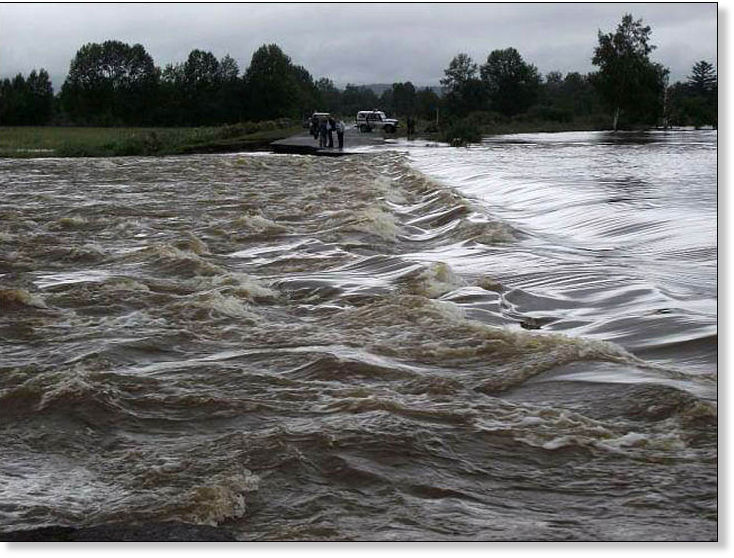
© Pavel Koshelenko, Yuri TsyganchukIn neighbouring China, it is reported that 25 people have been killed in flooding. So far Russia has avoid such a toll. Pictures of Blagoveschensk, and of the road to the town of Zeya.
About 30,000 people are mobilised to deal with the flood with the use of 5,000 vehicles, boats and aircraft. Worst hit regions are Amur, Khabarovsk, and the Jewish Autonomous Region. Some 92 settlements in Amur were under water.
'The level of the Amur could reach 6.5 metres in the metropolis of Khabarovsk on Monday', said Vyacheslav Parshin, head of the with the meteorological service. 'That would be 8 centimetres higher than the hundred-year-flood level of 1898'.
In neighbouring China, it is reported that 25 people have been killed in flooding. So far Russia has avoid such a toll.
Measures are being take to ensure doctors can inoculate the population against typhus and other diseases that could spread in such conditions. Early on Saturday it was reported that 5,306 houses, homes for more than 32,600 people, were flooded, 668 more than a day earlier.
The emergency services were also dealing with forest fires ranging in at least three major regions in Siberia.
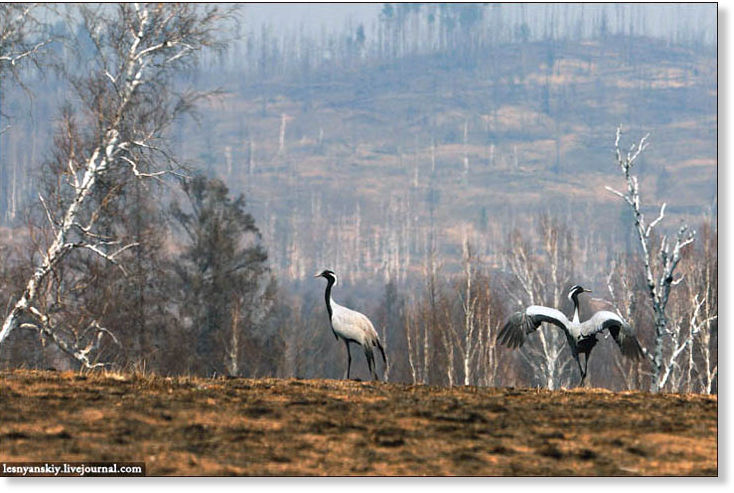
© Alexander LesnyanskiyAfter the wildfire... picture taken by photographer Alexander Lesnyanskiy in Trans-Baikal region, year 2012
More than 600 specialists, 55 units of equipment, and 11 aircraft were combating the blazes in Siberia.
While cyclones hit the Far East, dry weather has created a tinderbox in Siberia.
'The fires are not posing any threat to towns, villages and industrial enterprises. They have been caused by violations of fire safety rules by the population in the forests and dry thunderstorms', said the regional forestry administration.


Reader Comments
to our Newsletter