
- Drought has destroyed one-sixth of U.S. expected corn crop
- Soyabean harvest expected to be the worst for five years
- Food manufacturers warn they will pass on price rises to consumers

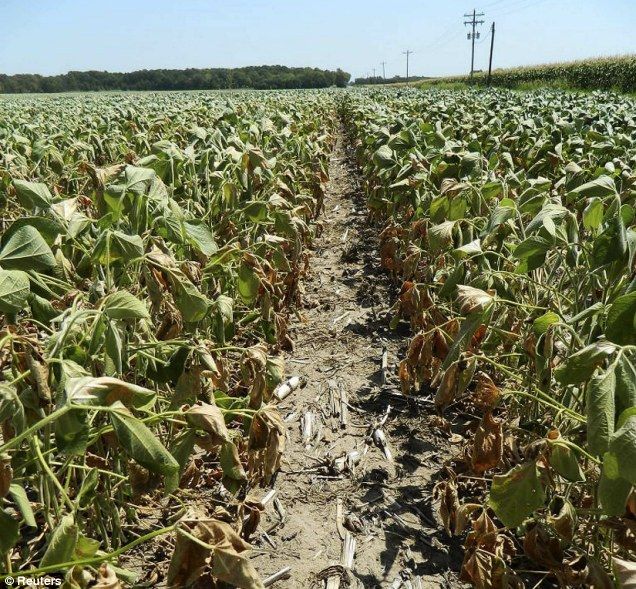
It's all over bar the crying: The worst drought for half a century in the U.S. has destroyed one-sixth of the country's expected corn crop
The hottest July in U.S. history has caused irreparable damage to crops, forcing corn farmers to abandon fields greater in area than Belgium and Luxembourg.
Comment: It actually wasn't that hot in July - they're spinning the crop failures in favour of 'global warming'. Clearly other factors are involved in killing off crops.
'Inconvenient Result' - July 2012 NOT a Record Breaker
Wheat Plague Threatens Crops Around World
Soya beans, which are used for animal feed and to make vegetable oil, have also been affected, with this harvest likely to be the worst for five years.
The crisis has prompted the US Department of Agriculture (USDA) to forecast record-breaking price rises, and some of the world's largest food manufacturers, including Kraft, Tyson and Nestle, have already indicated that they will pass on the increase to consumers.
The US Department of Agriculture has significantly reduced its forecasts for crop harvests - this will drive up prices and food shortages will follow in supermarkets and stores.
USDA chief economist Joseph Glauber told the Financial Times: 'We're going to see very high prices.'
The problem could have far-reaching consequences internationally.
In 2007-08, high food costs led to riots in more than 30 countries, but Jose Graziano da Silva, the director general of the UN's Food and Agriculture Organisation, said the current crisis was not as severe.
'We do not have the demand pressure from China and India as five years ago.'
The situation has worsened since the week ending July 29, when USDA found that 48 per cent of the nation's corn crop was either poor or very poor.
The department said 47 per cent of the soybean crop was in very poor or poor condition.
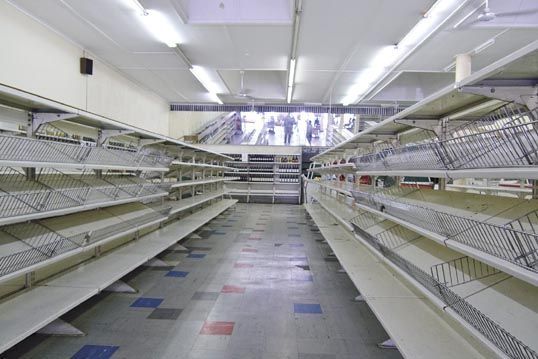
Empty supermarket shelves in Zimbabwe - coming to a town near you soon.
With grazing pastures also parched and feed prices at record highs, many ranchers are sending their animals to slaughter early because it is too costly to keep them until full size.
President Barack Obama's administration has opened up protected US land to help farmers and ranchers and has encouraged crop insurance companies to forgo charging interest.
It has also provided emergency low-interest loans to farmers in 31 states, where disaster areas have been declared due to the drought.


Reader Comments
to our Newsletter