
© hurtbyadoctor.com
Officials at Brigham and Women's Hospital in Boston say they are investigating whether a faulty staple gun may have misfired during Ann Marie Simonelli's gastric bypass surgery and contributed to her death days later. They have suspended the popular surgery while the investigation continues.
Dr. Anthony Whittemore, chief medical officer at the hospital, said the ban on laproscopic bypass surgery was a safety precaution that would not necessarily be permanent.
"We temporarily halt this activity as a means of coping with this particular situation till we understand what actually occurred," Whittemore said.
Simonelli, of Lawrence, Mass., died Oct. 23, three days after undergoing the gastric bypass surgery in an attempt to fight obesity.
Gastric bypass surgery, more commonly known as stomach stapling, is a booming industry. The operation typically involves stapling off a large portion of the stomach so that the patient is left with a stomach the size of a golf ball. More than 100,000 stomach-reduction surgeries will be performed this year in the United States and membership in the American Society for Bariatric Surgery has more than doubled in the past few years.
Celebrities such as singer Carnie Wilson and TV weatherman Al Roker have helped popularize stomach surgery after undergoing successful procedures themselves.
Just How Dangerous Are the Staplers?
The Food and Drug Administration, which keeps statistics on deaths associated with medical devices, lists 14 deaths from 2001-2003 that occurred after abdominal surgery involving staplers. However, in most cases, the surgeons were able to correct the stapler mishap so it is not clear what role the stapler malfunction may have played in the patients' deaths.
Dr. Peter Pressman, who performs bariatric surgeries at the University of Southern California, said he has not had any serious problems with the staplers. "None of us [at USC] has had experience that would lead us to suspend the procedure," he said.
But Dr. Robert Kozol, chairman of the surgery department at the University of Connecticut, said he has experienced trouble with staplers. Once while he was performing a laproscopic colonectomy, the stapler jammed, and he couldn't remove it from the patient. Kozol said he had to convert to an open procedure, and everything proceeded smoothly after that.
"I expect there are misfires happening weekly," he said. "Maybe daily. But overall, the staplers are very reliable."
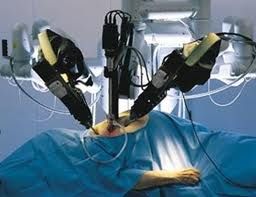
An open gastric bypass requires a large incision. In the laproscopic procedure, a small incision is made and the physician uses a scope to look inside.
Pressman said even if something were to go wrong with the stapler, the surgeon usually can correct any misfires. "What generally happens is that the suture lines are tested before you close the incision," he said.
"The problem [with mechanical devices] is never going to be totally eliminated," said Kozol. "The important thing is for the surgeons to be very aware of the different things that might go wrong so that they can be prepared."
Who Gets the Surgery?
The National Institutes of Health and the American Society of Bariatic Surgeons both agree that a person must be seriously overweight before gastric bypass surgery is recommended. Their guidelines say a person is eligible for gastric bypass surgery only if he or she has a body mass index of 40 or higher, or a BMI of 35-39 with co-morbid risk factors such as hypertension or diabetes. People seeking the surgery must also have made at least one serious attempt to lose weight without surgery.
American Surgery recently published a study of more than 16,000 patients who had received gastric bypass surgery. Overall, 10 percent of the patients experience complications. While 84 percent of the patients were women, the men had a 70 percent greater chance of complications.
Even when all the equipment works perfectly, gastric bypass carries significant risk. Mortality rates for the surgery have been calculated as high as 1 percent to 2 percent. Seams that seemed fine during surgery can develop leaks afterward. It was complications from a leak that killed Simonelli.
"It's a complicated operation," said Dr. Ed Felix, whose Fresno, Calif., group has performed more than 2,000 gastric bypass surgeries. "And if you do any operation on morbidly obese patients, even a simple appendix removal, the risk of mortality goes up. These are typically very sick patients."
Rolling the Dice
For obese patients who have exhausted all other options, gastric bypass surgery may literally be a lifesaver. It allows people to shed 100 pounds or more quickly, and this loss typically brings relief from diabetes and hypertension.
ABCNEWS affiliate KGTV in San Diego followed a young woman through the surgery last year. Amy Suter lost 58 pounds in 2 ½ months, and she is thrilled. "[The surgery] is the best hour and a half of your life," she said.
For others, the outcome is not as fortunate. ABCNEWS affiliate WBMA in Birmingham, Ala., reported last December on a woman who lost her daughter after gastric bypass surgery.
Doris Gracia said her daughter, Donna, wanted to lose weight to help control her diabetes, but something went wrong and Donna ended up with a hole in her small intestine. She was placed on life support and later died.
"I don't think it's wonderful 'cause I don't have my daughter," Gracia said "I didn't bring her in this world to be mutilated and for me to go through my old age without her."
Because of the risks, people need to be aware that this surgery is used only in cases where other weight-loss methods have failed. It is not an easy "get-thin-quick" scheme. Even patients for whom the operation is most successful face a lifetime of chronic diarrhea and vitamin deficiency.
Still, with 97 million Americans overweight, bariatric surgeons feel that this is not a treatment we can afford to lose.
While acknowledging that they did not have all the details of the Simonelli case, many surgeons found the Brigham and Women's decision to halt all laproscopic gastric surgery extreme.
"Any death is tragic and should be investigated," said Felix. "But you don't stop flying planes because of one crash."
Felix said he had a patient, a 500-pound man, who died because he did not get the surgery in time. "That's equally tragic," Felix said.
Patients Should Do Their Homework
The American Surgery study found that hospitals that had a lot of experience with gastric bypass procedures were far less likely to experience complications than smaller, less-experienced hospitals. If your doctor thinks you are a candidate for gastric bypass, ask him what his complication and mortality rates are for bariatric cases.
"The skill of the surgeon is key," said Pressman.
But make sure the complication rate is in context. If your doctor tends to accept the heaviest, sickest, patients, he may be an excellent surgeon who just takes on cases that are likely to have complications.
Patients can also look up their doctors on the American Society for Bariatric Surgery's Web site (asbs.org). If the doctor is listed as a regular member, he or she is broadly certified by the American Board of Surgery (there's no special certification for bariatric surgeons). If listed as an "affiliate" member, the doctor is not yet board-certified.
Laproscopic surgeries are generally preferable to open procedures because they are less invasive and leave less scarring, but not everyone will be a candidate for the laproscopic procedure. Patients who are relatively thinner, younger and healthier do best with the laproscopy.
Brigham and Women's hospital will continue to perform open gastric bypasses.



P.R. Dept won't like the word "misfires"
"But Dr. Robert Kozol, chairman of the surgery department at the University of Connecticut, said he has experienced trouble with staplers. Once while he was performing a laproscopic colonectomy, the stapler jammed, and he couldn't remove it from the patient. Kozol said he had to convert to an open procedure, and everything PROCEEDED SMOOTHLY after that." (Unless YOU happened to be the person on the table, eh?)
"I expect there are MISFIRES happening WEEKLY," he said. "Maybe DAILY. But overall, the staplers are very reliable."
(And he's not kidding! Perhaps even a new record for unintentional damning by faint praise, eh what?)
Well the article contains enough data (hopefully true) to do some calculations. Article says that there are "over" 100,000 of these operations a year. . . Let's make that 104K. Divided by 52 weeks per year, = 2,000 per week. So, per the guy who is DEFENDING the procedure and the "Swingline Medical Stapler", du jour, they have "MISFIRES" (love that word!) daily, so that's at least 5/2000 or 1/400. It sure seems to me that such data (since the truth is probably worse) constitutes a pretty sorry success rate on an elective surgery, but I could be wrong. It's got to happen eventually.... ;-)
I must imagine that the folks at "Swingline - or whoever is making them - Medical Staplers" are in a tizzy over his candor. Truth can be bad for business, eh?
I recognize the cost benefit issues involved, and believe there was a time when a patient could trust America's medical system to mostly make a fair estimate on that ever so critical decision. However, those days are now in the past. (See, e.g., the countless instances of dubious medical studies "backing up" and justifying - generally via cherry picking - whatever the whore "research" doctors are told - and handsomely paid - to justify.)
R.C.