
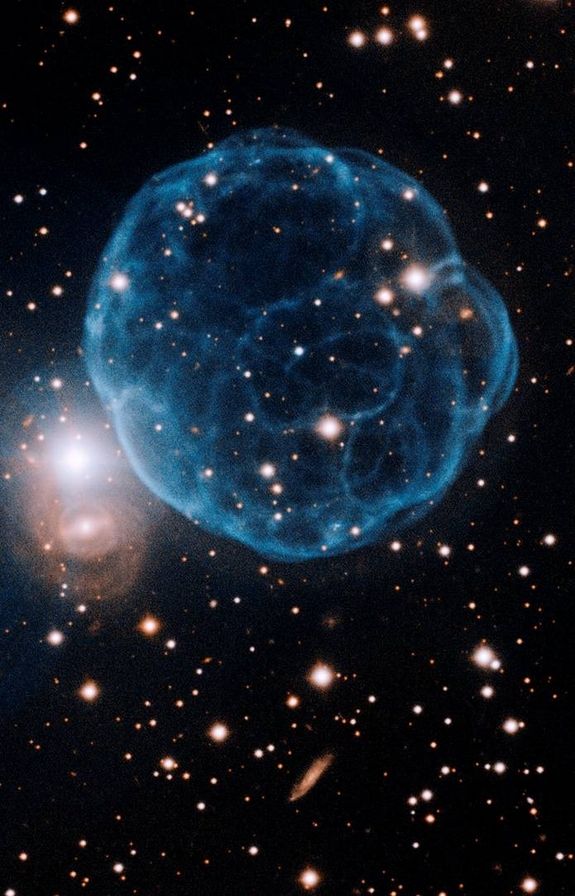
© Gemini Observatory/AURAThe elegant beauty of this planetary nebula was discovered by an amateur astronomer and captured by the Gemini Observatory.
The findings of this discovery could provide significant evidence for the role that stellar companions play in the formation of planetary nebulae.
Planetary nebulae are likely the "end of life" event for stars. They form when the nuclear fusion in an old star can no longer sustain the pressure of gravity. The star becomes unstable, pulsating and throwing off a shell of gas from its outer layers. What we see as a planetary nebula, is actually this expanding shell - still glowing because of the radiation emitted by the star. Over 3,000 planetary nebulae exist throughout our galaxy.
The location of the new nebula, which is named "Kronberger 61," or "Kn 61," after its discoverer, is within a patch of sky that is monitored by NASA's Kepler planet finding mission.
The striking new nebula image was featured at an International Astronomical Union symposium on planetary nebulae the week of July 25, 2011 in Spain's Canary Islands.
For more information about the discovery, view the full press release.



Reader Comments
to our Newsletter