
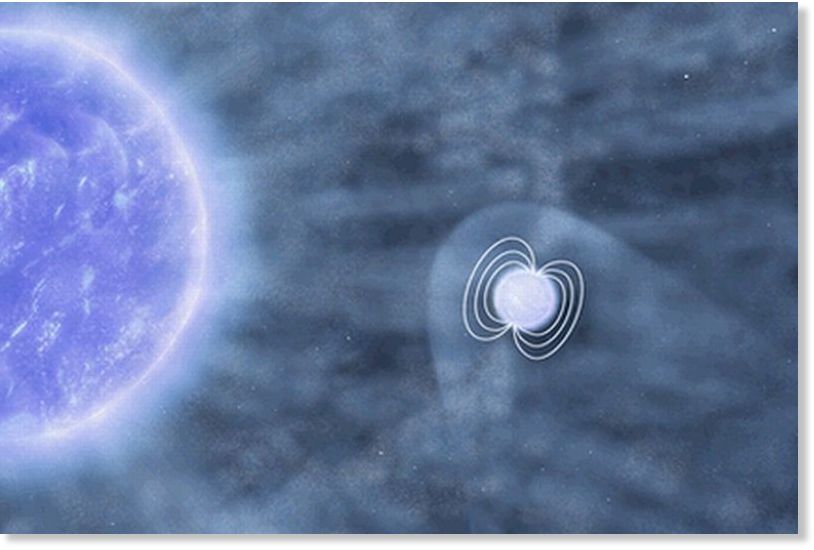
© ESA/AOES MedialabA clump of matter from a massive blue supergiant star (Left) is being pulled by an intense gravitational field of a neutron star (Right).
ESA's XMM-Newton space observatory has watched a faint star flare up at X-ray wavelengths to almost 10 000 times its normal brightness, ESA said in a statement.
According to ESA scientists, the flare took place on a neutron star, which is formed when a giant star collapse during supernova explosion.
About 10 km in diameter, a neutron star is so dense that it generates a strong gravitational field intense enough to pull a clump of matter emitted by giant stars.

© ESA-C. CarreauAn artist's impression of XMM-Newton
"The flare lasted four hours and the X-rays came from the gas in the clump as it was heated to millions of degrees while being pulled into the neutron star's intense gravity field," they said, adding that the clump was so big that not much of it hit the neutron star.
Scientists estimate that an X-ray flare of this magnitude can be expected a few times a year and they were extremely lucky to get the observations, which will probably help astronomers understand the behavior of the blue supergiant and the way it emits matter into space.



Reader Comments
to our Newsletter