
© NASA
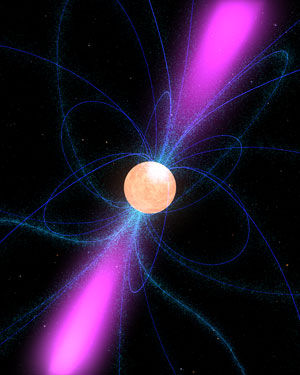
The gamma ray binary, known as PSR B1259-63/LS 2883, is one of only a handful known and consists of a massive Be star which is orbited by a smaller, dense pulsar. The Be class star is 24 times the mass of the Sun and is rotating at a very high rate. A combination of mass loss and rapid rotation results in an equatorial disc of hot gas and, when the pulsar is at the point in its orbit where it is closest to its massive companion - known as periastron - it actually passes through the disc. After periastron, it also makes a second trip through the disc. This voyage through the hot gas creates gamma radiation because particles emitted from the pulsar interact with the disc.
The most recent periastron of the 3.4 year orbit was on 15 December 2010 and during the pulsar's first passage through the disc, normal levels of gamma radiation were observed with Fermi. However, the second passage created massive amounts of gamma radiation that were completely unexpected.
This is not the first time that the binary has been observed at periastron, but it is the first time that such a flare has been detected. The binary had been previously observed with EGRET on the Compton Gamma-Ray Observatory. However, EGRET only observed the binary for three weeks and was not pointed at the binary at time of the flare. "If the EGRET team had pointed the spacecraft starting a couple of weeks later they would have been able to detect the gigaelectron volt gamma-ray flare during the second passage, provided this activity occurs at the same orbital phase in each periastron passage," explains research team leader Aous Abdo.
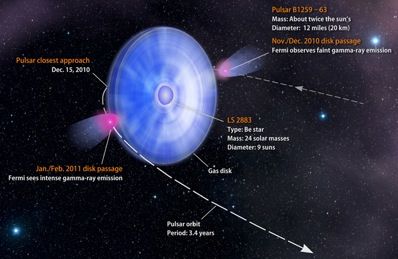
© NASA's Goddard Space Flight Center/Francis ReddyDiagram showing the passage of the pulsar through the disc of the giant Be star around the time of closest approach.
"We do have some theories/ideas that we are still working on to see if they agree with our observations," says Abdo. "The flare we saw during the second passage could be either due to anisotropy of the gamma-ray emission, the appearance of new emission mechanism, or by an abrupt change in the physical conditions in the emission region."
An upcoming paper using data which is in the teraelectron volt range from the HESS telescope in Namibia will hopefully fill in the blanks. The next time the pulsar and its massive companion cross paths will be in May 2014, and astronomers will be watching eagerly to see if there is a repeat performance.



Reader Comments
to our Newsletter