
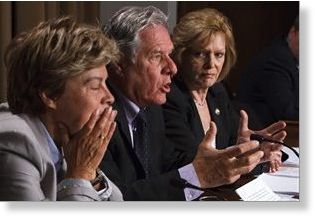
© The Canadian Press / Clement AllardLouise Beaudoin, left, Pierre Curzi, centre, and Lisette Lapointe, right, appear at a news conference in Quebec City on Monday, June 6, 2011. The Parti Quebecois experiened one of the darkest days in its history, with three of the most influential members of the pro-independence party announcing their departure Monday.
The bombshell announcement included: the wife of the party's most beloved living figure; an actor-turned-politician considered the PQ's most popular current member; and an ex-cabinet minister who has served the PQ since 1970 and acted as the party's international envoy, building relationships with foreign governments and other nationalist movements.
Lisette Lapointe, Pierre Curzi and Louise Beaudoin all vowed to continue fighting for sovereignty while sitting as independents.
Lapointe is the wife of Jacques Parizeau, revered by the party's grassroots as the premier who led Quebec to within a few votes of independence in 1995. He continues to wield considerable influence within the party.
The departing members cited a variety of reasons for their disaffection. The final straw, they said, was the party's breathless championing of the Quebec City arena project without pausing to reflect on it.
One Parti Quebecois ex-premier declared Monday's events will carry deep implications and require some soul-searching.
"This is an earthquake that risks becoming a tsunami," Bernard Landry said in an interview.
At the epicentre of the storm is Pauline Marois' leadership.
The exiting members said that the party, under Marois, had become increasingly obsessed with power over principle; too partisan; indifferent to its members' opinions; and, in the words of Lapointe, had distanced itself from its raison d'etre.
"I no longer feel in my place," Lapointe told a news conference in Quebec City.
"I'm doing this also because I have the troubling impression that we are getting further away from sovereignty and even power that seemed so close."
Just weeks ago, the PQ appeared to be sailing smoothly.
Marois notched an approval rating of 93 per cent at a party convention and she was easily expected to win power in an election expected in two years. The party has long been leading in the polls.
A series of sudden storms have darkened that sunny picture.
First, the party's cousin at the federal level - the Bloc Quebecois - began imploding almost the moment its leader Gilles Duceppe appeared at a PQ convention in support of Marois and of the party's push for independence.
The Bloc was decimated in the federal election weeks later. That prompted some consternation about what had gone so suddenly, terribly wrong for a sovereigntist party that seemed so dominant.
None of the departing members actually demanded Marois' departure Monday; in fact, they explicitly stated that they were not making such a demand and actually wished for broader changes within the party.
But Marois expressed shock during a news conference and conceded that her leadership was being attacked.
She appeared prepared to fight back, however.
She argued that, if anybody was hurting the cause of Quebec independence, it was the three people who held a news conference to announce they were abandoning the party.
Marois predicted the PQ would recover. She noted that, under her watch, the PQ has consistently placed first in the polls.
"We'll roll up our sleeves," she said in Montreal.
"Keep an eye on the Parti Quebecois team. It's a pretty remarkable team. Full of young blood - dynamic, determined - from all the regions of Quebec. The future is there...
"I'm persuaded that this team will take its lumps. We'll roll up our sleeves and, as (poet) Felix Leclerc said, 'We'll spit in our hands and get back to work.' "
That mess on her hands was caused, in part, by the Quebec City arena saga.
Monday's three defectors said the final straw, for them, was a PQ-sponsored private-member's bill designed to thwart any future lawsuit against a financial arrangement for the proposed arena.
Judicial experts have ridiculed the effort, calling it legally unjustifiable.
The bill is supposed to protect the arena naming-rights agreement between Quebec City and the Quebecor media empire, which now faces legal threats. The deal violated municipal contracting standards, opponents say.
Now the PQ-sponsored bill has created a wedge in the party.
Curzi said he felt morally troubled by the legislation: "I couldn't even look myself in the mirror and be at peace. My personal threshhold of ethical tolerance had been reached."
Lapointe said she's leaving the party with a lot of sadness - but it's not the party she came into, decades ago.
In an image that will resonate with the party base, she exited the legislature Monday arm in arm with Parizeau. The elderly PQ warhorse told reporters he was perfectly aware of the moment's symbolism.
Parizeau declined to say much else as they left the building but did declare: "(I'm) very, very - I'm very conscious (of the implications)."
Monday's resignations were reminiscent, albeit on a smaller scale, of the departure of numerous hardline sovereigntists who temporarily quit the party in 1984.
The PQ was in power at the time and, back then, the departed members included cabinet ministers. One of them was Parizeau. His departure was the beginning of the end of the leadership of party founder and icon Rene Levesque.
Parizeau eventually returned, becoming the PQ's leader, premier, and mastermind behind the 1995 sovereignty referendum.
Lapointe now says she's long been uncomfortable with the way things are done within the party - pointing to the arena bill as an example. She says she learned about it on the radio.
All three defectors say they didn't appreciate that the party imposed the legislation on them, forcing them to support it without consulting them first.
Ottawa long ago washed its hands of the arena project, with Prime Minister Stephen Harper announcing that any infrastructure funding for the provincial capital would not include cash for the arena.
The city hopes to build an arena to lure back an NHL team - although the NHL has made no promises that it would get a team, even with a new building.
Beaudoin expressed disdain for a bill that would grant legal immunity for a contract that, she said, hasn't even been written up. Quipping that she was a judge's daughter, Beaudoin said she couldn't accept it.
But that bill was only the tip of the iceberg, she said.
"The deeper reason for my quitting concerns precisely a certain way of doing politics, one that I have known and have long adhered to," said Beaudoin, who served her party and province as a foreign diplomat.
Beaudoin said a five-year political break before returning in 2008 has allowed her to see things differently and she now understands why the public is so cynical about politics.
She says a change is necessary.
"I know that some of my fellow PQ members will bring this change from within the party, but I choose to do it from the outside," Beaudoin said.
Premier Jean Charest couldn't resist weighing in Monday.
When asked about the PQ turmoil he said he didn't want to get involved - but in the next breath engaged in some gentle ribbing.
"Obviously there's something very wrong within the Parti Quebecois," Charest told reporters in Montreal.
"Those who resigned this morning clearly said it is related to the way they practise politics.
"I'd say for the last two years - it's been a way of practising politics that we've disagreed with vehemently, this excess of partisanship and negative attacks."
Monday's news even overshadowed Prime Minister Stephen Harper's long-awaited visit to Quebec's flood zone.
The Prime Minister's Office, however, hardly seemed to mind.
During a helicopter flight over the floods, the Blackberries of Harper's officials began buzzing with the news and they eagerly pointed it out to each other - and to reporters.


Seems to be all shapes and sizes showing up everywhere these days... as the pressure builds up and one either stands up and walks away or sits down, shuts up and goes back into the Matrix.