
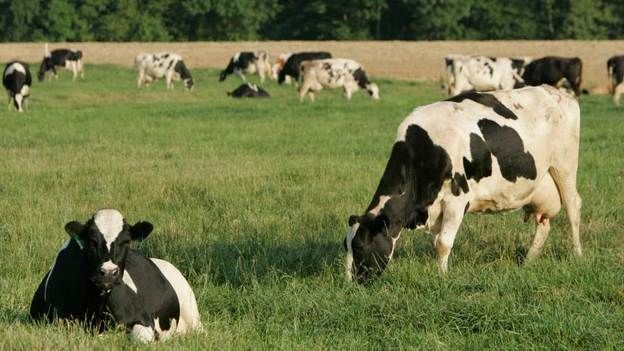
© Keri Pickett/HorizonCows graze at a Horizon Organic farm in eastern Maryland. Even though the milk produced here is deemed organic, a very small percentage of corn used to feed the animals may contain genetically modified material because of unavoidable cross-pollination between genetically modified corn and the organic variety.
Organic food producers opposed the USDA's decision - some more fiercely than others. That split has provoked angry debates within the organics community, with some activists accusing organic businesses of "surrendering" to the biotech company Monsanto. And it has reopened some old arguments about what's most important in the label "organic."
The cause of this dispute is not easily visible, at first, in the rolling pastures of an organic dairy operated by Horizon Organic near Kennedyville, in eastern Maryland. During the summer, the farm's cows graze on hundreds of acres of pasture.
But the grass doesn't grow in wintertime, so on this February day, the cows are eating inside. Farm manager Dudley McHenry explains that the animals eat a mixture of corn silage, clover, alfalfa, corn, soybeans and a grass called triticale. And there's a tiny bit of something in that feed - mainly in the corn - that's provoking the current disagreements among people who all describe themselves as defenders of organic farming.
Farming Organic Crops
The provocation is GMOs, or genetically modified organisms, which is the popular term for living organisms that contain genes that were inserted in the laboratory. This includes, for instance, corn or soybean plants that contain genes that make the plant poisonous to certain insects, or allow it to survive doses of the weedkiller Roundup.
Organic farmers aren't allowed to plant GMO seeds. But most conventional corn in America is genetically modified, and among all grains, corn is perhaps the most promiscuous cross-pollinator, so its genes often migrate into organic fields via windblown pollen that lands on the tassels of organic corn.
As a result, most organic corn in the U.S. typically contains anywhere from half a percent to 2 percent GMOs, according to companies that sell such corn to organic dairies or poultry farmers. It has been that way since genetically engineered corn and soybeans became popular, more than a decade ago.
But does that matter? Tom Spohn, director of dairy operations for Horizon Organic, says it doesn't keep the company from calling its milk organic.
"We just make sure we're meeting the letter of the organic regulations to the T," he says.
According to those regulations, if an organic farmer plants non-GMO seed and uses organic methods, the harvest is organic, even if a few stray genes blew in.
But in the past few years, anti-biotech activists like Ronnie Cummins, from the Organic Consumers Association, have been calling on organic businesses to fight back more fiercely against GMO contamination.
"If you're not willing to sue the person who pollutes the organic crop and really undermines organic integrity, then we're not going to stand up for you. You've got to do the right thing," he says.
Comment: For more information about the Organic Consumers Association's stance on GMO contamination read the following article: The Organic Elite Surrenders to Monsanto: What Now?
Why Is Organic Inc. Surrendering?
According to informed sources, the CEOs of WFM and Stonyfield are personal friends of former Iowa governor, now USDA Secretary, Tom Vilsack, and in fact made financial contributions to Vilsack's previous electoral campaigns. Vilsack was hailed as "Governor of the Year" in 2001 by the Biotechnology Industry Organization, and traveled in a Monsanto corporate jet on the campaign trail. Perhaps even more fundamental to Organic Inc.'s abject surrender is the fact that the organic elite has become more and more isolated from the concerns and passions of organic consumers and locavores. The Organic Inc. CEOs are tired of activist pressure, boycotts, and petitions. Several of them have told me this to my face. They apparently believe that the battle against GMOs has been lost, and that it's time to reach for the consolation prize. The consolation prize they seek is a so-called "coexistence" between the biotech Behemoth and the organic community that will lull the public to sleep and greenwash the unpleasant fact that Monsanto's unlabeled and unregulated genetically engineered crops are now spreading their toxic genes on 1/3 of U.S. (and 1/10 of global) crop land.
The Threat Of Cross-Pollination
Cummins and other anti-GMO groups have focused their attack on alfalfa, because it is the GMO crop that the government approved most recently.
Farmer Tim Winn, who has a farm on the banks of the Willamette River, says government scientists have concluded that there is nothing dangerous about the "Roundup Ready" version of the sugar beet crop.
Comment: Nothing Dangerous about 'Roundup Ready' crops? The following articles detail the many concerns associated with Roundup Ready crops and their effects on human health and the environment:
Scientists Reveal Negative Impact of Roundup Ready GM Crops
More herbicide use reported on genetically modified crops
Sorry Monsanto, You're Wrong: More GE Crops Mean More Pesticides
Death of the Bees: GMO Crops and the Decline of Bee Colonies in North America
GMO Scandal: The Long Term Effects of Genetically Modified Food in Humans
Monsanto's Superweeds Come Home to Roost: 11 Million U.S. Acres are Infested
Farmers can't plant genetically engineered sugar beets next year. Now they're in a bind.
Alfalfa, when it's grown for animal feed, is much less likely than corn to cross-pollinate. It's usually harvested before it flowers, and even when it does flower, those plants don't often produce seeds that sprout into new plants. (Cross-pollination is much more of a problem for the small minority of farmers who grow alfalfa for seed.) But activists say that even a small amount of cross-pollination will be a disaster for organic dairy farmers, and that claim is echoed by some organics executives.
"The threat to the alfalfa supply is very real, and the concern of our dairy producers is a huge one," says Christine Bushway, executive director of the Organic Trade Association. Bushway even asserts that if pollen from GMO alfalfa fertilizes alfalfa in organic hay fields, "you can't at that point sell it as organic."
This is a dangerous claim for the country's biggest organic trade association to make. Because if that claim were true - if cross-pollination actually turned organic crops into non-organic crops - there's wouldn't be much organic corn left in the country.
'Consumer Perception Is A Real Concern'
Charles Benbrook, chief scientist for the Organic Center, says there's a danger that this anti-GMO campaign could undermine the trust that increasing numbers of consumers have in organic food.
"It would be a shame for the momentum behind the growth in the organic livestock industry to be siphoned off or diverted because of one-tenth of 1 percent contamination in a source of animal feed," he says.
In fact, he says, if you insist on organic milk and eggs from animals that eat absolutely no GMO genes, you'll have to get that food from Europe, "and that's hardly a welcome solution for people who see in the organic food industry the best hope for positive change and innovation in the U.S. food system."
Some organics executives are worried that this infighting will lead to unrealistic demands by consumers.
"There's reality and there's perception," says George Siemon, CEO of Organic Valley, one of the country's biggest organic food companies. "And the perception is, consumers are saying they don't want any pollution in organic products. And whether that's realistic or not is another matter. But for sure, consumer perception is a real concern." Siemon cited a survey in which 77 percent of organics consumers said they would stop buying organic food if it contained GMOs.
Pamela Ronald, a plant biologist at the University of California, Davis, says those consumers are losing track of what's most important. Ronald has a foot on each side of the biotech wars - she works with genetically engineered plants in the laboratory, and she's married to a longtime organic farmer. She and her husband together wrote the book Tomorrow's Table: Organic Farming, Genetics, and the Future of Food.
"What really is important is, can we reduce the use of insecticides? Can we foster soil fertility? Can we feed the poor and malnourished?" she says. Those should be the goals of organic farming, she says, and they should be the goals of non-organic farming, too. According to Ronald, they're much more significant than avoiding laboratory-spliced genes.
Comment: Pamela Ronald's comments about 'reducing insecticides, fostering soil fertility, feeding the poor and malnourished and the goals of organic and non organic farming' as being more important than 'avoiding laboratory-spliced genes' appears to deflect from the deeper issue. GM foods do not reduce insecticide/pesticide use, do not foster soil fertility and do not produce higher yields to feed the poor and malnourished. GM foods and crops DO make Agribusiness Corporations a lot of profits:
GM Crops Criticized For 'Feeding Profits, Not The Poor'
Friends of the Earth International has accused biotech firms of using genetically modified crops to feed profits instead of the world's poor while increasing costs for US farmers, in a report released Tuesday.
The report, Who Benefits From GM Crops?, outlined how agribusiness corporations have seen increased profits on the back of rising grain prices, even as the world's hungry were hit by the food crisis.
It is particularly critical of Monsanto's 'Roundup Ready' seeds, which are modified to be resistant to Roundup, the world's biggest selling herbicide, also marketed by Monsanto. The report claimed that the company is incorporating the 'Roundup Ready' trait into nearly all its seeds, so that farmers who once bought insect resistant maize, for example, now find that it also has the herbicide resistant trait. "This trait penetration strategy means higher profits from both seeds and Roundup sales, and ensures farmers' dependence on GM traits and Roundup," said the report.
The two most prevalent GM traits are insect resistance and herbicide tolerance, with the latter accounting for 82 percent of global GM crops acreage in 2007.



are quickly becoming intersecting subsets. Most (in the US) do not realize how difficult it is to get non-GMO feeds for farm animals. It is nearly impossible for a small farm without incurring major cost from the few suppliers who grow/ship the feed mixes. Large organic farms can afford to grow their own feeds (at greater expense), but the small farm must rely on local growers that insist on open pollinated non-GMO grains. These local growers are disappearing. And it is clear that the USDA is moving to make GMO organic!
If small organic farms are to survive as truly non-GMO, they will have to choose their livestock carefully and match them to what natural feeds are available on the farm or in the local area. They will need to cooperate closely with local grains growers and select breeds that do well as pastured animals. And to do this, they will have to take care of their natural/wild assets as feeds for the animals (and the environment in general). To increase your chances of remaining GMO-free, look for "pastured" animals/products.