
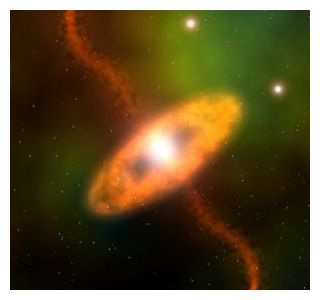
© Kirk Woellert/National Science FoundationArtist's conception of the aging star, W43A, surrounded by a disk of material and a water maser - a precessing, twisted jet of molecules streaming away from it in two directions.
Perth: Three new water masers have been discovered in the Milky Way, including what could be one of the fastest ever found - reaching speeds of up to 350 km per second - and a rare 'water fountain' type.
Water fountains are a special class of 'masers' - large microwave lasers caused by high-mass dying stars or high-mass star formation regions. The high mass source spews out material including clouds of water that can travel at a couple of hundred kilometres per second.
"At this speed [350 km/sec] it would be possible to surf the outflow from Sydney to London in under one minute," said Glen Rees from the Commonwealth Scientific and Industrial Research Organisation (CSIRO) summer vacation program, who found the three masers using data collected by the H2O Southern Galactic Plane Survey (HOPS).
When water molecules absorb energy
The term 'maser' originated as an acronym of Microwave Amplification by Stimulated Emission of Radiation. Masers work the same way as lasers except they emit microwaves instead of visible light.
Water molecules in High Mass Star-forming Regions (HMSR) and around dying stars absorb energy from their surroundings and re-emit it as radiation in the microwave frequency range.
Using the Australian Telescope Compact Array near Narrabri in New South Wales, Rees investigated the characteristics of three unique water masers located in the Milky Way by searching for a particular radiation frequency in the microwave region that is characteristic of water masers. "Water masers emit at 22 Giga-Hertz so we conducted our observations at this frequency," said Rees.
Only 12 water fountains ever found
One of the water masers Rees discovered was found around a post-Asymptotic Giant Branch (AGB) star - a star nearing the end of its life - and falls under the 'water fountain' classification for water masers.
'Water fountains' occur when a dying star spurts out jets of water molecule emission as it transitions into the next stage of its life. Only 12 water fountains have ever been detected so far.
These stellar 'water fountains' can help scientists work out how spherical AGB stars evolve into planetary nebulae - a bright, colourful shell of gas and dust surrounding a star in the last stages of life, which display a range of shapes and sizes.
"Exactly how high-mass stars form is still not well understood and water masers can give a valuable insight into the processes involved," said Rees.
An "insanely fast" maser
One of the other water masers Rees is studying has been confirmed as the fastest water maser found in a HMSR with velocities of up to 200 km per second. The average speed of a water maser is usually around 27 to 30 km per second.
The third water maser has a velocity spread of 350 km per second, and Rees is still trying to determine if it is in a HMSR or around a post-AGB star, calling it "insanely fast".
If the water maser is in a HMSR it will be the fastest known water maser found in a HMSR, beating the other water maser Rees found by 150 km per second.
"The most extreme examples known"
Physicist Simon Ellingsen from the University of Tasmania, who was not involved in the study said, "These three sources represent the most extreme examples known to date both in Post-AGB stars and high-mass star formation regions."
"The most extreme examples are particularly important as they provide the biggest tests of theories as to how such outflows are produced," said Ellingsen.
Other scientists are researching other types of masers, including methanol, hydroxyl and formaldehyde masers, to help discover more about how stars and galaxies change over time.






..bs
sorry, but it is not science