
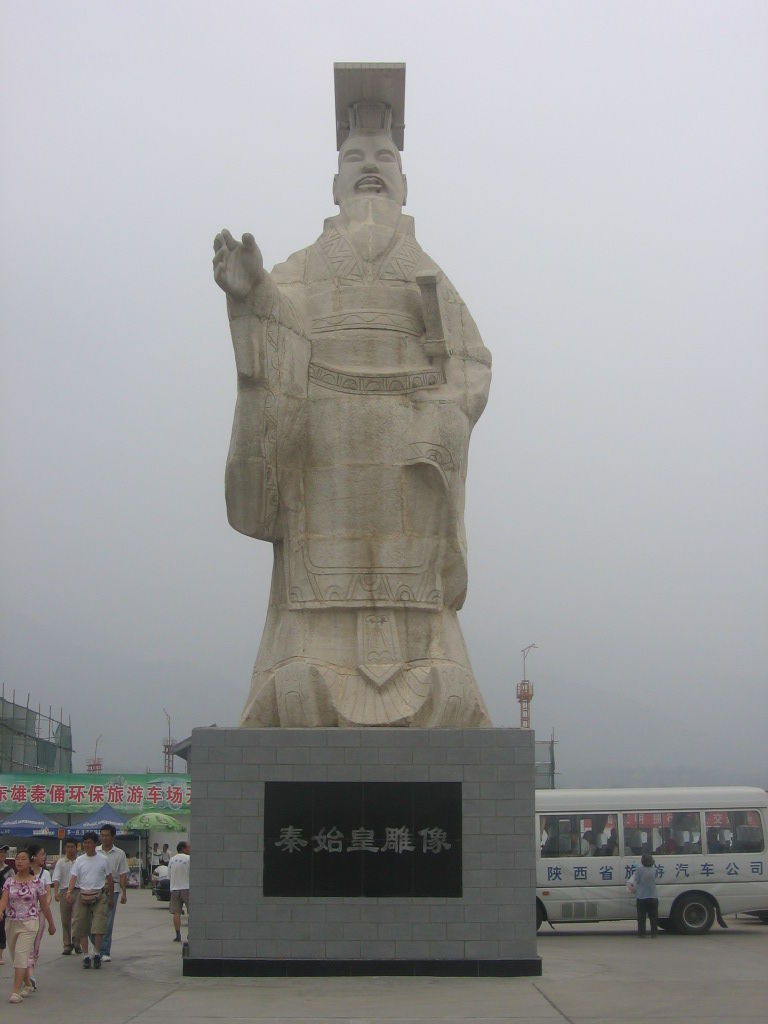
© Nat KrauseA modern day statue of the first emperor - built near the site of the Terracotta Army.
Qin Shi Huang unified China in 221 BC after conquering the other Chinese states. His reforms were numerous. He forced all of China to use a single currency, brought in a uniform system of rules and started construction of the Great Wall. He is perhaps best known for the Mausoleum he constructed with life-size Terracotta warriors nearby.
He died in 210 BC and in the ensuing chaos a new emperor, Han Gaozu, came to power. He inaugurated the Han Dynasty, a ruling line that would reign over China for 400 years.
The document discovery was made in 2002 in Liye City. It's an ancient settlement located in the area of modern day Xiangxi.
They were discovered when a construction team, working on a middle school, came across a well. When archaeologists ventured in they found a stash of 18,000 documents that were written on slips of bamboo and wooden boards. In addition they also found about 18,000 blank documents - stationary that was not used.
Although known in China this discovery does not appear to have been reported in western media.
Professor Robin Yates, of McGill University, discussed the discovery at a recent lecture at the Royal Ontario Museum in Toronto Canada. The museum is currently hosting a Terracotta Warriors exhibit that looks at Qin Shi Huang's rule.
Yates is a historian and editor of the journal Early China. He has been following this work closely. At the Toronto lecture Yates said that the Liye City documents date to 221 - 208 BC. This means that they would have been put into the well about two years after the First Emperor's death.
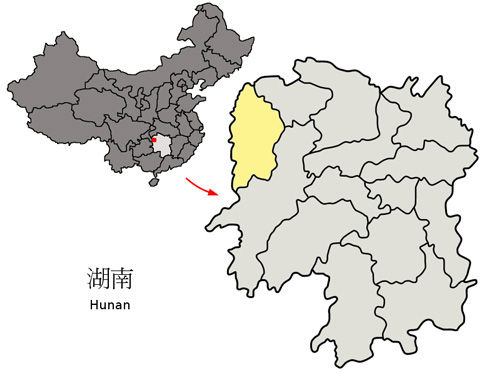
© CroquantThe discovery was made in the area of Xiangxi, located in Hunan Province. Its location is shown here.
Professor Yates took the time to share some of the remarkable stories that these documents tell.
The World's Oldest Multiplication Table
On a giant screen Professor Yates showed the audience an image of one of the most important documents - the "world's first and oldest multiplication table."
Yates said that "this was obviously used by officials for mathematical calculations concerning rations and other stores under their jurisdiction."
Every schoolchild knows what a table looks like - 1 x 1 is 1, 2 x 2 is 4 and so on. However, in this case, the table starts at 10 and works its way down to one. I asked Yates, in an email, why it goes this way. "From at least Shang times, a thousand years earlier, the Chinese used a decimal system, so it's not surprising to me that they started at ten and worked downwards," he wrote.
Ten is a base number in a decimal system - making it a natural place to start a multiplication table. Yates pointed out that the better question is "why do we (western civilization) go the other way?"
Debt Slave - The Punishment of Xiaokai
One of the documents tells of a man, referred to as "Xiaokai," who ran afoul of authorities. He was a commoner, with no special rank - someone who would have been "at the lower end of the social scale."
By the fourth month of the 33rd year of the First Emperor (214 BC) Xiaokai was in a position where he owed the Qin authorities a huge amount of money - 11,211 cash! Cash is a term used to describe Qin money.
It was "a huge sum given that food (cost) two cash per day," said Yates. There were few options available for him. "He was obliged under law to work off his debt to the government by the sweat of his brow."
He was credited with eight cash for every day of labour he served. If he got food from the government he was only credited with six cash a day. "This means that this individual probably would have had to work for the government for more than five years to work off his debt," said Yates.
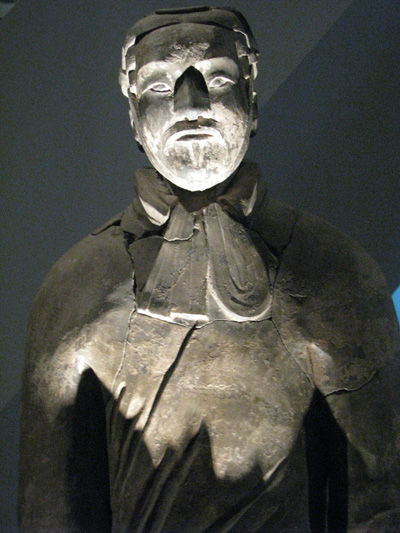
© Owen JarusA terracotta civil servant - unearthed near the First Emperor's Mausoleum. It's on display at the Royal Ontario Museum as part of an exhibit.
Harsh sentences, like the one Xiaokai got, may explain why these documents were dumped in a well around 208 BC.
"They may well have been looted from the Qin county offices by local family members wanting to dispose of the evidence of the debts that their family members had contracted with the Qin state authorities," said Yates.
"Like George Orwell in 1984"
Not only did the First Emperor control people, as mentioned above, but he tried to control words as well. "They controlled language rather like George Orwell in 1984," said Professor Yates.
One of the documents from Liye City "listed the new words that were required to be used by state bureaucrats and officials in state communication."
One rule "is that the names of objects or people associated with the former Qin royal house were now to be known as imperial," said Yates. In other words if a family had the name "royal," before their name, they now had the title "imperial" instead.
Also "former Qin rulers were also given the name of emperor." They were given this honour even though they did not rule over a united China.
There's more...
"In addition affairs of the royal house were now to be referred to as matters of state, thus indicating that the Qin ruling house was now claiming authority over its conquered subjects," said Professor Yates.
"Qin was no longer just one kingdom among others but was an empire incorporated all under heaven."


Reader Comments
to our Newsletter