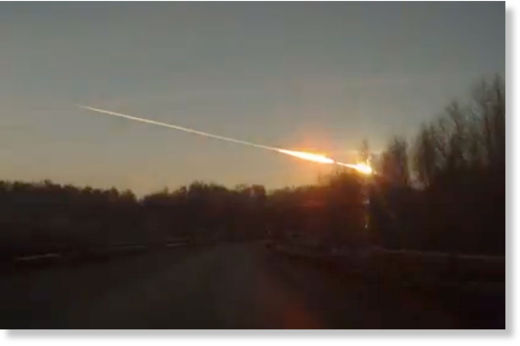
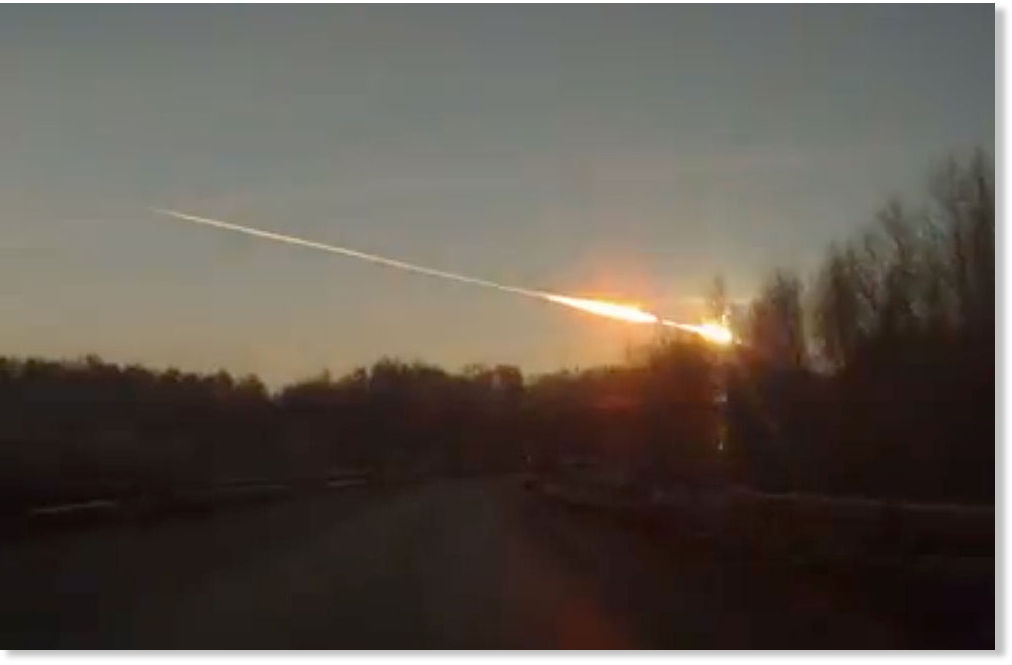
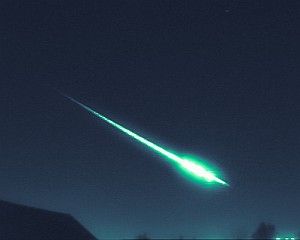
© YoutubeA meteorite causes panic as it falls in the Ural Mountains region of Russia, Feb. 2013.
Is there anything sneakier than an asteroid? They run silent, run deep and run very, very fast - hurtling toward Earth from any point in the vast bowl of the sky at speeds that can exceed 40,000 mph (64,000 k/h). They typically whiz right past us or plunge harmlessly and spectacularly into the atmosphere, burning up before they hit the ground - unless, of course, they explode in the sky or collide with the surface, leaving a massive footprint of destruction for miles around.
Asteroids - or, in their atmospheric incarnations, meteors or meteorites - don't do that kind of damage very often anymore, perhaps once every 70 to 100 years on average.
But when they do, they can spell big trouble. You could ask the folks living in the Tunguska region of Russia in 1908, where a 330 ft. (100 m) rock exploded in the sky one morning, flattening trees in an 830 sq. mi. (2,150 sq. km) radius. You could ask the dinosaurs - if they weren't all dead of course, thanks to a 6 mi. (10 km) rock that struck off the Yucatan 65 million years ago, throwing up a sky darkening debris screen that made the planet too cold for them to survive.









Comment: A sonic boom from a military jet does not cause houses to shake...