Animals
S


Blackbox

'Oriental yeti' discovered in China

Image
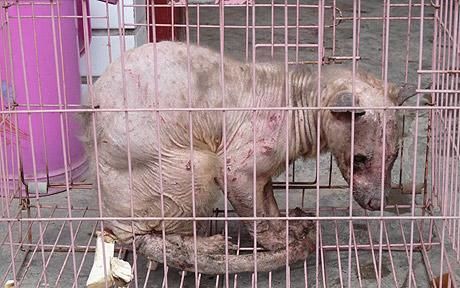
© Photo: CENThis bizarre creature dubbed the oriental yeti has baffled scientists after emerging from ancient woodlands in remote central China.
A creature dubbed the 'oriental yeti' is being examined by scientists after emerging from ancient woodlands in remote central China.

The hairless beast was trapped by hunters in Sichuan province after locals reported spotting what they thought was a bear.

Hunter Lu Chin explained: "It looks a bit like a bear but it doesn't have any fur and it has a tail like a kangaroo."

Better Earth

Hostile volcanic lake teems with life

Lake
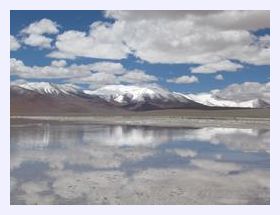
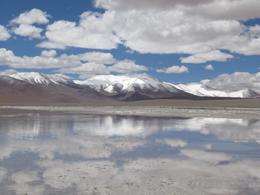
© MARÍA EUGENIA FARÍASIt looks peaceful, but Laguna del Diamante's waters are deadly.
Argentinian investigators have found flamingos and mysterious microbes living in an alkaline lagoon nestled inside a volcano in the Andes. The organisms, exposed to arsenic and poisonous gases, could shed light on how life began on Earth, and their hardiness to extreme conditions may hold the key to new scientific applications.

In 2009, a team led by María Eugenia Farías, a microbiologist at the National Scientific and Technical Research Council in Tucumán, Argentina, discovered living stromatolites in the Socompa and Tolar Grande lagoons high in the Andes (see 'High window on the past'). Stromatolites - collections of photosynthetic microorganisms and calcareous concretions - are thought to have been common more than 3.5 billion years ago.

After that discovery, scientists in Argentina decided to look at lakes and lagoons in the Puna de Atacama, a desert plateau that sits more than 4,000 metres above sea level, in an attempt to understand what life might have looked like on the early Earth.

Blackbox

A killer in the bat cave

Corpse upon corpse they lie, a carpet of emaciated, fungus-ridden carcasses. Where once healthy animals hung in slumber from the cave roof, now there is a mass grave on the floor. It is a scene that is repeated throughout the eastern US, from Vermont to West Virginia. America's bats are in crisis, under threat from a mysterious killer.


Bizarro Earth

Mysterious Whale Die-Off Is Largest on Record

Mass death among baby right whales has experts scrambling to figure out the puzzle behind the largest great whale die-off on record.

Observers have found 308 dead whales in the waters around Peninsula Valdes along Argentina's Patagonian Coast since 2005. Almost 90 percent of those deaths represent whale calves less than 3 months old, and the calf deaths make up almost a third of all right whale calf sightings in the last five years.

"This is the single largest die-off event in terms of numbers and in relation to population size and geographic range," said Marcela Uhart, a medical veterinarian with the Wildlife Conservation Society (WCS). She represents an associate director in Latin America for the WCS Global Health Program.

Bizarro Earth

Australia: New South Wales facing huge locust plague

Image
© Brad MarkhamLocust eggs discovered on a property near Parkes in September 2009
There're fears NSW could be facing its worst locust plague since 2004.

Heavy rains have triggered a surge in locust activity. The pest has already ravaged early oat crops in the state's south. Some of the biggest clusters of baby locusts ever seen in NSW have been found in the far-west around Tibooburra.

The state's locust coordinator Simon Oliver is urging all landholders to check their paddocks for the pest.

"We've had good rain across NSW over the past three months," he says. "That's led to strong pasture growth and as a result the locusts have reinvigorated themselves. We're now finding large numbers in most parts of western NSW."

Info

Common Toads Can Predict Earthquakes, New Study Finds

Common toads (Bufo bufo) can detect impending seismic activity and alter their behaviour from breeding to evacuation mode, suggests a new study in the Zoological Society of London's (ZSL) Journal of Zoology.

Researchers from The Open University reported that 96 per cent of male toads in a population abandoned their breeding site five days before the earthquake that struck L'Aquila in Italy in 2009. The breeding site was located 74 km from the earthquake's epicentre.

The number of paired toads at the breeding site also dropped to zero three days before the earthquake. No fresh spawn was found at the site from the date that the earthquake struck to the date of the last significant aftershock (magnitude >4.5).

Breeding sites are male-dominated and the toads would normally remain in situ from the point that breeding activity begins, to the completion of spawning.

Bizarro Earth

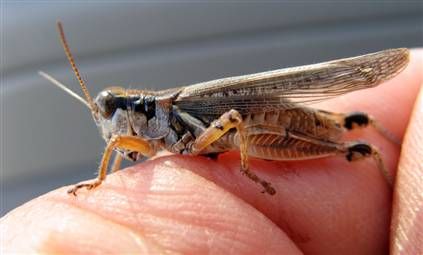
US: Grasshopper Invasion Feared This Summer

Grasshopper
© Scott Schell/University of Wyoming
Some Western, Plains states could see worst outbreak in 30 years

Newcastle, Wyoming - Grasshopper infestations have taken on mythic tones here on the arid prairie of northeastern Wyoming - they blanket highways, eat T-shirts off clotheslines and devour nearly every scrap of vegetation on ranches and farms.

The myth may come closer to reality this summer than at any time in decades in several states in the West and the Plains.

A federal survey of farm areas taken last fall found high numbers of adult grasshoppers in parts of Wyoming, Montana, South Dakota, North Dakota, Nebraska and Idaho. Each female lays hundreds of eggs so that high count could turn into costly grasshopper infestations this summer.

Well-timed cool and wet weather to stifle the young grasshoppers when they hatch around May and June.

Question

Northern Ireland eels suffer mysterious decline

Image
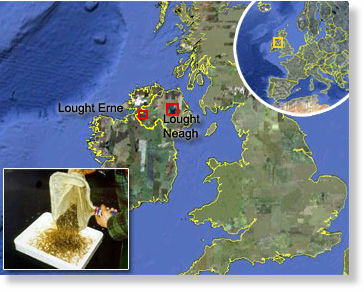
© Stock File / FISThe eel fisheries of Lough Neagh and Lough Erne are in a poor state.
There have been dire warnings about the future of Europe's largest eel fishery at Lough Neagh: numbers of elvers returning to Europe's rivers and lakes have been mysteriously dropping for years, but this season the decline has hit more fisheries than ever before.

Since 1983, Lough Neagh fishermen have been noticing the low numbers of glass eels returning from the Sargasso Sea spawning grounds.

With a view to the future, they took action, re-stocking their fishing grounds with glass eels bought from healthier fisheries such as the Severn estuary, and that has allowed them to continue meeting their quota of adult eels.

But last season the Severn estuary was the latest fishery to be hit by plummeting glass eel returns and prices for glass eels have shot up - posing a challenge for the Lough Neagh Eel Fishermen's Cooperative as they struggle to find ways to re-stock the lough, reports the Belfast Telegraph.

Wolf

Wolves on the prowl again in Western Europe

wolf
© Unknown
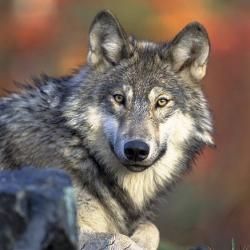
Wolves are again howling through the woodlands of western Germany for the first time in 150 years, after spreading back into Western Germany now that most of their natural enemies have disappeared, conservationists say.

Wolf sightings have been common in Poland and eastern Germany for several years, but never in the heavily urbanised and industrial heartland of the Ruhr Valley and the Rhineland - until now.

Front-page tabloid headlines shocked city dwellers recently with reports that at least one wolf is on the prowl in North-Rhine Westphalia, Germany's most populous state and a region which borders on France.

Frog

The mysterious case of the frogs' legs

Image
© Brandon Ballengee
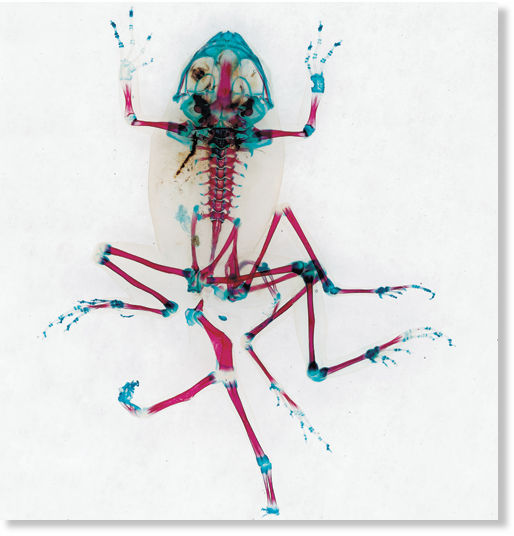
In 1995, a group of schoolchildren from Minnesota discovered that half of the frogs they found in a pond were deformed. Some had bent, truncated legs, some had extra legs, while others had none at all. Photos of the frogs caught the attention of journalists, who blamed chemical pollution.

Since then, American artist Brandon Ballengée has found similarly deformed frogs and toads all over the world when working with the biologist Stanley Sessions from Hartwick College in Oneonta, New York state. Ballengée documents their field trips photographically. He also brings back dead specimens, which he uses to create artistic images like this one of an extra-limbed Pacific treefrog from Aptos, California.

Ballengée says he's attracted to the frogs because he finds them uncanny, almost other-worldly. To heighten this effect, he stains the frogs with dyes that turn cartilage blue, bones red and flesh translucent. He then scans them using a high-resolution scanner to produce a detailed, ghostly image. "I wanted to find a way to exhibit what I was finding without being scary or exploitative."