Animals
S


Hourglass

Arctic Birds are Contaminated with Pesticides and Heavy Metals

Image
On an isolated island high in the Arctic, biologists recently tested the toxicity of birds by testing their droppings. The conclusion? The birds' poop was loaded with environmental poisons. In these remote birds, they found high concentrations of pesticides and heavy metals including lead, mercury, aluminum and cadmium. The source of these poisons was determined to be the birds' diet of fish and shellfish and the source of the pollution of the fish and shellfish was human pollution. After these toxins were released via their excrement, they were recycled onto the earth producing toxic and contaminated areas.

The testing was done in a remote, isolated area far from industrial and agricultural pollution. In fact, there is little industry and few people anywhere close by. However, over 45 years ago atomic weapon testing was done in the area.

The media is reporting that the people who are eating the eggs of the birds are perfectly safe, but the birds' eggs weren't even tested. And if the birds' droppings contain elevated levels of these contaminants, so do the birds - and the birds' eggs. Eating mercury, lead, cadmium and aluminum is never safe and since these are in birds from isolated areas of the Arctic, it's curious to wonder what contaminants are in birds from more populated industrialized areas. Since the birds obtained these toxic poisons from the fish and shellfish they ate, it's also safe to assume that fish from less isolated areas - closer to industries and toxic agricultural runoff - are equally as polluted and likely far more so. Yet, many people are eating those fish regularly - and their poisons too.

Question

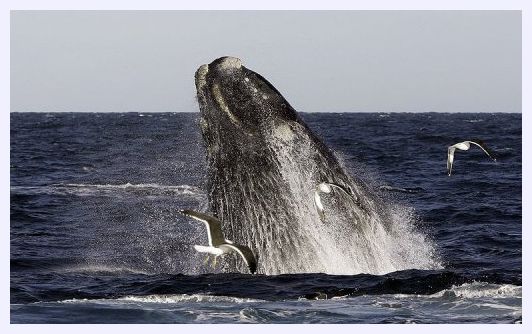
What is Killing Argentina's Right Whales?

Right Whale
© AFPA Franca Austral whale (also known as Southern Right Whale).
Agadir, Morocco - Fatal strandings of southern right whales around Argentina's Valdes Peninsula have soared in recent years, and worried scientists are not sure why, the International Whaling Commission heard Friday.

From 1971, when systematic monitoring began, only a relative handful of whale deaths were reported over the next three decades.

Starting in 2003, however, the mortality rate began to soar: from 31 that year, to 47 in 2005, 83 in 2007, 95 in 2008 and 79 last year, the IWC's scientific committee reported.

"Over 90 percent of the deaths have been of first-year calves," the scientists said.

The Valdes Peninsula is one of the most popular whalewatching venues on the planet, attracting some 200,000 eco-tourists every year hoping to see the huge mammals -- which grow up to 17-metre (56-foot) long -- in their element.

It is also a critically important breeding and nursery ground for right whales.

Three causes, possibly in combination, have been fingered as possible culprits.

Question

Grand Cayman Island: DoE Investigate Mystery of Dead Fish

Dead Fish
© CNS
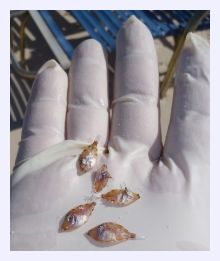
The cause of a large number of dead juvenile fish along the waterline on Seven Mile Beach is unknown, according to the Department of Environment, and appears to be confined to a single species.

The fish, which were reported to the DoE Wednesday 23 June, appeared to all be filefish fry about 2-3cm long, possibly white-spotted filefish, but because of their young stage of development the department is unable to identify the species with certainly.

"Despite the large number of dead fish observed over several miles on southern and central Seven Mile Beach we do not suspect that there is a systemic environmental problem at this time," said John Bothwell, Senior Research Officer with the Department of Environment.

Bizarro Earth

Big Algae Bloom Expanding Off China's East Coast

Image
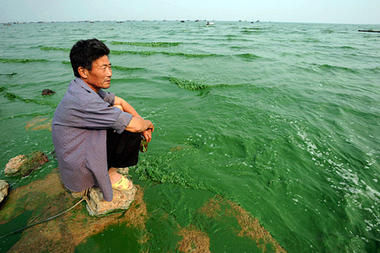
© Jianan Yu/ReutersGreen algae outbreak in 2008, in Chaolu lake in Hefei, Anhui province, endangered water supply in nearby cities and posed a great threat to aquatic life.
A huge bright green algae bloom is blanketing the sea off China's east coast and wind is driving it closer to land, an official said Friday.

Cui Wenlin, an official with the State Oceanic Administration, said the slimy bloom is the biggest China has seen since a huge outbreak in 2008 threatened to disrupt sailing events during the Beijing Summer Olympics. Before the games, thousands of soldiers, volunteers and fishing boats were recruited to clean up that bloom, which sailors took to calling "The Fairway" and "The Carpet."

The current outbreak has nearly doubled in size since it was first spotted June 14 near eastern China's Shandong province and now measures about 110 square miles (300 square kilometers), said Cui, who works at the administration's North China Sea Environmental Monitoring Center.

Winds are pushing the mass toward the resort city of Qingdao, and it was 6-12 miles (10-20 kilometers) from shore late Friday, he said.

Bad Guys

BP Is Burning Rare Sea Turtles Alive, Blocking Efforts to Save Them

Image
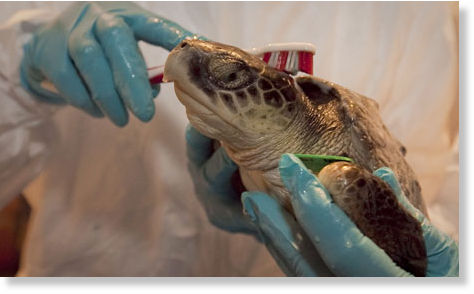
By now, almost everyone is aware of the out-of-control oil spill down in the Gulf of Mexico that seems to be getting exponentially worse with each passing day. But what people may not know is that BP's efforts to control the oil by burning it are actually burning alive a certain rare and endangered species of sea turtle.

For several weeks now, rescue crews have been feverishly trying to save Kemp's Ridleys sea turtles, as well as four other endangered varieties, from being caught in the oil corral areas that are being intentionally burned by BP, but according to Mike Ellis, one of the boat captains involved in the project, BP has now blocked all such rescue efforts from taking place.

"They ran us out of there and then they shut us down, they would not let us get back in there," he explained in an interview with Catherine Craig, a conservation biologist.

Attention

Bee decline could be down to chemical cocktail interfering with brains

£10m Insect Pollinators Initiative will look at the multiple reasons thought to be behind devastation of bees, moths and hoverflies

A cocktail of chemicals from pesticides could be damaging the brains of British bees, according to scientists about to embark on a study into why the populations of the insects have dropped so rapidly in recent decades. By affecting the way bees' brains work, the pesticides might be affecting the ability of bees to find food or communicate with others in their colonies.

Neuroscientists at Dundee University, Royal Holloway and University College London will investigate the hypothesis as part of a £10m research programme launched today aimed at finding ways to stop the decline in the numbers of bees and other insect pollinators in the UK.

Insects such as bees, moths and hoverflies pollinate around a third of the agricultural crops grown around the world. If all of the UK's insect pollinators were wiped out, the drop in crop production would cost the UK economy up to £440m a year, equivalent to around 13% of the UK's income from farming.

Cloud Lightning

North Carolina, US: Man Mauled by Bear After Lightning Strike

A North Carolina man dubbed the unluckiest in the state had the unlikely experience of being mauled by a bear -- four years after being struck by lightning.

Rick Oliver, 51, of Wake County, said he was attacked by a bear while working on his truck at about 2 a.m. June 3, leaving him with deep cuts on his wrist, the Raleigh News & Observer reported Thursday.

"You have a greater chance of getting struck by lightning than getting killed by a bear," a report published by the U.S. Forest Service's Bear Aware program reads.

However, Oliver had the unlikely experience of a bear attack only four years after being struck by lightning.

Eye 1

2 Pensacola Beach Scenes: Dying Baby Dolphin and Ocean "Water Bubbling "...Like It's Got Acid In It. God Help Us All"

Two scenes from Pensacola-- one of a dying baby dolphin, the other of water bubbling like there's acid in it.

dolphin baby
A dying, oil-covered baby dolphin is taken from Pensacola waters. It died shortly after being discovered.

Fish

Miles of oil washing up in Florida Panhandle

Pensacola Beach -- The worst blow yet to the Florida coastline from the growing oil spill struck Wednesday in an eight-mile line of thick, sticky goo that stained the pristine sands of this Panhandle community.

Workers spent the day raking up the chocolate-brown oil mats and tar patches that washed ashore, and the state ordered road graders to lift the gunk from the once-white beaches.

Some local leaders complained it was too little, too late.

''It's pitiful,'' said Buck Lee, executive director of the Santa Rosa County Island Authority. ''It took us four hours to clean up 50 to 60 feet of beach and I don't see this stopping for a while.''

Attention

Siberian tiger threatened by mystery disease

Image
© Grant Faint/Getty ImagesThe number of siberian tigers has fallen 40% in five years.
Conservationists say an epidemic is destroying the big cats' ability to hunt and turning them into potential man-eaters

A mystery disease is driving the Siberian tiger to the edge of extinction and has led to the last animal tagged by conservationists being shot dead in the far east of Russia because of the danger it posed to people.

The 10-year-old tigress, known to researchers as Galya, is the fourth animal that has had a radio collar attached to it for tracking to die in the past 10 months. All had been in contact with a male tiger suspected of carrying an unidentified disease that impaired the ability to hunt. "We may be witnessing an epidemic in the Amur tiger population," said Dr Dale Miquelle, the Wildlife Conservation Society's (WCS) Russia director.

Galya had recently abandoned a three-week-old litter of cubs and come into the town of Terney looking for an easy meal. Following a series of all-night vigils by researchers, attempts to scare the tigress away failed. She was reported to the Primorsky State Wildlife Department as an official "conflict tiger", and a state wildlife inspector was called in to destroy her earlier this month.

"This tiger had lost its fear of humans - typically Amur tigers will never expose themselves for observation. It was like seeing someone you know turn into a vampire," Miquelle said.