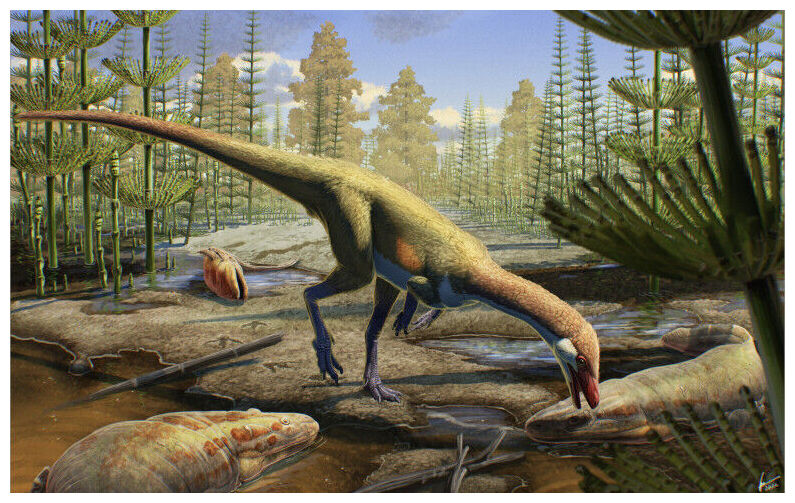
© Illustration by Gabriel UguetoAn artist’s rendering shows how Ahvaytum bahndooiveche may have appeared in a habitat dating to around 230 million years ago.
How and when did dinosaurs first emerge and spread across the planet more than 200 million years ago? That question has for decades been a source of debate among paleontologists faced with fragmented fossil records. The mainstream view has held that the reptiles emerged on the southern portion of the ancient supercontinent Pangea called Gondwana millions of years before spreading to the northern half named Laurasia.
But now, a newly described dinosaur whose fossils were uncovered by University of Wisconsin-Madison paleontologists is challenging that narrative, with
evidence that the reptiles were present in the northern hemisphere millions of years earlier than previously known.The UW-Madison team has been analyzing the fossil remains since they were first discovered in 2013 in present-day Wyoming, an area that was near the equator on Laurasia. The creature, named
Ahvaytum bahndooiveche, is now the oldest known Laurasian dinosaur, and with fossils estimated to be around 230 million years old, it's comparable in age to the earliest known Gondwanan dinosaurs.
UW-Madison scientists and their research partners
detail their discovery Jan. 8, 2025, in the Zoological Journal of the Linnean Society.
"We have, with these fossils, the oldest equatorial dinosaur in the world — it's also North America's oldest dinosaur," says
Dave Lovelace, a research scientist at the
University of Wisconsin Geology Museum who co-led the work with graduate student Aaron Kufner.












Comment: Update January 19
The same source reports: