Health & WellnessS


Sheeple

Humans can sleep for days when living alone underground - and they suffer for it

tent cave
Really weird stuff happens when humans are left alone in the dark.
Whenever we've tried to test the effects that living in isolation without sunlight have on the body, a common thread has emerged: much longer sleep cycles.

Back in 2015, Julie Beck over at The Atlantic pulled together the findings from a number of different experiments that all saw the participants involved drifting off for days at a time... and suffering some fairly acute mental stresses along the way too.

Take cave explorers Josie Laures and Antoine Senni, for example, who lived underground for months in the 1960s.

When they emerged from their self-imposed solitude (having stayed in separate caves), both thought much less time had passed than was actually the case, to the tune of several weeks.


Comment: This article probably isn't such a surprise to those of us who love our sleep, and/or those of us who are sleep deprived - as so many are these days. What it does hightight is how we're still in the dark about many of the processes and mechanics involved in sleep: Also check out SOTT radio's: The Health & Wellness Show: Seeing the Light with Dr. Alexander Wunsch


Sun

Vitamin D deficiency linked to greater risk of diabetes

Sonnenlicht, Vitamin D
An epidemiological study conducted by researchers at University of California San Diego School of Medicine and Seoul National University suggests that persons deficient in vitamin D may be at much greater risk of developing diabetes.

The findings are reported in the April 19, 2018 online issue of PLOS One.

The scientists studied a cohort of 903 healthy adults (mean age: 74) with no indications of either pre-diabetes or diabetes during clinic visits from 1997 to 1999, and then followed the participants through 2009. Vitamin D levels in blood were measured during these visits, along with fasting plasma glucose and oral glucose tolerance.

Over the course of time, there were 47 new cases of diabetes and 337 new cases of pre-diabetes, in which blood sugar levels are higher than normal but not yet high enough to be categorized as type 2 diabetes.

For the study, the researchers identified the minimum healthy level of 25-hydroxyvitamin D in blood plasma to be 30 nanograms per milliliter. This is 10 ng/ml above the level recommended in 2010 by the Institute of Medicine, now part of The National Academies, a health advisory group to the federal government. Many groups, however, have argued for higher blood serum levels of vitamin D, as much as 50 ng/ml. The matter remains hotly debated.

Comment: Vitamin D is an insulin sensitizer. See also:


Health

Infectious disease experts wonder why more Canadians are getting shingles

Shingles
As many as 130,000 Canadians develop shingles each year in Canada, and it appears those numbers are rising -- but no one is quite sure why.
It started with weakness in her left leg and pain in her lower back. Then, there were rashes "that felt like little sewing needles" stabbing her.

"It was difficult to walk for a couple of days -- the nerve pain was pretty bad," said Lorena Rosati, who works for CTV News.

"It was in my back and then travelled down my leg as well, so sitting all day was extremely uncomfortable and I had some trouble sleeping at night."

As many as 130,000 Canadians develop shingles each year in Canada, and it appears those numbers are rising -- but no one is quite sure why.

When Rosati, 36, visited her doctor, she was shocked to learn that she had shingles.

"I actually started laughing at first because I couldn't believe that it would be shingles," she said. "You don't usually hear about a younger person having shingles, so that was quite surprising."

Comment: Slashing high sugar content in carbohydrates from diet would likely help in preventing shingles. It can also be treated using Vitamin C.


Family

Sex change hormones put kids at risk of infertility, heart disease, baldness, doctor warns

Women and men
© Julen Garces Carro / EyeEm / Getty Images
Sex change drugs are harming children, a leading NHS psychiatrist has warned. Dr. Lucy Griffin spoke out about British kids using cross-sex hormones, warning they could have grave consequences, like heart disease or osteoporosis.

Griffin, who works at the Bristol Royal Infirmary, said she was concerned about the extent to which medicines were used with children. Griffin suggested that her colleagues shared the same concerns, but they were "running scared" because they feared being labelled bigots.

She told the Mail on Sunday: "Children can't vote and they can't leave school, but we are allowing them to make decisions about their fertility and sexual function. My own feeling is I can't see how young people's health can be anything but harmed by these treatments."

Griffin also spoke of the serious side effects for sex change and puberty blocking drugs, warning that they are associated with serious health risks. "Puberty blockers are not designed for the blockage of puberty in healthy adolescents," she said. "Now they're being used for something that's a psychological presentation without a body of scientific study behind it."

Comment: See also: Philosopher states the obvious: There is no such thing as a "sex change"


Brain

Strength of handgrip is related to the health of the brain, researchers say

Fist

The study used data from 475,397 people in the UK.


A strong handgrip is a simple sign that your brain is healthy, new research finds.

The study of almost half a million people found that stronger people - as measured by grip strength - performed better on tests of reaction speed, memory and logical problem solving.

The link was found in young and old alike.

Comment: See also:


Alarm Clock

Even one night of bad sleep causes dangerous changes in your brain

insomnia
© H. Armstrong Roberts/ClassicStock/Getty Images
  • During the day, mental activity causes brain cells to release beta-amyloid proteins, which are basically waste byproducts. Sleep cleanses the human brain of these toxins.
  • The buildup of these proteins is considered a sign of Alzheimer's Disease.
  • One night of bad sleep can cause these Alzheimer's-related proteins to build up in the human brain, a new study found.
One of the most important things that happens when we drift off at night is a cleansing process: sleep helps remove toxins from the human brain.

Scientists recently found that even one night of sleep deprivation causes the buildup of a kind of protein that's known to make up the plaque that surrounds nerve cells associated with Alzheimer's in the brain.

A new study published in the journal Proceedings of the National Academy of Sciences demonstrated this effect in the human brain for the first time. The results indicate just how serious chronic sleep deprivation might be over time.

While researchers don't know the exact cause of Alzheimer's disease, they have found that the brains of people with Alzheimer's generally have higher concentrations of beta-amyloid proteins. The proteins make up a plaque that's associated with the disease and is thought to interfere with signaling between brain cells.

In the recent study, the beta-amyloid proteins built up in sleep-deprived participants regardless of whether they had a variant of a gene that's associated with a higher risk of Alzheimer's. That indicates a lack of sleep could play a role independent of genetic risk.


Comment: You also need a certain enzyme to keep the brain clear from these beta-amyloid plaques. But your brain also uses the same enzyme to clear out insulin. In fact, it's called "insulin-degrading enzyme" or IDE. If you have insulin resistance, IDE is too busy clearing out insulin and has no time to break down amyloid-beta proteins. See also:

Snowflake Cold

Enduring cold temperatures alters fat cell epigenetics

JMJD1A
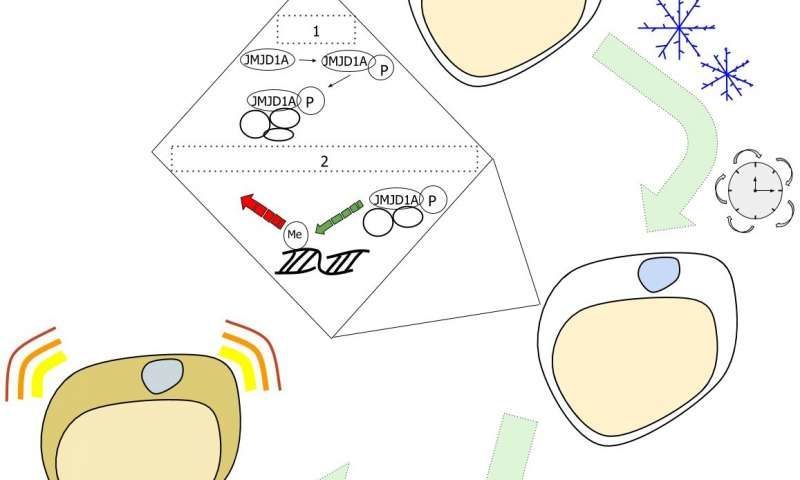
© The University of TokyoResearchers hope to use this signaling pathway to find treatments for diseases such as diabetes and obesity. Environmental signals can change the epigenetic code of white fat cells in a two-step process. Long-term exposure to cold initiates a change in one protein, JMJD1A. The altered JMJD1A then combines with other protein partners to change the epigenetic code on a gene involved in heat production. White fat cells that have undergone this epigenetic change are called beige fat cells and can contribute to keeping the body warm.
A new study in fat cells has revealed a molecular mechanism that controls how lifestyle choices and the external environment affect gene expression. This mechanism includes potential targets for next-generation drug discovery efforts to treat metabolic diseases including diabetes and obesity.

Researchers tracked how the epigenome changes after long-term exposure to cold temperatures, and how those changes cause energy-storing white fat cells to become heat-producing brown-like, or "beige," fat cells.

"We believe that this is the first time that anyone has collected data to prove that there are two steps between the environmental stimuli and epigenetic changes," said Professor Juro Sakai from the University of Tokyo and Tohoku University, an expert in the epigenetics of metabolism.

Gene expression is regulated by epigenetics-patterns of chemical signals that are "above" the gene sequence. An individual's gene sequence is determined at conception, but the external environment and an individual's lifestyle can change the epigenetic sequence throughout a lifetime, continually altering how genes are expressed. The scientific community has long suspected that there may be a stepwise process inside the cell to manage environmental influences on the epigenome, but no specific molecular mechanisms had been identified previously.

Comment: See also: The Health & Wellness Show: A conversation with Dr. Jack Kruse


Biohazard

Coal plant emissions damage infant DNA

coal china
© Damir Sagolj/ReutersA migrant worker steps outside in an area next to a coal power plant in Beijing, 2015.
A study from Columbia University has found notable differences in the DNA of neonatal babies born after a coal plant in China was shut down, compared with babies born in the same place while the plant was still operating and polluting the surrounding air.

Dr. Frederica Perera and Dr. Deliang Tang, researchers at Columbia University's Mailman School of Public Health, found that babies born during the coal plant's operation had shorter telomeres than those born after the plant's closure - a result which seemed to validate the Chinese government's push to reduce air pollution.

"Telomeres are repeated sequences of DNA that form a kind of cap on the ends of chromosomes and preserve the integrity of those chromosomes," Perera says. "It's been seen, mostly in adults, that shorter telomeres are associated with cardiovascular illness, premature aging, cognitive decline and certain cancers. So, you want to have longer telomeres."

The study was the first to look into the "very early window, in [placental or umbilical] cord blood, when babies are first born," Perera says. "We used this particular biologic marker because we could use it to see whether this was an additional benefit of closing a polluting coal plant."

Comment: See also: China scrapping 85 coal plants in pivot to green energy


Health

The Bugs in Your Gut Could Make You Weak in the Knees

microbiome
Bacteria in the gut, known as the gut microbiome, could be the culprit behind arthritis and joint pain that plagues people who are obese, according to a new study published today in JCI Insight.

Osteoarthritis, a common side effect of obesity, is the greatest cause of disability in the US, affecting 31 million people. Sometimes called "wear and tear" arthritis, osteoarthritis in people who are obese was long assumed to simply be a consequence of undue stress on joints. But researchers at the University of Rochester Medical Center provide the first evidence that bacteria in the gut - governed by diet - could be the key driving force behind osteoarthritis.

The scientists found that obese mice had more harmful bacteria in their guts compared to lean mice, which caused inflammation throughout their bodies, leading to very rapid joint deterioration. While a common prebiotic supplement did not help the mice shed weight, it completely reversed the other symptoms, making the guts and joints of obese mice indistinguishable from lean mice.

Comment: For more clues, see:


Magic Wand

Why dreaming is vital: The power of REM sleep

dream sleep balloon pin pop
© Patryk HardziejDreams play a key role in boosting creative thought, memory, learning and even mental health. Now modern life may be cutting them short, with serious consequences
YOU know that feeling when someone wakes you up in the middle of a really good dream? There is a real sense of loss, like ending a TV episode on a cliffhanger. You want to jump back in, but no such luck.

That is me every morning. I have a baby sleeping in the same room and am wrenched awake early each day, often mid-dream.

That might sound like a trivial complaint. We tend to think of dream sleep as unimportant, the poor relative of vital and restorative deep sleep. But now it seems that dreams are much more than mystical night-time adventures. Recent research suggests that rapid eye movement (REM) sleep - when we have the most powerful dreams - is vital to learning and creativity, and promotes a healthy mind in a variety of ways. It isn't romantic whimsy to say that if we stifle our dreams, we aren't going to reach our potential.

Chronic dream deprivation isn't just a problem for people with small children. Going to bed drunk or stoned, taking various medications or even just using an alarm to wake up in the morning can all leave your dreams smothered. So, currently sleep deprived, I wanted to find out if missing out on dream sleep is as bad as it seems, and if so, what we can do to get our dreams back.

Comment: See Also: