

© iStockphoto / Thinkstock
This rider would allow biotech crops to be planted even if a federal court has ordered planting to be halted until an Environmental Impact Statement has been completed. It also puts restrictions on regulations, and allows fast-track approval of genetically engineered (GE) crops, despite the fact that the US is already the only developed country that does not require safety testing of GE plants.Danielle Stuart, a Monsanto spokeswoman, has stated the bill "provides an assurance for farmers growing crops which have completed the U.S. regulatory review process that their harvest won't be jeopardized by subsequent legal disputes."1
Are Biotech Companies About to Gain Immunity from Federal Law?
The rider was added by the agricultural sub-committee chair Jack Kingston (R-Ga.). Not surprisingly, Kingston was voted "legislator of the year for 2011-2012" by the Biotechnology Industry Organization. The featured article by Alexis Baden-Mayer and Ronnie Cummins2 spells out the many problems with this "Monsanto protection act," snuck in by biotech's inside man:
- The Monsanto Rider is an unconstitutional violation of the separation of powers. Judicial review is an essential element of U.S. law, providing a critical and impartial check on government decisions that may negatively impact human health, the environment or livelihoods...
- Judicial review is a gateway, not a roadblock... The ability of courts to review, evaluate and judge an issue that impacts public and environmental health is strength, not a weakness, of our system...
- It removes the "legal brakes" that prevent fraud and abuse. In recent years, federal courts have ruled that several USDA GE crop approvals violated the law and required further study of their health and environmental impact. These judgments indicated that continued planting would cause harm to the environment and/or farmers and ordered interim planting restrictions pending further USDA analysis and consideration. The Monsanto rider would prevent a federal court from putting in place court-ordered restrictions, even if the approval were fraudulent or involved bribery.
- It's unnecessary and duplicative. Every court dealing with these issues is supposed to carefully weigh the interests of all affected farmers and consumers, as is already required by law. No farmer has ever had his or her crops destroyed as a result. USDA already has working mechanisms in place to allow partial approvals, and the Department has used them, making this provision completely unnecessary.
- It shuts out the USDA. The rider would not merely allow, it would compel the Secretary of Agriculture to immediately grant any requests for permits to allow continued planting and commercialization of an unlawfully approved GE crop. With this provision in place, USDA may not be able to prevent costly contamination episodes like Starlink or Liberty Link rice, which have already cost farmers hundreds of millions of dollars in losses. The rider would also make a mockery of USDA's legally mandated review, transforming it into a 'rubber stamp' approval process.
- It's a back-door amendment of a statute. This rider, quietly tacked onto an appropriations bill, is in effect a substantial amendment to USDA's governing statute for GE crops, the Plant Protection Act. If Congress feels the law needs to be changed, it should be done in a transparent manner by holding hearings, soliciting expert testimony and including full opportunity for public debate.




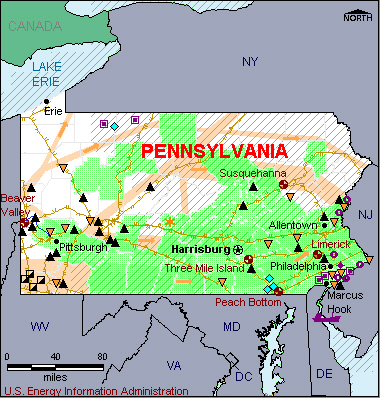









Comment: According to the PA Department of Environmental Protection's website, Pennsylvania currently has five operating power plants. Last month, two reactors at the plant in Limerick were shut down - one for the replacement of a pipe and another after an electrical issue caused a malfunction. Is there more we aren't being told?
US: Report finds high rate of thyroid cancer in eastern Pennsylvania.; blames nuclear power plants