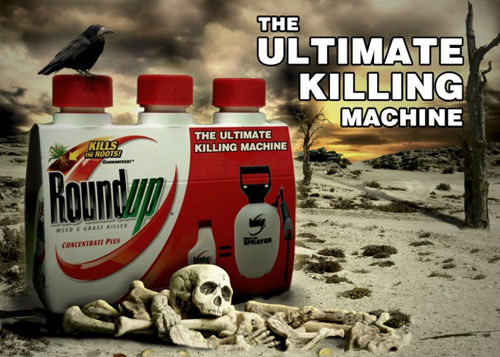
© politicalfilm.wordpress.com
There was a time when Monsanto claimed their patented herbicide Roundup was "safer than table salt" and "practically nontoxic," and aggressively marketed this message until 1996, when they were ordered by Dennis C. Vacco, the Attorney General of New York, to pull the ads.
[1]Fast forward 15 years, after millions of farmers around the world bought into the false advertising and who, as a result, are now driving the production and use of several hundred million pounds of the chemical annually, Roundup herbicide is beginning to look eerily like Monsanto's Agent Orange 2.0.
Indeed, within the scientific community and educated public alike, there is a growing awareness that
Roundup herbicide, and its primary ingredient glyphosate, is actually a broad spectrum
biocide, in the etymological sense of the word: "bio" (life) and "cide" (kill) - that is, it broadly, without discrimination kills living things, not just plants. Moreover, it does not rapidly biodegrade as widely claimed, and exceedingly small amounts of this chemical - in concentration ranges found in recently sampled rain, air, groundwater, and human urine samples - have
DNA-damaging and cancer cell proliferation stimulating effects.







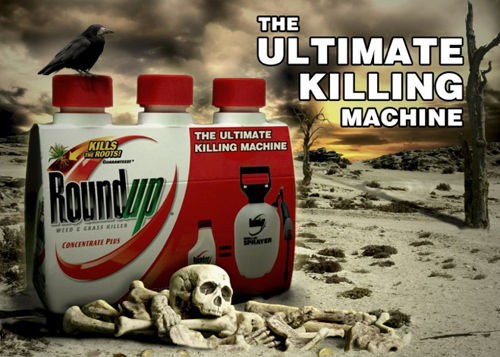




Comment: Monsanto's executive vice president of sustainability is correct in his statements, that 'glyphosate has a long track record and has been extensively studied' the results of extensive study however are not what Monsanto wants to hear or share with the wider public! Read more about the serious health concerns associated with glyphosate (RoundUp):