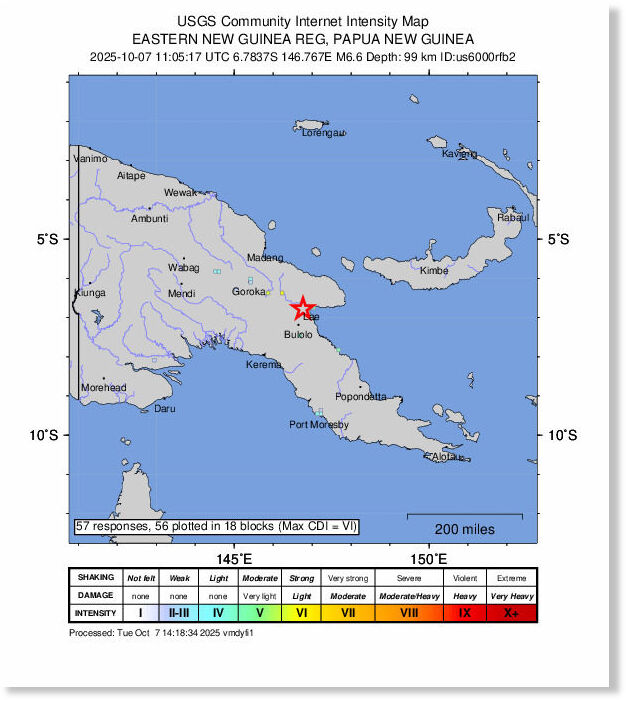
A strong 6.6 magnitude earthquake struck northern Papua New Guinea on Tuesday, according to the US Geological Survey (USGS).
The USGS originally reported a magnitude of 6.7, but later revised it down to a 6.6.
The quake originated at a depth of 99.4 kilometers (61.7 miles), 26 kilometers (16.1 miles) west of Lae, the coastal capital of the country's Morobe province
Lae, with a population of 76,255, is the country's second-largest city.
There were no immediate reports of damage or casualties.
The US Geological Survey did not issue any tsunami warning after the jolt, and both the Philippines and Australia have reported no tsunami danger to their countries.
Papua New Guinea lies along the Pacific "Ring of Fire," where most of the world's earthquakes and volcanic activity occur.
Meteorologists have measured the largest snow layer in the mountain area at 41 centimeters on Omu Peak, followed by 23 centimeters on Tarcu Peak and 15 centimeters at Balea Lake, according to the snow-meteorological bulletin issued Monday by the Transylvania South Regional Center in Sibiu.
The bulletin notes that small to medium avalanches are possible above 2,000 meters in the Fagaras and Bucegi mountains.
At over 2,000 m: in the Fagaras and Bucegi massifs, a snow layer of 20-40 cm has been recorded, wet, over which a new layer of snow will accumulate in the coming days, locally 10-30 cm and in some areas more than 30 cm near the ridges. With daytime temperatures around 0°C above 2,000 m, the layer will remain wet and unstable. In certain valleys, larger accumulations or drifts may occur. The new layer will deposit over ice crusts formed on the surface of the current layer due to overnight negative temperatures. Some small and locally medium-sized avalanches and slippages are expected, with the risk increasing where loads are heavier,' the bulletin from the Sibiu snow experts adds.
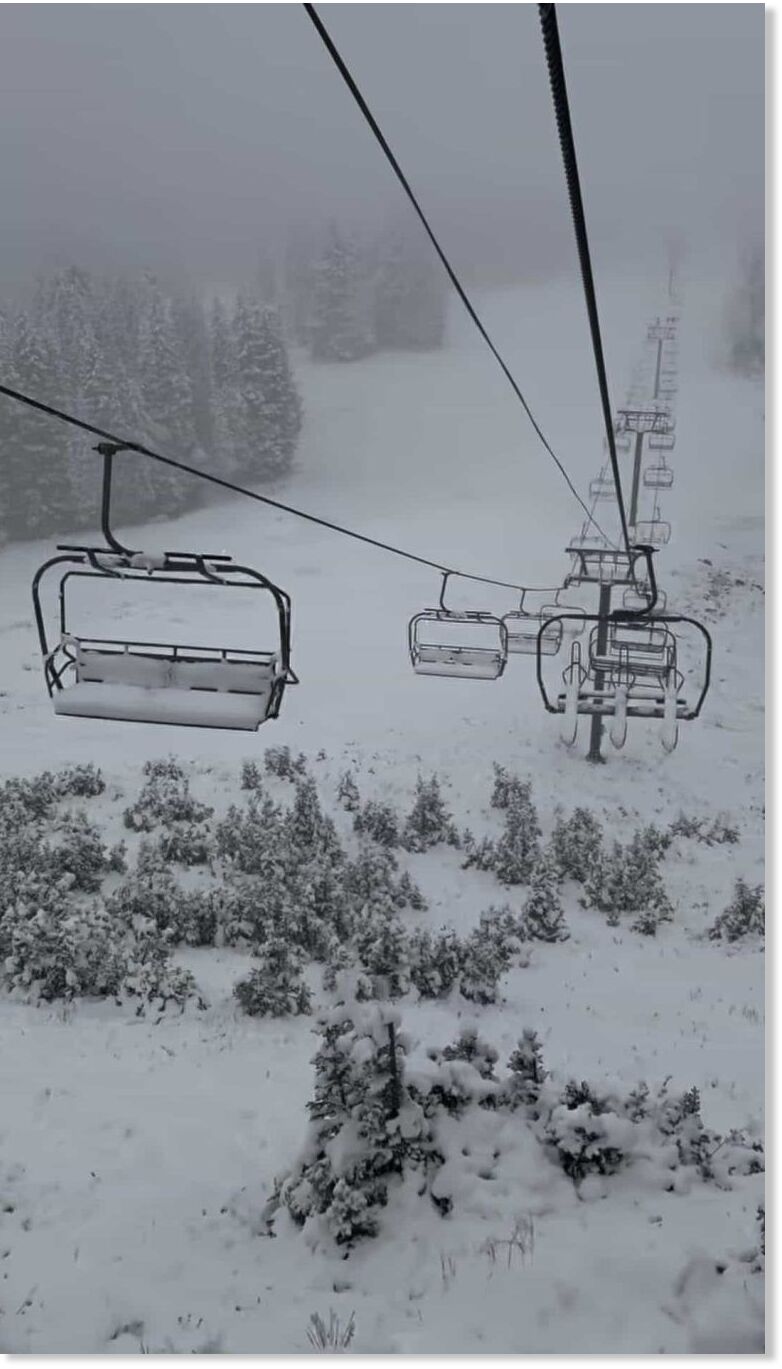
The first significant snowstorm of the 2025-26 season has blanketed parts of Utah, Wyoming, and Montana, bringing winter back to the northern Rockies. As forecasted by the SnowBrains weather force, the weekend of October 4-5 saw up to 12 inches of snow in some high-elevation regions.
This early snow band primarily affected the higher peaks and mountain ranges, including the Wyoming Wind Rivers, Big Horn Mountains, Tetons, and areas around Yellowstone, as well as Montana's Big Sky, Red Lodge, and Absaroka-Beartooth ranges. In Utah, the upper Wasatch peaks, from 10,000 to 11,000 feet, were among the hardest-hit areas. Snow accumulations ranged from 8 to 16 inches in the hardest-hit spots, according to reports.
Impressive snow levels were seen Sunday at the Long Lake road-closed gate on U.S. 212 (Beartooth Highway) between Cooke City, MT, and Red Lodge, MT, which includes 22 miles of highway inside Wyoming. Road crews are clearing snow with no time yet set for reopening.
A 2-year-old boy died after being mauled by two "large" dogs while at an allegedly unlicensed daycare in Georgia.
At around 3:45 p.m. local time on Saturday, Oct. 4, Valdosta Police Officers, Valdosta Firefighters, and the South Georgia Medical Center Emergency Medical Services responded to reports of a dog attack at a residence in the 3800 block of Pecan Drive in Valdosta, the Valdosta Police Department said in a news release shared on Facebook.
First responders arrived to find that a child — identified as Kaimir Jones, per local news outlet WALB — was already dead.
Valdosta Police Department Detectives and Crime Scene personnel soon determined that Stacy Wheeler Cobb, 48, was running an allegedly unlicensed daycare at her home, per the police news release. Their investigation revealed that Jones' mom had left him in Cobb's care for the day.
Police believe that Cobb left Jones unattended for at least two hours, allegedly telling officers she took a nap and "thought the child was well," per the police news release.
Heavy rains triggered a deadly landslide in Piedades Sur, San Ramón, Alajuela, late Saturday night, burying a family home and killing two adults and a young girl. The Red Cross confirmed the deaths early Sunday after a grueling rescue effort that lasted over five hours.
Emergency teams arrived at the scene around 11:30 p.m. following reports of the collapse. Six people were inside the house when the earth gave way. Three managed to escape on their own, but the others remained trapped under the debris. Rescuers worked through the night to locate the victims, who showed no signs of life when found.
The deceased included a minor girl and two adults, identified as her grandparents. Local reports indicate they were all part of the same family. The survivors, though shaken, did not require immediate medical attention beyond the initial checks.
At least 23 people, including seven children, were killed after heavy rainfall triggered massive landslides across the Darjeeling district in West Bengal on Sunday, officials said.
However, the situation is gradually stabilising, said DG and IG of North Bengal Police, Rajesh Kumar Yadav, who went to examine the affected sites.
The landslides flattened homes, damaged roads, and cut off access to several remote areas.
According to reports compiled by the NDRF and the district administration, fatalities were reported from several locations, including Sarsaly, Jasbirgaon, Mirik Basti, Dhar Gaon (Mechi), Nagrakata, and the Mirik Lake area.
Meanwhile, authorities in North Bengal are on high alert after Bhutan's Tala Hydropower Dam began overflowing due to a technical failure.
Hundreds of thousands of people were evacuated from their homes as Typhoon 'Matmo' made a landfall and lashed China's southern coast on Sunday, state media reported. The powerful storm made landfall around 2:50 pm in Guangdong province, according to state broadcaster CCTV. Authorities evacuated 197,000 people from their homes on Hainan Island and 150,000 from Guangdong province.
The National Meteorological Centre (NMC) recorded winds of more than 150 kilometres per hour. As the storm approached, authorities evacuated 197,000 people from their homes on Hainan Island and 150,000 from Guangdong province, according to the official Xinhua news agency on Hainan Island and 150,000 from Guangdong province, according to the official Xinhua news agency.
Public transportation, construction sites and businesses were also shuttered in coastal cities including Haikou, Wenchang, Zhanjiang, and Maoming. The city of Beihai in the south of Guangxi region also announced Sunday it would suspend work, classes and transportation.
Rescue efforts were underway on Oct 5 to clear access to campsites on Tibet's eastern slope of Mount Everest, where nearly 1,000 people have been trapped by a blizzard that blocked roads, according to Chinese state media reports.
Hundreds of villagers and rescue teams have been deployed to help remove snow blocking access to the area, which sits at an altitude above 4,900m, said a report in Jimu News.
Some tourists on the mountain have already been brought down, it added.
The snowfall began on the evening of Oct 3 and continued throughout Oct 4, according to notices on the official WeChat accounts of the Tingri County Tourism Company, which said ticket sales and entry to the Everest Scenic Area were suspended from late Oct 4.
But while the eight previous homes that collapsed in this current period of heavy surf had been in the seaside town of Buxton, Friday evening's collapse was the first of the week 25 miles farther north up the Outer Banks in Rodanthe.
Another home has been lost to the Atlantic Ocean along North Carolina's Outer Banks on Friday evening as the result of powerful waves churned in the wake of two offshore hurricanes that passed hundreds of miles offshore earlier in the week.
But while the eight previous homes that collapsed in this current period of heavy surf had been in the seaside town of Buxton, Friday evening's collapse was the first of the week 25 miles farther north up the Outer Banks in Rodanthe.
This home fell into the waves just before 6 p.m. in the 23000 block of G.A. Kohler Court, according to national park officials with Cape Hatteras National Seashore.
Last August, the Daily Sceptic drew attention to the UK Met Office inventing temperature data at its fictitious 'open' weather station at Lowestoft. Figures were said to be compiled from "well-correlated neighbouring stations", but research by citizen sleuth Ray Sanders found there were no such operations within a 40-mile radius. At the time, the Daily Sceptic referred to the matter as a "smoking gun" and said that unless the Met Office could finally reveal its workings out, "the only realistic conclusion to draw is that the data are invented". No explanation has been provided but in a shock unannounced move the Met Office has now withdrawn all the Lowestoft data from its historical record back to when the site closed in 2010. Similar withdrawals of data have also occurred in the stations at Nairm Druim and Paisley.
The move casts serious doubt over attempts by the Met Office to estimate temperature trends across many once open but now closed weather stations. Sanders is not inclined to minimise the scale of the problem facing the Met Office. When subject to "proper scrutiny", the Met Office "could not substantiate its fabrication of false data and has had to delete them in their entirety".
Comment: