BBCMon, 05 Feb 2007 07:13 UTC
We are all seeing rather less of the Sun. Scientists looking at five decades of sunlight measurements have reached the disturbing conclusion that the amount of solar energy reaching the Earth's surface has been gradually falling. Paradoxically, the decline in sunlight may mean that global warming is a far greater threat to society than previously thought.
Comment: Haven't they figured out that Global Dimming might mean that there is more to "Global Warming" than human activity?
APSun, 04 Feb 2007 23:38 UTC
A strong earthquake shook parts of Cuba, Jamaica and the Cayman Islands today. There were no immediate reports of damages or injuries.
The quake had a preliminary magnitude of 6.1 and was centred in the Caribbean Sea about 120km north-west of Montego Bay, Jamaica, and 200km south-west of Bayamo, Cuba, according to the US Geological Survey in Colorado. It occurred just before 4pm local time (9pm Irish time).
PRESS RELEASE: Monday, August 18, 2003
Until ten years ago, most astronomers did not believe stardust could enter our Solar System. Then ESA's Ulysses spaceprobe discovered minute stardust particles leaking through the Sun's magnetic shield, into the realm of Earth and the other planets. Now, the same spaceprobe has shown that a flood of dusty particles is heading our way.
ABCWed, 26 Jul 2006 06:06 UTC
Astronomers at the University of Tasmania have found that the solar system's smallest planet is not getting colder as first thought and it probably does not have rings.
MITWed, 09 Oct 2002 06:04 UTC
BIRMINGHAM, Ala.--Pluto is undergoing global warming, as evidenced by a three-fold increase in the planet's atmospheric pressure during the past 14 years, a team of astronomers from Massachusetts Institute of Technology (MIT), Williams College, the University of Hawaii, Lowell Observatory and Cornell University announced in a press conference today at the annual meeting of the American Astronomical Society's (AAS) Division for Planetary Sciences in Birmingham, AL.
NASATue, 20 Sep 2005 05:59 UTC
New gullies that did not exist in mid-2002 have appeared on a Martian sand dune.
That's just one of the surprising discoveries that have resulted from the extended life of NASA's Mars Global Surveyor, which this month began its ninth year in orbit around Mars. Boulders tumbling down a Martian slope left tracks that weren't there two years ago. New impact craters formed since the 1970s suggest changes to age-estimating models. And for three Mars summers in a row, deposits of frozen carbon dioxide near Mars' south pole have shrunk from the previous year's size, suggesting a climate change in progress.
"Our prime mission ended in early 2001, but many of the most important findings have come since then, and even bigger ones might lie ahead," said Tom Thorpe, project manager for Mars Global Surveyor at NASA's Jet Propulsion Laboratory, Pasadena, Calif. The orbiter is healthy and may be able to continue studying Mars for five to 10 more years, he said.
Mars years are nearly twice as long as Earth years. The orbiter's longevity has enabled monitoring of year-to-year patterns on Mars, such as seasonal dust storms and changes in the polar caps. "Mars is an active planet, and over a range of timescales changes occur, even in the surface," said Dr. Michael Malin of Malin Space Science Systems, San Diego, principal investigator for the Mars Orbiter Camera on Mars Global Surveyor.
NASAMon, 08 Dec 2003 05:57 UTC
Mars may be going through a period of climate change, new findings from NASA's Mars Odyssey orbiter suggest.
Odyssey has been mapping the distribution of materials on and near Mars' surface since early 2002, nearly a full annual cycle on Mars. Besides tracking seasonal changes, such as the advance and retreat of polar dry ice, the orbiter is returning evidence useful for learning about longer-term dynamics.
The amount of frozen water near the surface in some relatively warm low-latitude regions on both sides of Mars' equator appears too great to be in equilibrium with the atmosphere under current climatic conditions, said Dr. William Feldman of Los Alamos National Laboratory, N.M. He is the lead scientist for an Odyssey instrument that assesses water content indirectly through measurements of neutron emissions.
"One explanation could be that Mars is just coming out of an ice age," Feldman said. "In some low-latitude areas, the ice has already dissipated. In others, that process is slower and hasn't reached an equilibrium yet. Those areas are like the patches of snow you sometimes see persisting in protected spots long after the last snowfall of the winter."
Frozen water makes up as much as 10 percent of the top meter (three feet) of surface material in some regions close to the equator. Dust deposits may be covering and insulating the lingering ice, Feldman said. He and other Odyssey scientists described their recent findings today at the fall meeting of the American Geophysical Union in San Francisco.


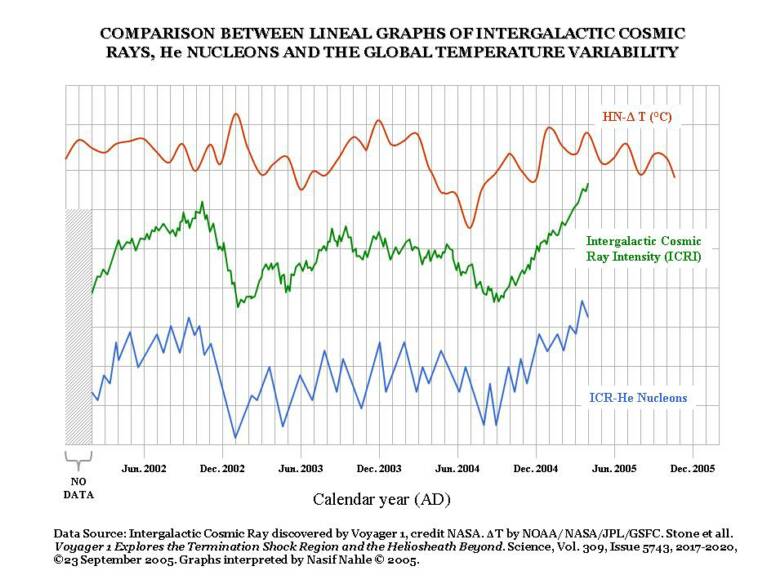




Comment: Haven't they figured out that Global Dimming might mean that there is more to "Global Warming" than human activity?