Earth ChangesS


Attention

Strong 6.8 Earthquake Jolts North East India

An earthquake with an intensity of 6.8 on the Richter Scale today jolted the northern and eastern parts of the country.


The India Meteorological Department (IMD) said in Delhi that the quake occurred at 6.10 pm with its epicentre near Sikkim-Nepal border.

The quake was also felt in certain parts of the national capital.

Bug

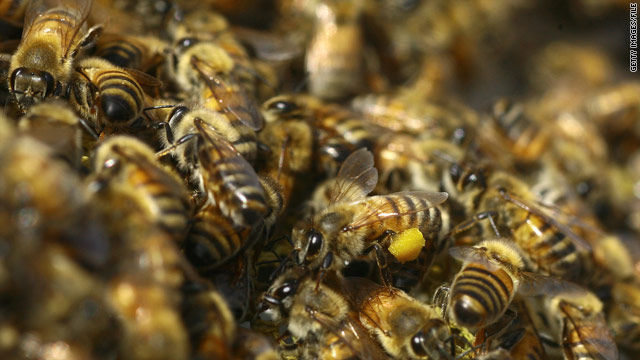
Hives bigger, killer bees meaner this year, say experts after attacks

Image
© GettyA killer bee expert says it's been a record year for big hives
Are the killer bees meaner than ever in 2011? The Killer Bee Guy thinks so.

They're much more ornery this year, according to Reed Booth, also know as The Killer Bee Guy. "This is the worst I've seen in 10 years," Booth told CNN affiliate KOLD-TV in Tucson this week.

Booth spoke after taking out a 200-pound hive of a quarter-million killer bees on a Bisbee farm earlier this week. The bees had swarmed after their hive in an outbuilding on the farm was disturbed. They killed a 1,000-pound hog and and sent a pregnant 800-pound sow into a coma. The piglets were lost, KOLD reported.

"A thousand-pound pig is a huge thing," Booth said. "I'm kinda surprised that they did kill it."

Farmer Jane Hewitt said the attack was frightening.

"I jumped into a car but the passenger side window was down, and they came in a black cloud towards me. I tried to swat at them and get them out the drivers side window," she told KOLD.

Fish

Georgia, US: New Ogeechee Swim Advisory After Report s of "Skin Sores"

New concerns in the Ogeechee River tonight. This comes just a few months after a fish kill wiped out tens of thousands of fish.


Better Earth

US: Magnetic pole shift means new Hillsboro runway name

hillsboro,airport

The slowly drifting location of Earth's magnetic north pole means the Hillsboro Airport's main runway underwent a name change early this week - from 12/30 to 13/31.

The new numbers were painted at one end of the runway early this week as part of general maintenance, said a spokeswoman for the Port of Portland, which owns and operates the airport.

Pilots and clients of the airport were mailed notices to be on the lookout for the runway work, but the airport was never shut down, as was rumored, said spokeswoman Kama Simonds.

Bizarro Earth

Something Odd Is Happening With Namibia's Weather

Nambia's Weather
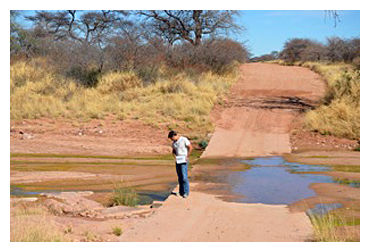
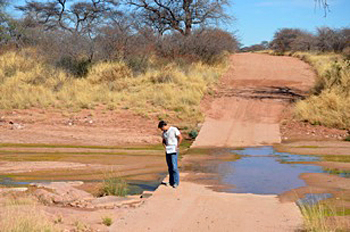
© Paul Bierman, UVMNormally dry Namibia river crossings weren’t dry this year; geologist Kyle Nichols stands in one.
Something's up with the weather in Namibia, say geoscientists Kyle Nichols of Skidmore College in Saratoga Springs, N.Y., and Paul Bierman of the University of Vermont in Burlington, Vt.

Nichols and Bierman should know. They're just back from the western mountains and coastal plain of this sparsely populated African country.

Usually, western Namibia is a dusty place where the stream beds are sand and the "lakes" are nothing more than flats of dried mud.

Not now.

This year, rivers with names like Swakop and Omaruru and Kuiseb flowed all the way to the sea - something they don't do often, "maybe once a decade," says Bierman.

The rivers didn't just flow for a day or two, Nichols and Bierman say, they ran from the desert to the ocean for weeks on end.

"There was so much water," says Bierman, "that people went swimming, they went tubing, and the desert turned green around rivers carrying so much sediment they were chocolate-brown."

The rains were unprecedented in both their intensity and duration. "There's nothing like this widespread, heavy rain in the historic record," says Nichols.

The two geoscientists have been working for more than a decade in Namibia, collecting samples of rock and river sediment and bringing them back for analysis at the University of Vermont (see Cosmogenic Nuclide Laboratory and Geomorphology Research Group's website).

Bizarro Earth

Stench From Arabian Sea Due to Geological Factor, Says Researcher

Stench From Sea
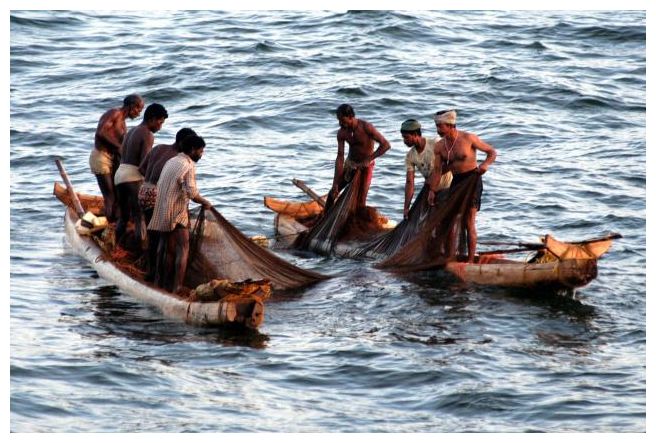
© Ratheesh Kumar / The HinduFishermen from Valiathura in Kerala starting their fishing operation in the Arabian Sea.

With a foul smell emanating from the sea in some parts of Kerala in the last few days, scientists have said there was no cause for anxiety but are divided on the reasons behind the phenomenon.

Some scientists have attributed this to the large mass of marine algae killed by lowering of salinity owing to influx of fresh water from rivers and run-off but another state-based researcher disagrees with it and said the phenomenon was due to seismic factors.

A team of researchers from Kerala University, which studied the phenomenon reported from coastal areas off Kollam and Thiruvananthapuram had held the foul smell was attributable to the bacterial decay of a possible algal bloom.

The researchers of the university's Department of Aquatic Biology and Fisheries led by A Biju Kumar have recommended to the government close monitoring of coastal waters to identify the presence of algal bloom that could produce toxins.

They said they reached the conclusion based on examination of various parameters like the colour of the sea, salinity, temperature, pH nutrients, plankton, microbes and fish mortality.

However, Dr Sainudeen Pattazhy, Associate Professor of Zoology in SN College Kollam, said the stench was linked to seismic phenomena like tremors of moderate intensity that had been experienced in several districts of Kerala and other states recently.

Bizarro Earth

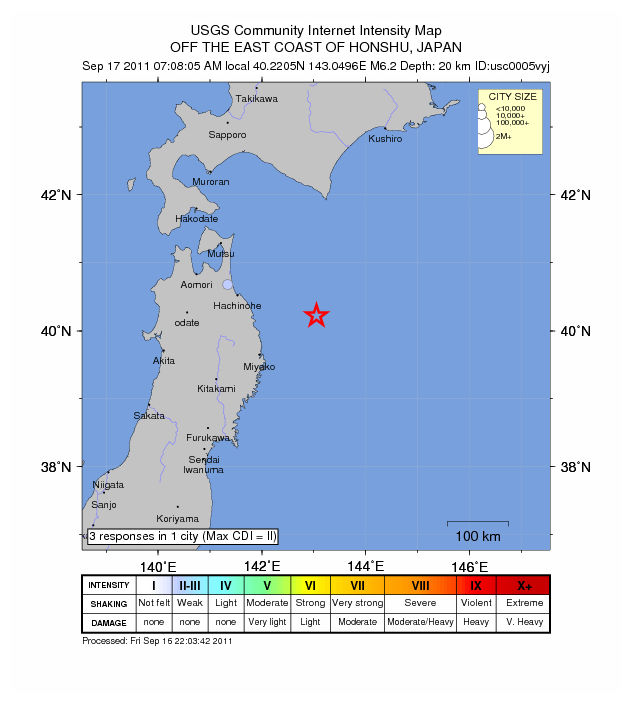
Off the East Coast of Honshu, Japan - Earthquake Magnitude 6.2

Honshu Quake2_160911
© USGSEarthquake Location
Date-Time:
Friday, September 16, 2011 at 21:08:05 UTC

Saturday, September 17, 2011 at 07:08:05 AM at epicenter

Time of Earthquake in other Time Zones

Location:
40.221°N, 143.050°E

Depth:
20.2 km (12.6 miles)

Region:
OFF THE EAST COAST OF HONSHU, JAPAN

Distances:
137 km (85 miles) ESE of Hachinohe, Honshu, Japan

172 km (106 miles) ENE of Morioka, Honshu, Japan

205 km (127 miles) ESE of Aomori, Honshu, Japan

580 km (360 miles) NNE of TOKYO, Japan

Bizarro Earth

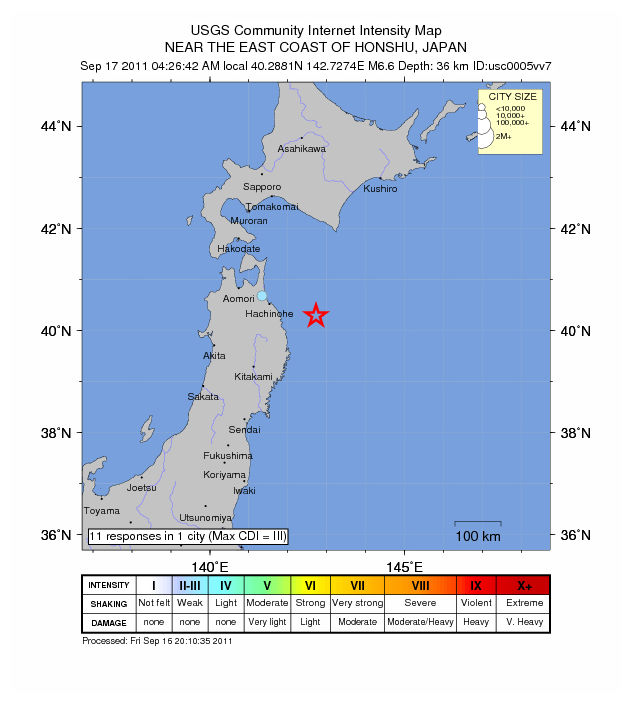
Near the East Coast of Honshu, Japan - Earthquake Magnitude 6.6

Honshu Quake_160911
© USGSEarthquake Location
Date-Time:
Friday, September 16, 2011 at 19:26:42 UTC

Saturday, September 17, 2011 at 04:26:42 AM at epicenter

Time of Earthquake in other Time Zones

Location:
40.288°N, 142.727°E

Depth:
36.3 km (22.6 miles)

Region:
NEAR THE EAST COAST OF HONSHU, JAPAN

Distances:
108 km (67 miles) ESE of Hachinohe, Honshu, Japan

149 km (92 miles) ENE of Morioka, Honshu, Japan

177 km (109 miles) ESE of Aomori, Honshu, Japan

574 km (356 miles) NNE of TOKYO, Japan

Butterfly

Cold UK Summer Hits Butterflies

Image
© Unknown
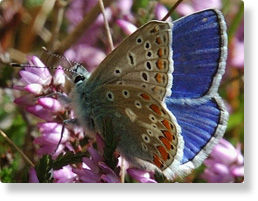
UK butterflies have suffered following the coldest summer for 18 years, the world's biggest butterfly count has revealed. More than 34,000 people took part in the Big Butterfly Count 2011, seeing 322,000 butterflies and day-flying moths. But the survey, by Butterfly Conservation, found that the average number of individual butterflies seen per count was down by 11% compared with last year's figures. The Common Blue butterfly was the biggest loser with numbers down by 61%.

The survey also revealed something of a North/South divide for one species with three times as many Small Tortoiseshells recorded per count in Scotland than in England. Hopes had been high for a bumper butterfly summer after parts of the UK basked in a record-breaking warm, dry spring. But the balmy conditions gave way to chilly temperatures and prolonged spells of rain as the summer of 2011 became the coldest since 1993.

Butterfly activity is impaired by low temperatures and heavy rain so they are unable to fly, feed, find mates or lay eggs during bad weather. Richard Fox, Butterfly Conservation Surveys Manager said: "The fantastic response of the UK public to Big Butterfly Count 2011 has given us a detailed snapshot of how butterflies fared this summer. Twice as many counts were carried out this year as in 2010.

Radar

Canada: 4.1 Earthquake hits off Vancouver Island

Image
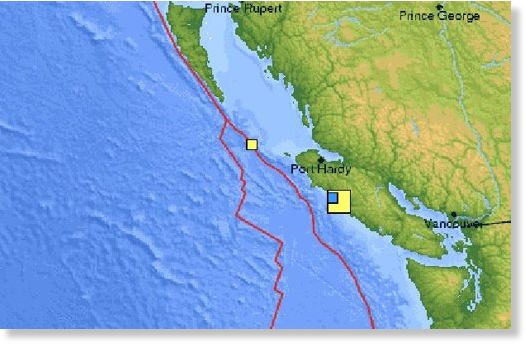
© Times Colonist4.1 Earthquake hits off Vancouver Island
Another earthquake has struck off the coast of Vancouver Island Thursday morning, the second to hit the region in a week.

According to the U.S. Geological Survey, the 4.1 magnitude quake struck about 25 kilometres off Nootka Sound in Northwestern Vancouver Island, roughly in the same area as a 6.3 earthquake that struck last Friday.

The quake happened roughly around 4 a.m. this morning, USGS indicates.

No tsunami warning has been issued, and there has been no reports of damage or injuries.

Meanwhile, a magnitude 6 earthquake occurred in the Caribbean Sea off the southern coast of Cuba on Thursday, but there were no immediate reports of any damage on the island.