Earth ChangesS


Phoenix

US: Minnesota Wildfire Now 19 Percent Contained

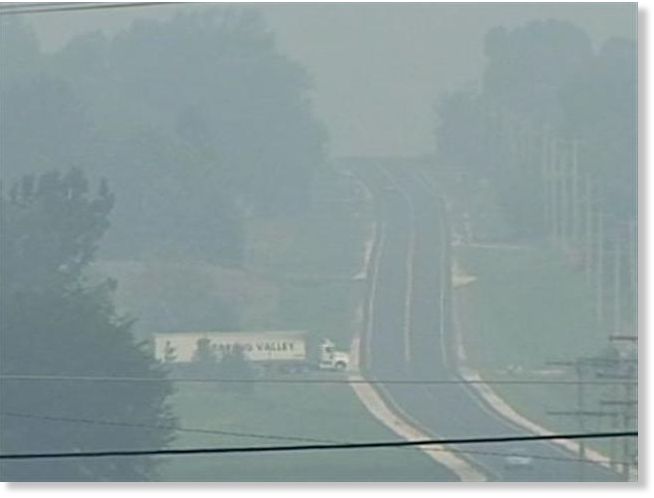
mn wildfire smoke
© WISN Milwaukee
Hundreds of firefighters continue to make progress in containing a huge wildfire in northeastern Minnesota that began a month ago.

A spokesman for the firefighters, Larry Helmerick, said Monday the 147-square-mile fire in the Boundary Waters Canoe Area Wilderness is 19 percent contained, an improvement from 11 percent on Sunday.

Helmerick says 598 firefighters are on the ground in the Boundary Waters, where helicopters, tankers and bulldozers are being used to battle the blaze that started with a lightning strike Aug. 18.

Smoke from the blaze traveled nearly 400 miles to Southeast Wisconsin early last week. Two days of smoke and ash prompted air quality alerts across southern Wisconsin.

Life Preserver

US: Nebraska flood victims must decide to rebuild, demolish or burn homes

Nebraska Flood Home
© ERIC GREGORY/Lincoln Journal StarFloodwaters in John Adkins' Plattsmouth home reached nearly the windows this summer. It now stands empty and filled with reeking mold from floor to ceiling.
As the Missouri River recedes, flood victims like Marilyn Roueche of Plattsmouth are returning home and finding what little is left of their former lives.

"The mold is so terrible in there. It's just unbelievable. It's on the ceiling and everywhere. It's eating the walls. And the cupboard doors -- they're falling off," Roueche said.

She and her husband, John Adkins, took most of their belongings and left their house along the river June 8. They rented a house in Plattsmouth and returned for the first time Sept. 6.

Inside their house, they found a stinking mess. Black, toxic mold. Seven feet of water in the basement. Floating sewage residue.

Their house appears to be a total loss. They are waiting for the insurance adjuster to make that decision and issue them a check.

Bizarro Earth

18 Dead in India, Nepal After Magnitude-6.9 Quake

Nepalese personnel in Kathmandu
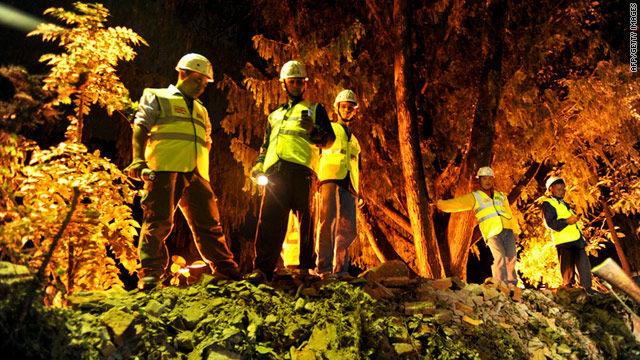
© CNNNepalese personnel in Kathmandu stand on the rubble of a British Embassy wall that collapsed in Sunday's earthquake.
At least 18 people -- 13 in India and five in Nepal -- died when a magnitude-6.9 earthquake struck the northern Indian state of Sikkim near the border between the two nations Sunday night, local government officials told sister network CNN-IBN.

The dead include three in Nepal's capital of Kathmandu, who died when a wall of the British embassy collapsed, according to Kedar Rijal, Kathmandu police chief. They included an 8-year-old girl, her father and a third person.

The British Foreign Office confirmed a "compound perimeter wall" of the embassy collapsed, adding that its ambassador has met with the community and offered condolences.

Police said in a statement that two more people died in the Nepalese town of Dhara, about 217 miles east of Kathmandu. About a dozen people were injured when they jumped from their houses during the quake, police said.

Cloud Lightning

Pakistan Floods: World Ignoring Humanitarian Crisis

The world is ignoring a growing humanitarian crisis in Pakistan's Sindh province where a second year of catastrophic floods has forced up to two million to flee their homes, washed away vital crops and left millions at risk of disease, according to aid agencies and local political leaders.


Info

25 Signs That A Horrific Global Water Crisis Is Coming

steer skull @ desert
© n/a
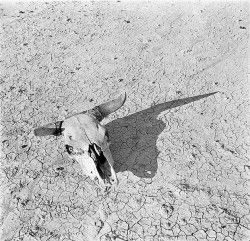
Every single day, we are getting closer to a horrific global water crisis. This world was blessed with an awesome amount of fresh water, but because of our foolishness it is rapidly disappearing. Rivers, lakes and major underground aquifers all over the globe are drying up, and many of the fresh water sources that we still have available are so incredibly polluted that we simply cannot use them anymore. Without fresh water, we simply cannot function. Just imagine what would happen if the water got cut off in your house and you were not able to go out and buy any. Just think about it. How long would you be able to last? Well, as sources of fresh water all over the globe dry up, we are seeing drought conditions spread. We are starting to see massive "dust storms" in areas where we have never seem them before. Every single year, most of the major deserts around the world are getting bigger and the amount of usable agricultural land in most areas is becoming smaller. Whether you are aware of this or not, the truth is that we are rapidly approaching a breaking point.

If dramatic changes are not made soon, in the years ahead water shortages are going to force large groups of people to move to new areas. As the global water crisis intensifies, there will be political conflicts and potentially even wars over water. We like to think of ourselves as being so "advanced", but the reality is that we have not figured out how to live without water. When the water dries up in an area, most of the people are going to have to leave.

And yes, it will even happen in the United States too. For example, once Lake Mead dries up there is simply no way that so many people are going to be able to live in and around Las Vegas.

Nuke

Massive New Radiation Releases Possible from Fukushima ... Especially If Melted Core Materials Hit Water

Fukushima
© n/a
Governments Underreported Severity of Fukushima

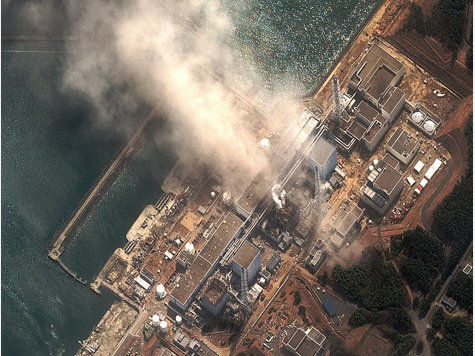
As I've noted for 6 months, the Japanese and U.S. governments have continually under-reported the severity of the nuclear crisis at Fukushima.

The Wall Street Journal points out:
The Japanese government initially underestimated radiation releases from the Fukushima Daiichi nuclear plant, in part because of untimely rain, and so exposed people unnecessarily, a report released this week by a government research institute says.
PhysOrg writes:
The amount of radiation released during the Fukushima nuclear disaster was so great that the level of atmospheric radioactive aerosols in Washington state was 10,000 to 100,000 times greater than normal levels in the week following the March 11 earthquake and tsunami that triggered the disaster.

***

[A] study [by University of Texas engineering professor Steven Biegalski and researchers at the Pacific Northwest National Laboratory] reports that more radioxenon was released from the Fukushima facilities than in the 1979 meltdown at the Three Mile Island Nuclear Generating Station in Pennsylvania and in the 1986 Chernobyl nuclear disaster in the Ukraine.

Biegalski said the reason for the large release in Fukushima, when compared to the others, is that there were three nuclear reactors at the Japan facilities rather than just one.

Fish

Another mass die-off: Millions of fish found dead in China

fish kill,china
© ChinaDailyMillions of dead fish have been found in several townships in the county since Aug 31, with reported loss of up to hundreds of millions yuan. The cause of the mass death remains unknown.

Two days before the massive 9.0+ magnitude earthquake struck off the coast of Japan, millions of dead fish were found mysteriously blanketing waters at King Harbor Marina in Redondo Beach, California.

And in a similar turn of events, millions of dead fish were recently discovered floating in China's Minjiang River -- just a coincidence, or a sign of worse things to come?

What's on Xiamen, a Chinese news source, reports that countless millions of dead fish were found floating on a large portion of the Minjiang River stretching from Huangtian in Gutian County, to Shuikou, an area that represents the largest grass carp breeding region in China's Fujian Province. As many as nine million fish have reportedly died in Huangtian alone, thus far.

Bizarro Earth

Scientists Concerned By Continued Eruptions At Alaskan Volcano

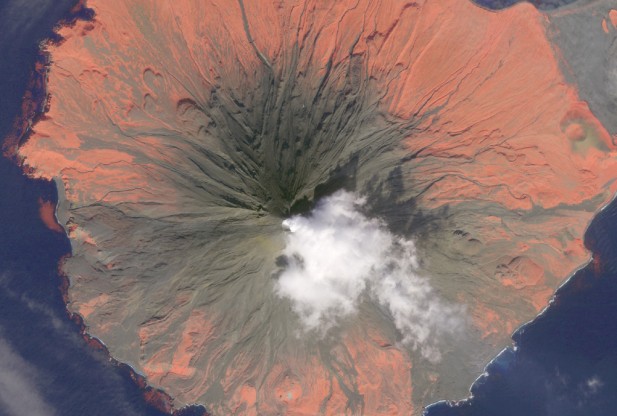
Cleveland Volcano
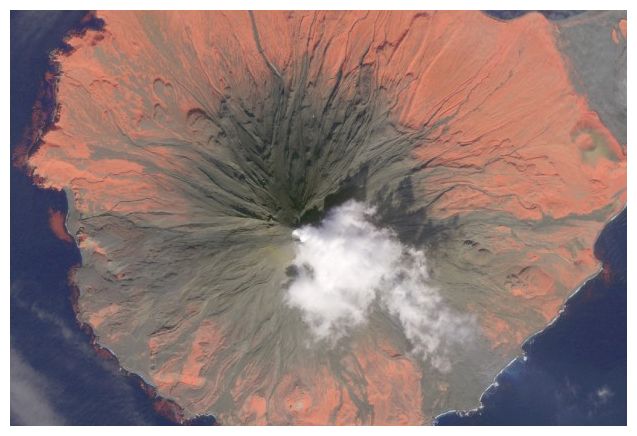
© 2010 – GeoEyeThis GeoEye IKONOS image shows a faint plume issuing from Cleveland Volcano at 2:31 PM on September 14, 2010. Red in this image highlights areas of vegetation detected by the near-infrared channel.
The two-month long, low-level eruptions occurring at a volcano in Alaska's Aleutian Islands have volcanologists worried that there could be a larger eruption forthcoming, Yereth Rosen of Reuters reported on Friday.

The volcano causing concern is Cleveland Volcano (also known as Mount Cleveland), a 5,676-foot peak located less about 940 miles southwest of Anchorage.

As previously reported here on RedOrbit, an eruption warning was issued by the Alaska Volcano Observatory in late July.

At that time, the Daily Mail warned that Cleveland Volcano "could be poised for its first big eruption in ten years," and that experts believed that it could "erupt at any moment, spewing ash clouds up to 20,000 feet above sea level with little further warning."

Nearly eight weeks later, such an eruption remains a definite possibility.

"The big thing we're concerned about is an explosive eruption," Steve McNutt of the University of Alaska Fairbanks, a coordinating scientist for the observatory, told Rosen.

Such an eruption, the Reuters reporter says, could come with "little warning." Satellite imagery has reportedly shown a lava dome growing inside the volcano's crater, and the observatory has reports that Mount Cleveland continues to generate heat. To date, there have been no signs of ash clouds, Rosen said, but those, too, could come with little warning.

Bizarro Earth

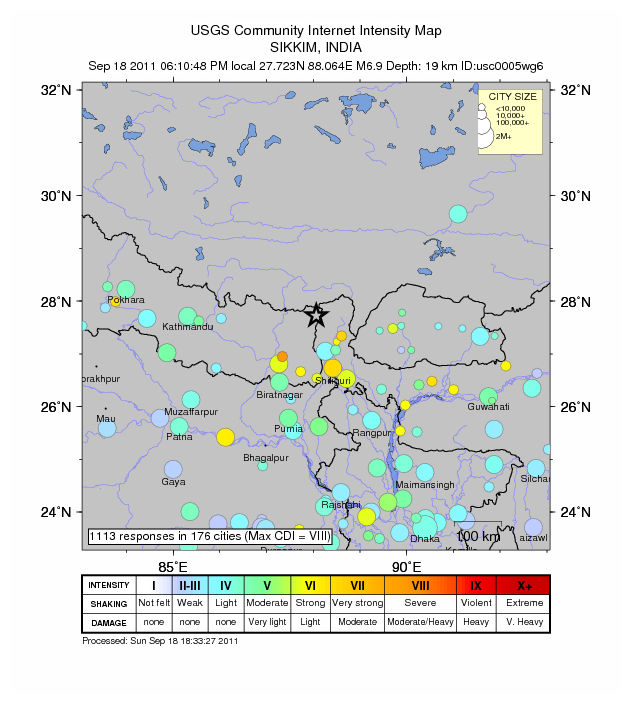
Sikkim, India - Earthquake Magnitude 6.9

Sikkim Quake_180911
© USGSEarthquake Location
Date-Time:
Sunday, September 18, 2011 at 12:40:48 UTC

Sunday, September 18, 2011 at 06:10:48 PM at epicenter

Time of Earthquake in other Time Zones

Location:
27.723°N, 88.064°E

Depth:
19.7 km (12.2 miles)

Region:
SIKKIM, INDIA

Distances:
68 km (42 miles) NW of Gangtok, Sikkim, India

119 km (73 miles) NNW of Shiliguri, West Bengal, India

272 km (169 miles) E of KATHMANDU, Nepal

572 km (355 miles) N of Kolkata (Calcutta), West Bengal, India

Bizarro Earth

US: Alaska - Aleutian volcano's behavior a challenge for scientists

Image
© Unknown
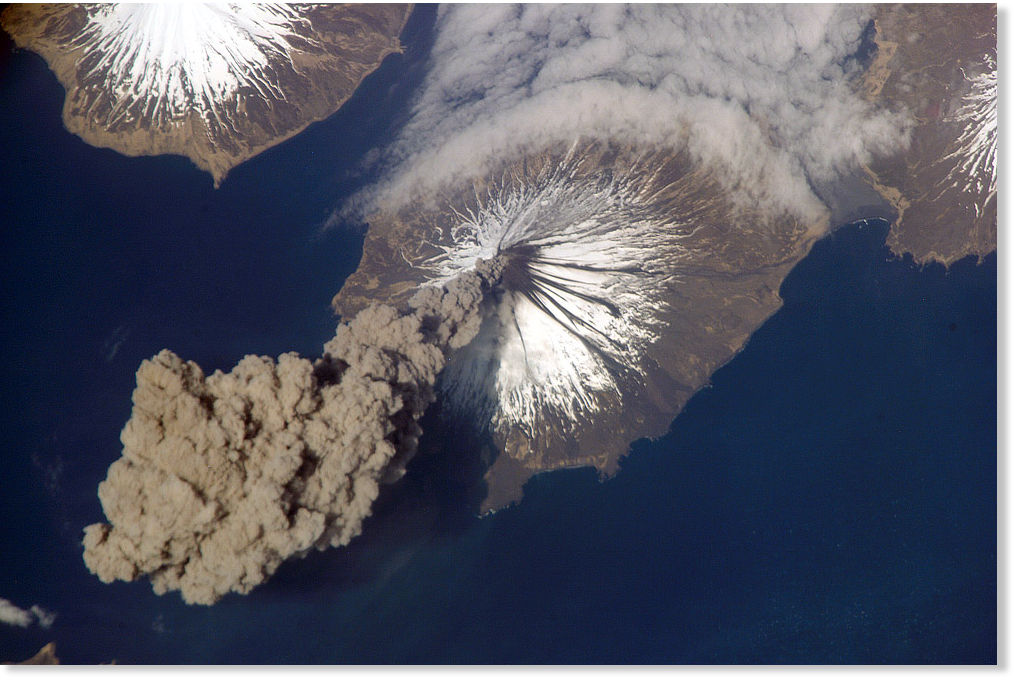
A volcano in Alaska's Aleutian Islands has been in an unusual low-level eruption for two months, raising the spectre of an explosive eruption with little warning, officials at the Alaska Volcano Observatory said on Friday.

Cleveland Volcano, a 5,676-foot peak located 940 miles southwest of Anchorage, continues to expel lava out its crater, a low-level eruption that began in mid-July, scientists at the Alaska Volcano Observatory said.

Satellite imagery shows a lava dome growing inside the volcano's crater. Satellite data also shows continued heat generated from the volcano, according to the observatory, a joint federal-state organization.

So far, there have been no signs of ash clouds. But those could come with little warning, scientists said. "The big thing we're concerned about is an explosive eruption," said Steve McNutt of the University of Alaska Fairbanks, a coordinating scientist for the observatory.