Earth ChangesS


Bizarro Earth

Mystery of Canada's Missing Salmon Continues

Sockeye Salmon
© Werner Van Steen / Getty ImagesThe number of sockeye salmon (Oncorhynchus nerka) in the Fraser River has fallen dramatically over the past two decades.

Multi-million dollar judicial inquiry expected to offer few solutions to declining fish stocks.

As the last of this year's sockeye salmon battle up the Fraser River along the southern outskirts of Vancouver, Canada, a rather longer battle about the fishes' fate is drawing to a close in a staid courtroom downtown.

More than 4.5 million salmon have surged along the Fraser this year, returning to spawn before dying. But that is far fewer than the sockeye runs of 20 years ago, when the river was the world's single largest source of Pacific salmon, contributing hundreds of millions of dollars each year to British Columbia's economy.

Back in 2009, when just 1.5 million out of a forecasted 10.6 million fish returned to the river, Prime Minister Stephen Harper called for a judicial inquiry into the missing salmon and appointed Bruce Cohen, Justice of the Supreme Court of British Columbia, to preside over the mammoth task. The last of the inquiry's 128 witnesses are taking to the stand this month. Yet scientists and the public are questioning whether the Cohen Commission, which has cost an estimated CAN$25 million (US$24.4 million), has been a waste of time.

Bizarro Earth

US: Washington - Earthquake-Magnifying Pocket Beneath Seattle Seen in New Detail

Seismogram
© DreamstimeSeismogram.
The deep basin that lies beneath Seattle is a source of seismic worry for scientists because the shape and material of the basin amplify ground shaking. Scientists hope that new research into the nature of this basin could help predict the seismic hazards this area faces.

The basin under Seattle essentially holds complex layers of sediment within a bowl of rock. Such basins can trap and focus seismic energy within them. This is due to how different materials conduct seismic waves - they move slower in sediment layers than in solid rock.

This difference in the velocity of seismic waves in sediments versus rock in the Seattle basin "causes the seismic waves to bend, just like a lens in your glasses bends light, and sometimes to become focused into a particular area," explained researcher Andrew Delorey, a seismologist at the University of Washington in Seattle. In addition, "once seismic waves enter the basin, they can become trapped by reflecting off the boundaries," Delorey told OurAmazingPlanet.

Bizarro Earth

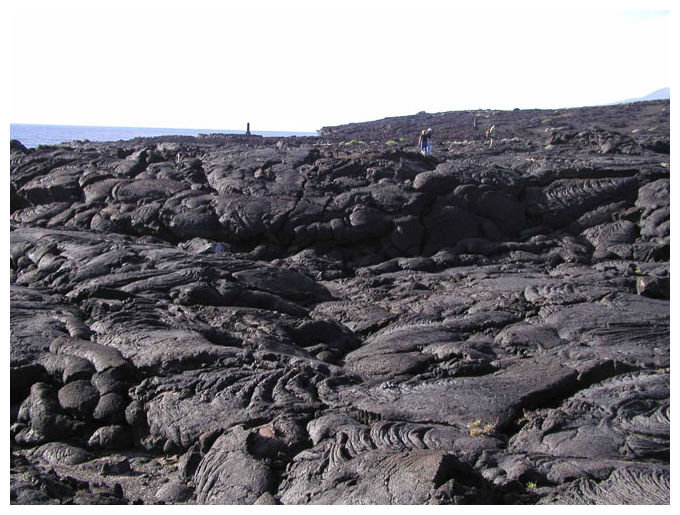
Increasing Indications of a Potential Eruption at El Hierro?

El Hierro
© Wired.comPotentially young pahoehoe lava flows at El Hierro in the Canary Island.
We've been closely watching the earthquake swarm at the Canary Island's El Hierro since the middle of the summer and it looks like there has been a dramatic increase in the number and intensity of the seismicity at the volcano. Since mid-July, the small island, which is the top of a shield volcano built by the Canary Hotspot, has registered over 8,000 earthquakes - check out the excellent video of the changing depth and location of seismicity put together by Eruptions reader Lurking (or is it GeoLurking now?) Until recently, the earthquakes have not been noticeable to the people living on El Hierro, but since Monday, multiple ~M3-4 earthquakes have occurred, with 30 earthquakes alone on Monday*.

Interestingly, if you look at the distribution of the earthquakes (see below), the earthquakes over the last few days are deeper than those 4 days ago or older. Many are centered 14-16 km below the surface of the volcano, putting them into the upper mantle, the likely source of the magma in the Canary Hotspot plume. The increasing seismicity and intensity might suggest that an eruption is in the cards, but you would really expect the earthquakes should be getting shallower as magma nears the surface and right now, it doesn't appear to be the case. Maria Jose Blanco, director of the National Geographic Institute on the Canaries puts the chances of an eruption in the near future at ~10%, although carbon dioxide emissions are steadily rising (spanish), another clue on new magma degassing under the volcano.

Comment: For additional data see Canary Islands Government Raises El Hierro Volcanic Risk Level.


Telescope

"Dark" Supermoon September 27th: New Moon Gets Closest to Earth

super moon
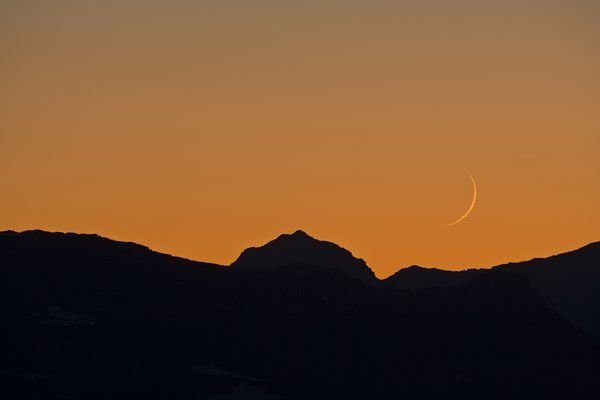
© Michael Melford, National GeographicA crescent moon is barely visible as the sun sets over Montana in a 2008 picture.
Tomorrow night the new moon will make a close approach to Earth, giving rise to the second supermoon of the year - but this one will have the power of invisibility.

Because the moon's orbit is egg shaped, there are times in the roughly monthlong lunar cycle when the moon is at perigee - its closest distance to Earth - or at apogee, its farthest distance from Earth.

"A supermoon occurs when the moon is at perigee and it's in either a full or new phase," said Raminder Singh Samra, an astronomer at the H.R. MacMillan Space Centre in Vancouver, Canada.

In March sky-watchers were treated to a full moon at perigee, which made for the biggest full moon seen in 18 years.

(See "Supermoon Pictures: Best Shots of Biggest Full Moon.")

Info

Earth's Annual Resources Used Up Today, Group Says

Earth's Resources
© SeaWiFS Project, NASA/Goddard Space Flight Center, and ORBIMAGEGray haze coats northeastern China in this NASA satellite image. The Global Footprint Network estimates that today (Sept. 27) is the day humans have outstripped the Earth's ability to provide renewable resources and absorb waste for the year.
It's only September, but humans have used up the Earth's natural resources for the year, according to a sustainability nonprofit group.

The Global Footprint Network (GFN) has declared today (Sept. 27) "Earth Overshoot Day." That's the day when humankind's demand on nature exceeds the planet's ability to regenerate resources and absorb the waste.

"Our research shows that in approximately nine months, we have demanded a level of services from nature equivalent to what the planet can provide for all of 2012," according to a GFN statement. "We maintain this deficit by depleting stocks of things like fish and trees, and by accumulating waste such as carbon dioxide in the atmosphere and the ocean."

Fish

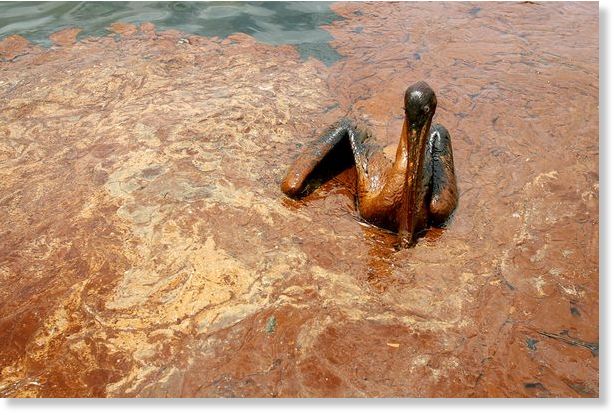
Gulf Oil Spill Could Cause Lasting Damage to Fish Populations, Study Finds Cell Abnormalities and Toxicity

Image
Fish living in Gulf of Mexico marshes exposed to last year's oil spill have undergone cellular changes that could lead to developmental and reproductive problems, a group of researchers reported Monday in the journal Proceedings of the National Academy of Sciences.

The study, which was funded by the National Science Foundation and the BP-funded Gulf of Mexico Research Initiative, suggests scientists are just beginning to capture the spill's ecological impact. The team of researchers from Louisiana State, Texas State and Clemson universities focused on the killifish, a minnowlike fish that is abundant and a good indicator of the health of wetlands.

Killifish residing in areas affected by the spill showed cell abnormalities, including impaired gills, two months after the oil had disappeared, researchers found. Killifish embryos exposed in the lab to water from the same site, which had only trace amounts of chemicals in it, developed cellular abnormalities as well.

Bizarro Earth

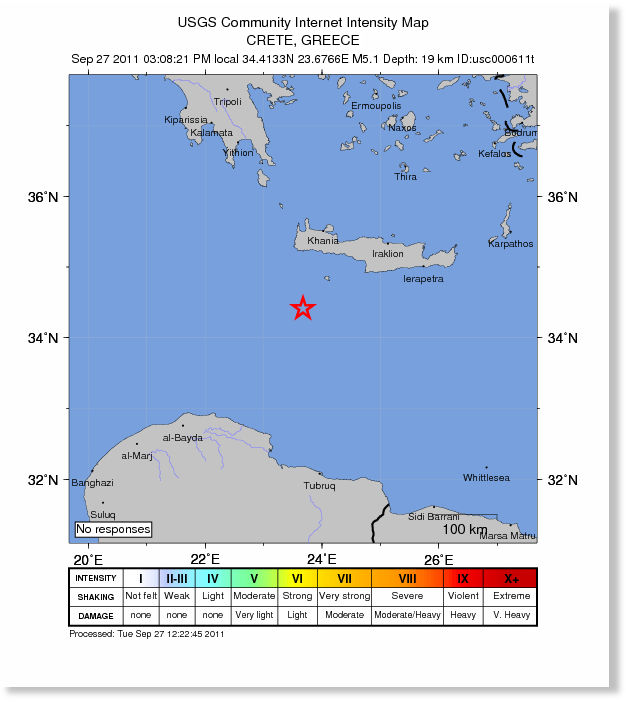
Greece: Earthquake Magnitude 5.1 - Crete

Image
© USGS
Date-Time:
Tuesday, September 27, 2011 at 12:08:21 UTC

Tuesday, September 27, 2011 at 03:08:21 PM at epicenter

Time of Earthquake in other Time Zones

Location:
34.413°N, 23.677°E

Depth:
19.1 km (11.9 miles)

Region:
CRETE, GREECE

Distances:
126 km (78 miles) SSW of Chania, Crete, Greece

167 km (103 miles) SW of Iraklion, Crete, Greece

259 km (160 miles) N of Tobruk (Tubruq), Libya

396 km (246 miles) S of ATHENS, Greece

Magic Wand

Scotland: Rare sighting of sperm whale off Skye

Image
© Calum Macaskill/HWDTThe MacAskills captured an image of the whale's tail fluke
The large marine mammal was seen and photographed by islander Calum MacAskill and his wife on a boat trip in the Sound of Raasay last Saturday.

Hebridean Whale and Dolphin Trust (HWDT) said the last confirmed sighting of a sperm whale in the area was made in 2008 off Canna.

A bull sperm whale can grow to 20m (67ft) long and is the largest living toothed animal.

HWDT said the Skye sperm whale was believed to have been a male and was feeding at the time.

Bizarro Earth

Florida, US: Partial closes at site of sinkhole in Tampa intersection

tampa sinkhole
© UnkownThe Hillsborough County Sheriff's Office has closed the intersection of Fletcher and Nebraska Avenues in all directions due to a sinkhole in the middle of the intersection.
The intersection of Fletcher and Nebraska Avenues in Hillsborough County is back open Monday night, after a sinkhole was discovered.

The sinkhole is approximately 6 feet in diameter and approximately 8 feet deep.

Alternate routes were provided for drivers.

Bizarro Earth

Philippines evacuates 100,000 as typhoon Nesat nears

Image
© Reuters/Romeo RanocoA woman uses a sheet of plastic to protect herself from rain brought by typhoon Nesat, known locally as Pedring, while walking along a main street in Manila, September 26, 2011.
The Philippines ordered the evacuation of more than 100,000 people in flood and landslide-prone parts of the main island of Luzon as Typhoon Nesat gathered speed and strength ahead of its expected landfall early on Tuesday.

Six fishermen were reported missing on Monday, the National Disaster Risk Reduction and Management Council said, adding about 50,000 people are now in temporary shelters in the central Albay province.

Nesat was expected to hit the rice- and corn-growing provinces of Aurora and Isabela in the north on Tuesday, crossing mountain regions before exiting via the northwestern Ilocos provinces, weather forecaster Robert Sawi told reporters.

Packing winds of 130 kph (80 mph) with gusts of up to 160 kph, Nesat was 260 km (161 miles) east by southeast of Casiguran town in northern Aurora province, moving west by northwest at 19 kph.