Earth ChangesS


Map

Yellowstone National Park registers 130 earthquakes in less than a week

Image
A total of 130 earthquakes shook Yellowstone National Park between Sept. 10 and Sept. 15, according to a University of Utah press release, though most were too small for a person to feel.

Bob Smith is a geophysicist who has spent the last 53 years monitoring seismic activity in and around the Yellowstone Caldera. During this time, he told The Associated Press, he only recently witnessed two simultaneous earthquake swarms, or groupings. Then, last week, he detected three.

"It's very remarkable," Smith said. "How does one swarm relate to another? Can one swarm trigger another and vice versa?"

The answers aren't clear, though Smith said he "wouldn't doubt" if at least two of the swarms were related.

According to the University of Utah Seismograph Stations, the sequence of swarms began on Sept. 10 and have concentrated around Lewis Lake, the Lower Geyser Basin and northwest of Norris Geyser Basin.

"Notably much of the seismicity in Yellowstone occurs as swarms," the press statement notes.

"This is pretty unusual, to be honest," Smith said, explaining that an earthquake generally isn't felt until it reaches a magnitude of 3.0 on the Richter scale. The range for the latest swarms have fallen between 0.6 and 3.6.

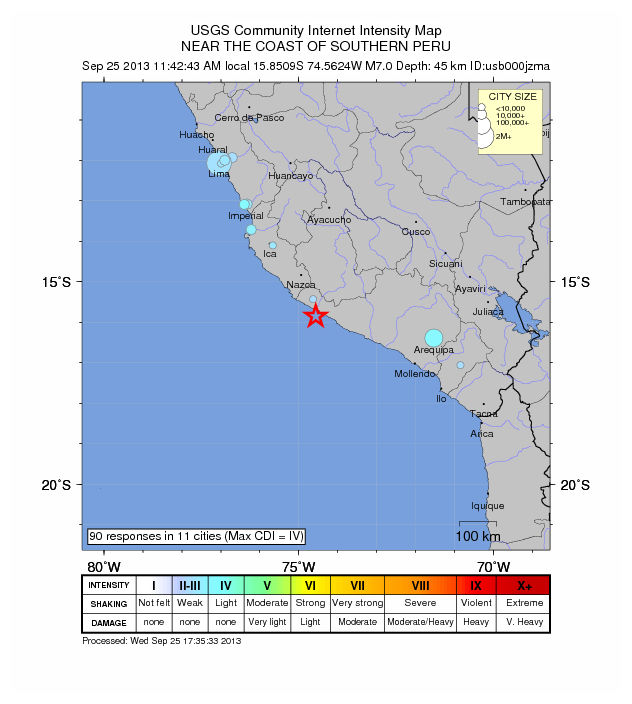
Bizarro Earth

USGS: Earthquake Magnitude 7.0- 46km S of Acari, Peru

Peru Quake_250913
© USGS
Event Time
2013-09-25 16:42:43 UTC
2013-09-25 11:42:43 UTC-05:00 at epicenter

Location

15.851°S 74.562°W depth=45.8km (28.5mi)

Nearby Cities
46km (29mi) S of Acari, Peru
91km (57mi) SE of Minas de Marcona, Peru
120km (75mi) SSE of Nazca, Peru
135km (84mi) SSW of Puquio, Peru
498km (309mi) SSE of Lima, Peru

Technical Details

Snowflake Cold

September 21 breaks the record for most sea ice ever measured at either pole

On September 21, Antarctica had the most sea ice ever measured at either pole - 19,514,000 km². The extent of southern hemisphere sea ice has increased dramatically since the start of satellite records in 1979.
Image

Most people with an IQ over 30 understand that ice forms when the air is cold, but this seems to exclude a significant number of government scientists.

Snow Globe Xmas

Flashback 1975 Science News: Climate change: Chilling possibilities

Global Cooling
© Science News
The winter of 1780-81 was a particu-larly bitter one for the American Revo-lutionary forces. Washington's troops hunkered down, ill-clothed and ill-fed, around their campfires at Morristown, N.J., while a few miles away British troops enjoyed the relative luxury of an occupied New York City. But even the British had their problems, for the win-ter was so cold that parts of New York harbor froze for weeks at a time, block-ing movement of their powerful fleet. The ice even got thick enough to allow hauling cannons from Manhattan to Staten Island. The colonists had struggled against devastating winters ever since establish-ment of the earliest settlements, when one of the few holidays celebrated by the stern Piiritans was that of Thanks-giving-for a harvest bountiful enough to ensure survival until spring. Though they didn't realize it, these hardy pio-neers were trying to conquer a New World in the midst of some of the worst weather in over 2,000 years, a cold spell that had begun in the early 15th century and was to continue until around 1850, known to later climatolo-gists as the "Little Ice Age."

Snow Globe

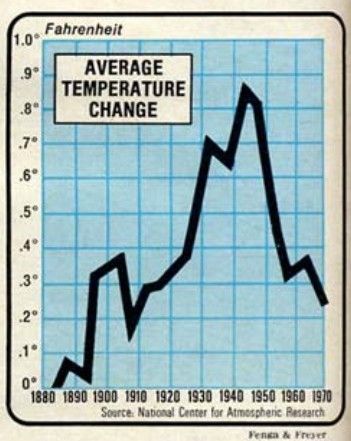
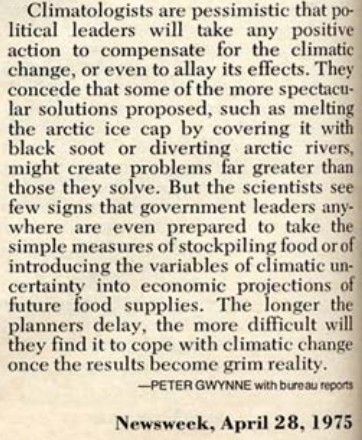
1975: Climatologists wanted to melt the North Pole - to keep the Earth from freezing

Climate change graph
© Steven Goddard
Climatologist fear global cooling
© Newsweekdenisdutton.com/newsweek_coolingworld.pdf
Note that this super cold period from 1975 is now understood by climatologists to have been a super hot period, thanks to pioneering work done at Penn State University.

Alarm Clock

Landslides leave 20 dead in northwest Philippines

Flooded street in Manila
© UnknownA Filipino banana vendor crosses a flooded street in Manila, Philippines Sunday September 22, 2013.
Deadly landslides triggered by torrential monsoon rains have killed 20 people in northwestern Philippines, raising the death toll from storms across Asia to 47.

Soldiers and villagers were also looking for at least seven people missing in mountainside villages struck by the landslides in the province of Zambales, Philippine officials said on Monday.

According to Subic Mayor Jeffrey Khonghun, 15 people died in two landslide-hit villages in his town. Five people were also killed in landslides in two other towns in Zambales.
"This is the first after a long time that we were hit by this kind of deluge," Khonghun said.
Meanwhile, Chinese officials said that Typhoon Usagi, which hit the country after passing by the Philippines, killed 25 people in China's southern province of Guangdong.

Two other people also died after their boat capsized in northeastern Aurora province in the Philippines late on Sunday.

Alarm Clock

At least 16 dead, others missing in Bolivia landslide

Bolivia's Cajones river
© UnknownFile photo of Bolivia's Cajones River
At least 16 people died and a dozen others went missing after a mudslide triggered by heavy rainfall swept vehicles off a road and into a river in Bolivia's northeastern Amazon region, officials say.

A bus, a minibus and a car were swept off the road on Monday near the village of Caranavi, about 180 kilometers (110 miles) north of La Paz, Colonel Juan Cuevas, a traffic police official, said Tuesday.

The vehicles were travelling along Bolivia's "Death Road" before falling down a 100-meter ravine and into the Cajones River, the official said.

The persistent rain has complicated rescue efforts, though officials marked the death toll as high as 16, stressing that it could rise further due to fears that more bodies are buried under the landslide.

Around 10 people have survived the accident.

The event marked the latest landslide disaster in Bolivia. In February 2011, over 300 homes were destroyed by a massive landslide in the country's capital city, La Paz.

Camera

Something the entire world should see - most of us are simply unaware

Image
© uncw.edu
North East of Hawaii, the ocean currents form a giant whirl pool of debris from around the Pacific, the scientific name is called the North Pacific Gyre. It's one of the largest ecosystems on Earth, comprising of millions of square kilometres. Today it's better known as "The Great Garbage Patch," an area the size of Queensland, Australia where there is approximately one million tonnes of plastic spread throughout the ocean. Drag a net in any area of this part of the ocean and you will pick up toxic, discarded plastic.

Photographer Chris Jordan has documented this phenomenon.
I had been studying for quite a while the phenomenon called the Pacific garbage patch. I was looking for a way to visualize it, it was really surreal to land on Midway, seeing that my worst hopes of what I would find there are true. These are all albatross chicks, hatched out of their eggs and the very first meal they got was deadly to them. What happens is, when the eggs hatch one of the parents goes out and flies looking for food. They search over this vast area of the pacific and when they come back with is a belly full of toxic plastics, and they feed that to their babies. They die of starvation, malnutrition and chocking. Simply allow yourself to feel whatever it is you feel about this, without jumping to the way to solve it. Because I think we really need to feel these things, even if the feelings are uncomfortable, because those are the feelings that will turn into the fuel and drive passionate action - Chris Jordan

Comment: Most of us are simply unaware.... that our ocean is being used as a trash can!

The Biggest Dump in the World
What is the Great Pacific Ocean Garbage Patch?
Are We Witnessing the Death of Our Planet?
Pacific Ocean garbage patch worries researchers
The world's rubbish dump stretches from Hawaii to Japan
Plastic Trash in Oceans May Be 'Vastly' Underestimated
'Great Pacific Garbage Patch' Plastic Has Increased Hundredfold Since the 1970s
A Passion to Clean up the Pacific Ocean's Great 'Garbage Patch'

See for yourself...
Image
Image
Image


Bug

As superbugs rise, new studies point to factory farms

Cow
© Eans/Dreamstime

When Russ Kremer, a fifth-generation hog farmer from Missouri, was gored in the knee by one of his Yorkshire boars, he figured it was a routine injury. But the cut got infected. His knee swelled up to twice its normal size, and his life hung in the balance as multiple courses of antibiotics over two months proved ineffective.

Finally, treatment with a potent form of the antibiotic cephalosporin managed to beat back the multidrug-resistant superbug.

Research shows that people who work with livestock, like Kremer, are more likely to carry antibiotic resistant bacteria on or in their bodies, posing a risk of a serious infection. But they're not the only ones at risk. Two million Americans are sickened by antibiotic-resistant bacteria every year, and 23,000 die from these infections, according to a landmark U.S. Centers for Disease Control and Prevention (CDC) report published last week.

Another recent study from Johns Hopkins University, published on the heels of the CDC report, showed that anyone who lives near industrial livestock operations, or fields fertilized with pig manure, is also at greater risk of getting infected by a superbug.

Bizarro Earth

Wild hogs roam streets, scare people near Atlanta

Image
© SVEN HOPPE/AFP/Getty ImagesFile photo of a wild hog.
Police have enlisted the help of a trapper to round up a group of feral hogs scaring residents of a subdivision in suburban Atlanta.

Some parents fear sending their children to a school bus stop in the Lithonia area, where up to four of the hogs are roaming the streets and eating trash in front yards.

Authorities hope the hogs can be trapped in cages by Wednesday morning, DeKalb County police spokeswoman Mekka Parish said.

"They're causing quite a stir to say the least," Parish said shortly before noon Tuesday, as she headed out to the neighborhood, about 17 miles east of downtown Atlanta.

The police department's animal control officers were at the scene, but the plan was for a volunteer trapper to actually capture the animals.

"My children are petrified," Taneisha Danner told WSB-TV.