
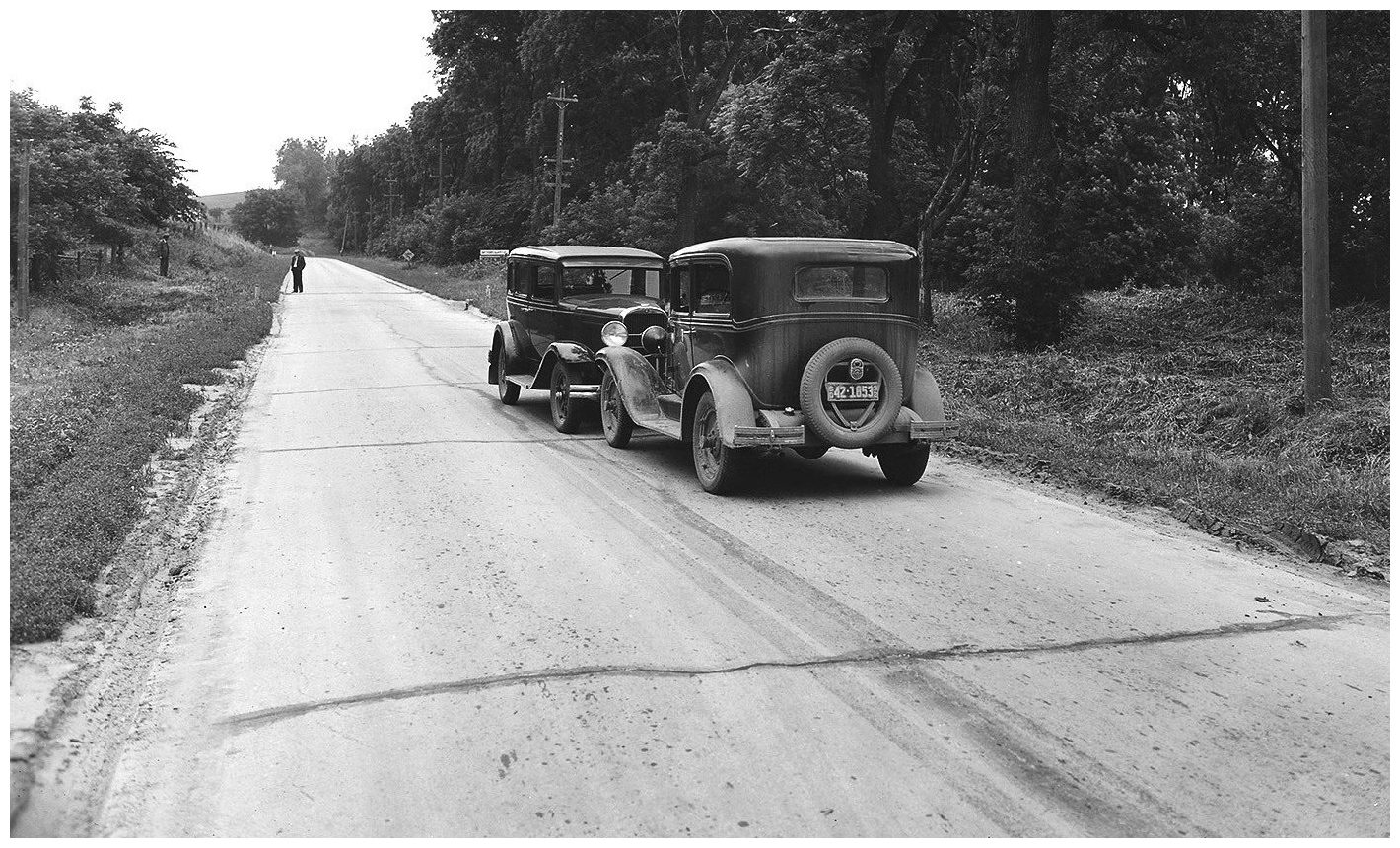
© Photo courtesy WikipediaLook out! Head-on car crash in rural South Dakota in 1932. Eighty per cent of drivers rate themselves as above average.
One day in 1995, a large, heavy middle-aged man robbed two Pittsburgh banks in broad daylight. He didn't wear a mask or any sort of disguise. And he smiled at surveillance cameras before walking out of each bank. Later that night, police arrested a surprised McArthur Wheeler. When they showed him the surveillance tapes, Wheeler stared in disbelief. 'But I wore the juice,' he mumbled.
Apparently, Wheeler thought that rubbing lemon juice on his skin would render him invisible to videotape cameras. After all, lemon juice is used as invisible ink so, as long as he didn't come near a heat source, he should have been completely invisible.Police concluded that Wheeler was not crazy or on drugs - just incredibly mistaken.
The saga caught the eye of the psychologist David Dunning at Cornell University, who enlisted his graduate student, Justin Kruger, to see what was going on. They reasoned that, while almost everyone holds favourable views of their abilities in various social and intellectual domains, some people mistakenly assess their abilities as being much higher than they actually are.
This 'illusion of confidence' is now called the 'Dunning-Kruger effect', and describes the cognitive bias to inflate self-assessment.To investigate this phenomenon in the lab, Dunning and Kruger designed some clever experiments. In one
study, they asked undergraduate students a series of questions about grammar, logic and jokes, and then asked each student to estimate his or her score overall, as well as their relative rank compared to the other students. Interestingly, students who scored the lowest in these cognitive tasks always overestimated how well they did - by a lot. Students who scored in the bottom quartile estimated that they had performed better than two-thirds of the other students!





















Comment: For more on the benefits of laughter see: The Health & Wellness Show: Don't Panic, Lighten Up!