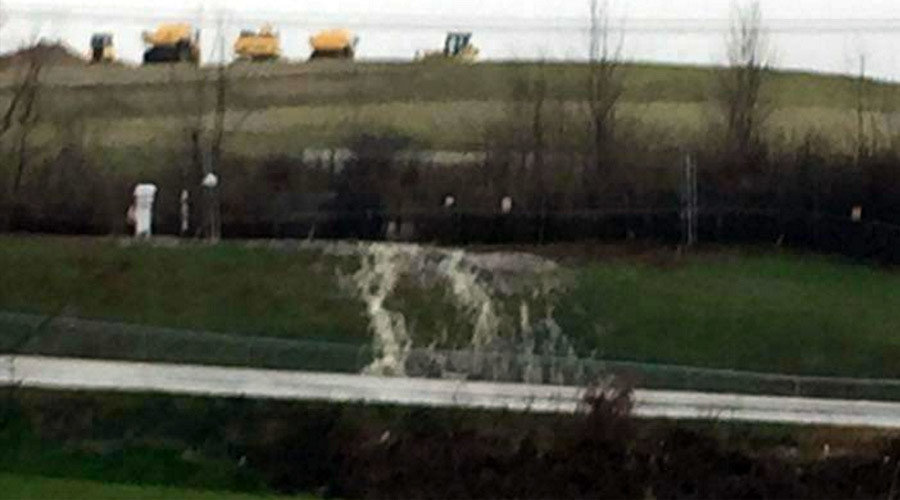
© West Lake Landfill / Facebook
Dangerous radioactive materials from a nuclear waste dump near St. Louis, Missouri have spread to neighboring areas, a new study shows. Storm water runoff from the site has also raised concerns and is being tested for radioactive pollution.
According to a peer-reviewed
study just published in the
Journal of Environmental Radioactivity, there is
"strong evidence" that radon gas and water emanating from the West Lake Landfill are responsible for the anomalous levels of a lead isotope (210Pb), created by radioactive decay, in the surrounding area.
Just northwest of the St. Louis International Airport, the West Lake Landfill is a repository of nuclear waste from the Manhattan Project, the WW2 effort to create the atomic bomb. The area was declared an Environmental Protection Agency (EPA) Superfund site in 1990, but the federal government is still deciding how to clean up the waste.
After analyzing nearly 300 soil samples from a 200-square-kilometer zone surrounding West Lake, the report's authors concluded that "offsite migration of radiological contaminants from Manhattan Project-era uranium processing wastes has occurred in this populated area."
"The stuff we're talking about at West Lake is hotter than what you would find in a typical uranium mill tailings operation," said Bob Alvarez, one of the authors, in an interview on Tuesday.
The study compared the levels of Lead-210 from 287 sample sites in the area to the baseline established by the US Department of Energy at the Fernald, Ohio uranium plant, which handled and stored the same concentrated nuclear waste from the Manhattan Project.











Comment: Also see: Poroshenko dreaming: Visa-free regime will make Donbass and Crimea want to rejoin Ukraine