OF THE
TIMES
The newest thing the Kiev junta is doing is banning Russian language during school breaks. Teachers caught speaking Russian will be fired.
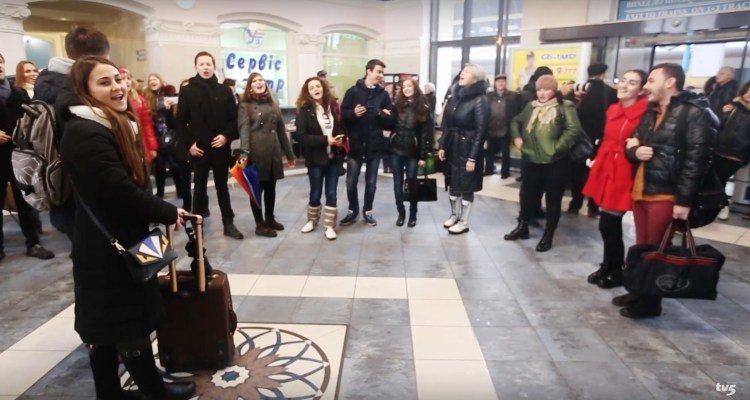
In the atmosphere of the oppression, the people are finding ways to resist in a beautiful and inspiring way, by performing Russian-Soviet songs at train stations.
It began on November 13 in Zaporozhye, the large industrial city in Eastern Ukraine, located next to Donbass. The city of Zaporozhye is located in the very center of the ancestral Zaporozhskie Cossack territories. Zaporozhye means basically 'beyond the white waters.' It is located on the banks of the river Dnepr and it is the white waters of the river that gave it its name. The city was founded by the Russian tsars; in 1930s it became the center of the Soviet industrialization. It is the sight of the famous symbol of the Soviet industrialization DneproGes (Dnepr Hydroelectric Station). It is also the home to the metallurgical giant Zaporozhstal' (Zaporozhye Metal Plant). Europe's largest nuclear power plant is also built here. I again want to stress that everything that has been built in Zaporozhye was built by either the Russian Empire or the USSR. During its 25 years of 'independence' Ukraine built nothing of significance.

Who selects the Electors?
Choosing each state's Electors is a two-part process. First, the political parties in each state choose slates of potential Electors sometime before the general election. Second, on Election Day, the voters in each state select their state's Electors by casting their ballots for President.
The first part of the process is controlled by the political parties in each state and varies from state to state. Generally, the parties either nominate slates of potential Electors at their state party conventions or they chose them by a vote of the party's central committee. This happens in each state for each party by whatever rules the state party and (sometimes) the national party have for the process. This first part of the process results in each Presidential candidate having their own unique slate of potential Electors.
Political parties often choose Electors for the slate to recognize their service and dedication to that political party. They may be state elected officials, state party leaders, or people in the state who have a personal or political affiliation with their party's Presidential candidate. (For specific information about how slates of potential Electors are chosen, contact the political parties in each state.)


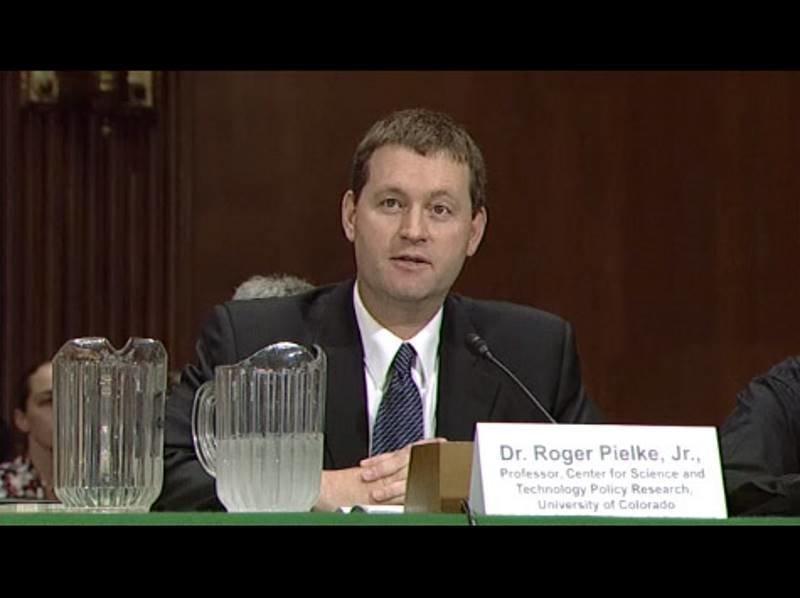
'My research led me to a conclusion that many climate campaigners find unacceptable: There is scant evidence to indicate that hurricanes, floods, tornadoes or drought have become more frequent or intense in the U.S. or globally. In fact we are in an era of good fortune when it comes to extreme weather. This is a topic I've studied and published on as much as anyone over two decades.'Intimidation Works! Dr. Pielke Jr. in 2015 announced that activist and media attacks have prompted him to quit climate research! 'The incessant attacks and smears are effective, no doubt, I have already shifted all of my academic work away from climate issues. I am simply not initiating any new research or papers on the topic'
My unhappy life as a climate heretic
By Roger Pielke Jr. Dec. 2, 2016 7:05 p.m. ET
Excerpts:
Much to my surprise, I showed up in the WikiLeaks releases before the election. In a 2014 email, a staffer at the Center for American Progress, founded by John Podesta in 2003, took credit for a campaign to have me eliminated as a writer for Nate Silver 's FiveThirtyEight website. In the email, the editor of the think tank's climate blog bragged to one of its billionaire donors, Tom Steyer : "I think it's fair [to] say that, without Climate Progress, Pielke would still be writing on climate change for 538."
WikiLeaks provides a window into a world I've seen up close for decades: the debate over what to do about climate change, and the role of science in that argument. Although it is too soon to tell how the Trump administration will engage the scientific community, my long experience shows what can happen when politicians and media turn against inconvenient research—which we've seen under Republican and Democratic presidents.
I understand why Mr. Podesta—most recently Hillary Clinton 's campaign chairman—wanted to drive me out of the climate-change discussion. When substantively countering an academic's research proves difficult, other techniques are needed to banish it. That is how politics sometimes works, and professors need to understand this if we want to participate in that arena.
More troubling is the degree to which journalists and other academics joined the campaign against me. What sort of responsibility do scientists and the media have to defend the ability to share research, on any subject, that might be inconvenient to political interests—even our own?
Comment: Are there restrictions on who the Electors can vote for?