Fire in the SkyS


Meteor

Large meteor seen across New Zealand

A meteor that illuminated the sky with a brilliant blue and white light as it exploded over New Zealand last night was likely to have been the size of a desk.

Reports of a bright flashing light in the sky about 11pm were received from Auckland to as far south as Wellington while a sonic boom was heard by many people near Raglan.

Stardome Observatory astronomer and Auckland Astronomical Society president Grant Christie said that was likely caused by a large meteor, or bolide, at least 1m in diameter.

He compared it to another meteor which caused shockwaves and knocked people to the ground when it exploded at a height of 32kms over Wanganui.

Sun

Sunspot Profusion

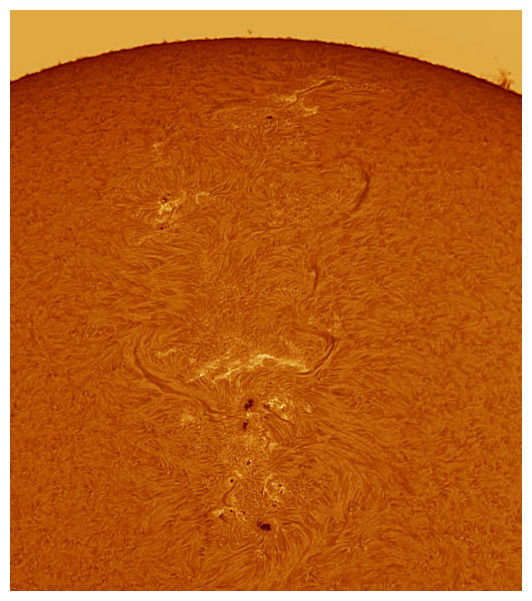
Sunspots are popping up in many locations across the sun's surface, causing the sunspot number to surge above 100. Leading the way is behemoth active region 1176, shown here in a photo taken yesterday by Larry Alvarez of Flower Mound Texas.

Sunspot 1176
© Larry Alvarez
AR1176, the multi-cored ensemble at the bottom of the image, is dragging a pair of long magnetic filaments behind as it cuts aross the solar disk. Two more sunspots are visible in the active region's wake. The entire starscape spans more than 500,000 km from top to bottom--truly impressive.

"I call this picture Solar Rip," says Alvarez, "because it looks like a rip across the stellar surface." With so much happening on the sun, now is a good time to consider purchasing a solar telescope. Browse the links below for inspiration.

Blackbox

1811-12 New Madrid Earthquakes, A NEO Connection?

Great Comet of 1811
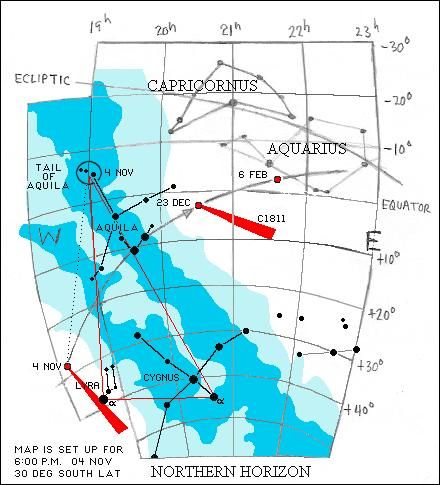
Partial projected path of the Great Comet of 1811 with locations of Burchell's comet and right triangle. Milky Way outlines are from Antonin Becvar's Atlas of the Heavens
The New Madrid seismic zone earthquakes of 1811-1812 may not have been caused by strictly run-of-the-mill seismic activity. This is a study into the possibility that some Near Earth Object (NEO), such as the "Great Comet of 1811", was an outside-the-box crustal stressor. If a NEO involvement is found, then some fear of the unknown about the timing of the next big one may come to be dispelled. See Earthquake Liquefaction Safety.

The following paragraph is extracted from the "Great Comet of 1811" article referred to above.

On November 4, [William J.] Burchell (near the Vaal River about 50 miles west of present day Kimberly, South Africa) wrote, "as I lay waiting for sleep, and amusing myself in observing the constellations above my head, I noticed a faint nebulous star of the third magnitude, which I had not been used to see in that part of the heavens. Looking at it more attentively, it appeared plainly to be a comet." He said it was located in the tail of Aquila and formed a right triangle with Alpha Cygni and Alpha Lyrae.

Blackbox

May 19, 1780: Darkness at Noon Enshrouds New England

1780: In the midst of the Revolutionary War, darkness descends on New England at midday. Many people think Judgment Day is at hand. It will be remembered as New England's Dark Day.

Diaries of the preceding days mention smoky air and a red sun at morning and evening. Around noon this day, an early darkness fell: Birds sang their evening songs, farm animals returned to their roosts and barns, and humans were bewildered.

Some went to church, many sought the solace of the tavern, and more than a few nearer the edges of the darkened area commented on the strange beauty of the preternatural half-light. One person noted that clean silver had the color of brass.

Meteor

Decoded: 'The clay tablet that tells how an asteroid destroyed Sodom 5,000 years ago'

Clay tablet
© APEXClay tablet
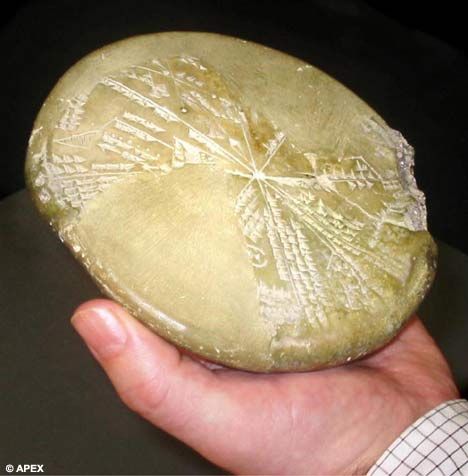
A clay tablet that has baffled scientists for more than a century has been identified as a witness's account of an asteroid that destroyed the Biblical cities of Sodom and Gomorrah 5,000 years ago.

Researchers believe that the tablet's symbols give a detailed account of how a mile-long asteroid hit the region, causing thousands of deaths and devastating more than one million sq km (386,000 sq miles).

The impact, equivalent to more than 1,000 tons of TNT exploding, would have created one of the world's biggest-ever landslides.

Meteor

US: Fire In The Sky Across Eastern Carolina

Fireball
© WITN

Calls and emails have been coming into the newsroom about a fireball streaking across the sky Tuesday night.

It appears what people saw was a meteor like the one in the picture accompanying this story, but maybe not quite as big.

We received calls emails and from people in Beaufort County, Kinston, Camp Lejeune, and Winterville all describing the same thing around 7:30: A blue-green fireball streaking across the sky towards the East until it disappeared. No one reports hearing or seeing any impact.

We talked with the National Weather Service out of Newport where officials say they have also had similar reports, but can't confirm for sure that it was a meteor.

A meteor is a piece of rock or other debris from space that burns up as it enters Earth's atmosphere. Because the objects are moving at many thousands of miles per hour, they create friction with the atmosphere as they enter and burn up.

If you happened to have seen the fireball streaking across the sky and took any pictures we would love to see them You can email them to Carolina Camera on our home page.

Sun

Here Comes Trouble?

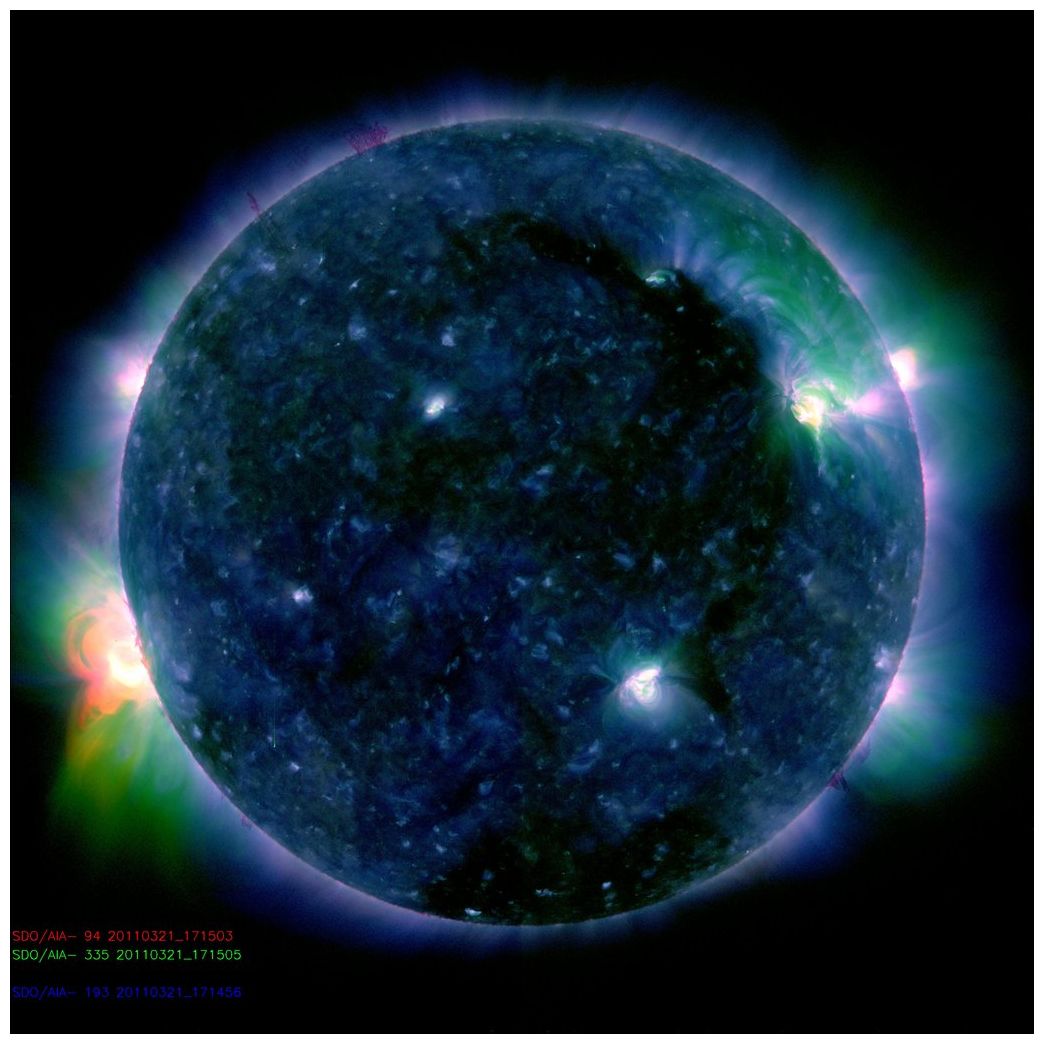
A big sunspot is emerging over the sun's southeastern limb, and it is crackling with activity. NASA's Solar Dynamics Observatory recorded a surge of extreme ultraviolet radiation from the sunspot's magnetic canopy on March 21st:
Sun Spot
© SpaceWeather

This appears to be the return of old sunspot 1165, last seen in early March when it formed on the sun's southwestern limb. Since then it has been transiting the far side of the sun, apparently growing in size and restlessness. The potential for trouble will become more clear in the hours ahead as the active region emerges in full. Stay tuned.

Sun

Massive Solar Eruption

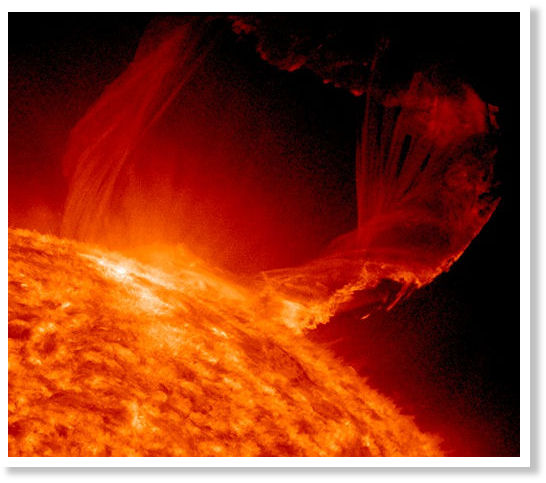
A huge filament of magnetism and hot plasma blasted off the sun's southwestern limb today, March 19th, at around 1200 UT. The eruption was not Earth-directed, but it was iconic. Just look at this snapshot recorded by NASA's Solar Dynamics Observatory:

Solar Flare
© SpaceWeather
Many amateur astronomers in Europe witnessed the blast and said it was the biggest one they'd ever seen. This event continues the recent trend of increasing solar activity, and shows anew that Solar Cycle 24 is gaining steam after a long period of relative quiet.

Meteor

Florida, US: Mysterious tremor rattles Flagler County residents

Something shook up Flagler County in northeast Florida on Friday morning, provoking dozens of reports of homes shaking and a sonic-boom-like noise.

Officials had no idea what rattled the region and may never figure out what happened, said Flagler County emergency management chief Troy Harper.

The most likely explanation is military activity offshore, Harper said.

The Navy drops live bombs on a range in the Ocala National Forest and over Lake George, both of which are west of Flagler County, he said.

Don't blame it on the Navy, said Navy spokeswoman Miriam Gallet. "We have nothing going on," she added.

Meteor

Hyperactive Comet Hartley 2 Is a Spiky Mystery for Astronomers

Image
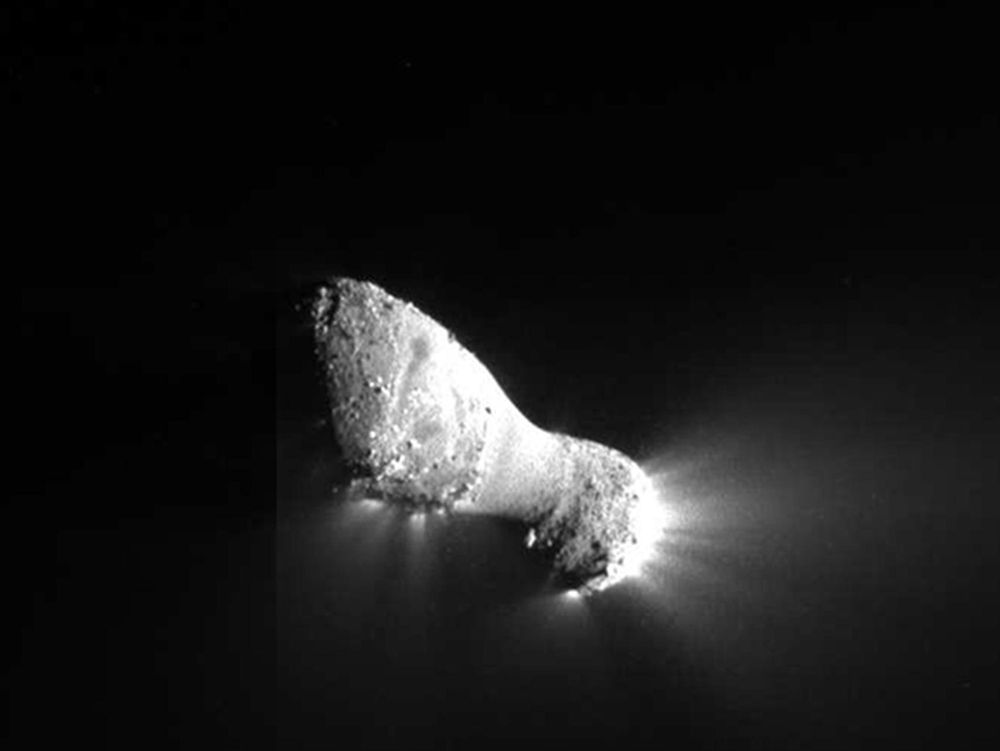
© NASA/JPL-Caltech/UMDA stunning close-up photo of Comet Hartley 2 from the Nov. 4, 2010 flyby performed by NASA's Deep Impact spacecraft. This close-up view of comet Hartley 2 was captured by the spacecraft's Medium-Resolution Instrument.
Houston - Comet Hartley 2, the icy "space drumstick" photographed by NASA's Deep Impact spacecraft last year, is an active object that still perplexes scientists as it travels through the solar system.


Comment: Comets are NOT "dirty snowballs". Perhaps the reason this comet (and all others) still "baffle" space scientists is because they have no clue about the true nature of comets.


Deep Impact visited Hartley 2 in November, revealing what one scientist described as "our favorite little hyperactive small comet."

Hartley 2 rotates around a central axis much as Earth does, scientists have revealed. But the comet also rolls around its long axis like a spinning bowling pin. Make that a spiky bowling pin: The rough edges of Hartley 2's surface are dotted with rocky spires that can reach 230 feet (70 meters) high.