
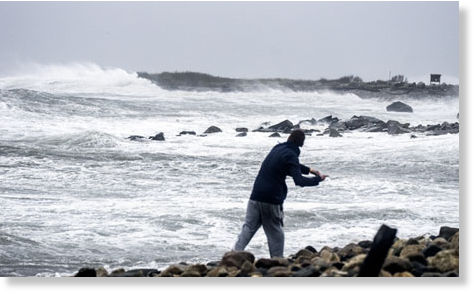
Some waves, yesterday. Amid the hype, the endlessly recycled images on 24-hour news channels left the viewer unsure of how serious the crisis really was.
After watching media mass hysteria over hurricane Sandy on CNN for a chunk of the evening I went to bed on Monday night uncertain whether New York would still be with us by breakfast time. Yo, Big Apple, glad to wake up and find you very wet but still more or less in one piece.
I'm not sure about CNN's reputation being intact in our house though. I don't often watch the channel much these days, but even with Christiane Amanpour - she's a veteran war correspondent and grown-up - in charge of coverage of "the monster storm from hell", the output was completely over the top. It's the sort of occasion when the only experts being consulted sounded like the OTT variety. And, no, little or no climatic context was provided.
By comparison, BBC1's Six O'Clock News, which only devoted its first five minutes or so to something that hadn't actually happened to the US eastern seaboard yet - and didn't live up to its billing when it did, peaking a few hours later - was a model of reticence. As ever Radio 4 is both calmer and more informative. All those misleading pictures often get in the way.
I won't be back on CNN in a hurry, which is worrying - and not just for CNN either because intense competition between rival media in search of readers and viewers leads to hype and hysteria which must put off many customers. Even those in search of lurid sensation go off in search of even dafter novelty when they tire of waiting to see if CNN's intrepid reporter in storm-torn Atlantic City - his name was Ali - would be picked up by the wind and blown into the sea (or the "literal Niagra Falls" as one eyewitness called the ocean).










Comment: The context is important and the context was, as ever, entirely lacking in mainstream US media coverage. Yes, Sandy was big, but it was not 'the end of the world' in and of itself, it was just another extreme weather event joining a long list of similar events in recent years.