Puppet MastersS


Eye 1

The Multibillion-Dollar U.S. Spy Agency You Don't Know About

National Geospatial-Intelligence Agency
© U.S. Army Corps of Engineers Baltimore District/Getty Images/Foreign Policy
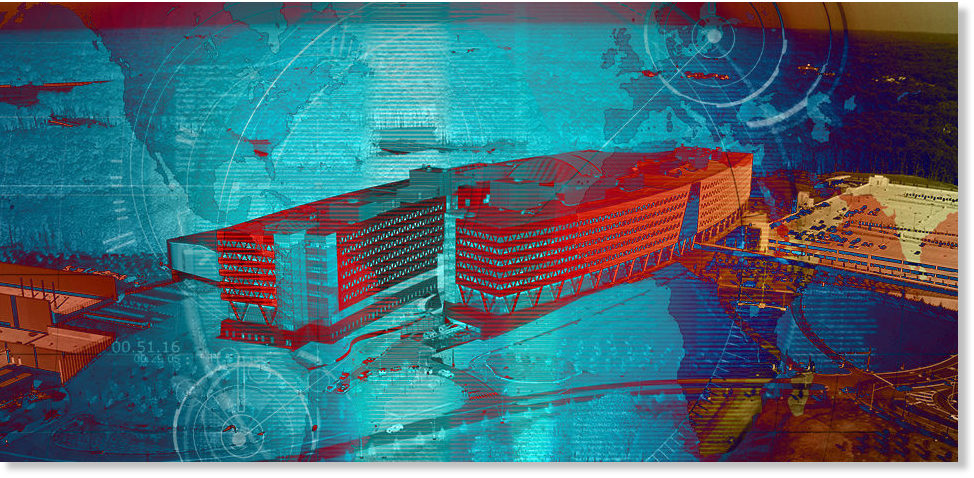
On a heavily protected military base some 15 miles south of Washington, D.C., sits the massive headquarters of a spy agency few know exists. Even Barack Obama, five months into his presidency, seemed not to have recognized its name. While shaking hands at a Five Guys hamburger restaurant in Washington in May 2009, he asked a customer seated at a table about his job. "What do you [do]?" the president inquired. "I work at NGA, National Geospatial-Intelligence Agency," the man answered. Obama appeared dumbfounded. "So, explain to me exactly what this National Geospatial..." he said, unable to finish the name. Eight years after that videotape aired, the NGA remains by far the most shadowy member of the Big Five spy agencies, which include the CIA and the National Security Agency.

Despite its lack of name recognition, the NGA's headquarters is the third-largest building in the Washington metropolitan area, bigger than the CIA headquarters and the U.S. Capitol.

Completed in 2011 at a cost of $1.4 billion, the main building measures four football fields long and covers as much ground as two aircraft carriers. In 2016, the agency purchased 99 acres in St. Louis to construct additional buildings at a cost of $1.75 billion to accommodate the growing workforce, with 3,000 employees already in the city.

Bizarro Earth

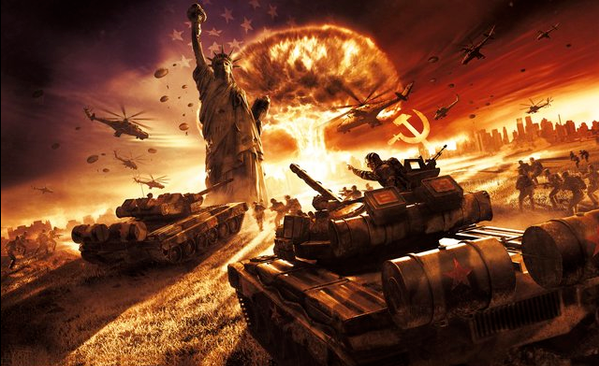
Will Washington Risk WW3 to Block an Emerging EU-Russia Superstate

War World 3
© YouTube
"Russia is an inalienable and organic part of Greater Europe and European civilization. Our citizens think of themselves as Europeans...That's why Russia proposes moving towards the creation of a common economic space from the Atlantic to the Pacific Ocean, a community referred to by Russian experts as 'the Union of Europe' which will strengthen Russia's potential in its economic pivot toward the 'new Asia.'"

— Russian President Vladimir Putin, "Russia and the changing world", February 2012
The relentless demonization of Vladimir Putin is just one part of Washington's multi-pronged strategy to roll-back Russian power in Central Asia and extinguish Putin's dream of a "Greater Europe". Along with the attempt to smear the Russian president as a "KGB thug" and "dictator", the media has also alleged that Moscow intervened in the US presidential elections and that Russia is a serial aggressor that poses a growing threat to European and US national security. The media onslaught, which has greatly intensified since the election of Donald Trump in November 2016, has been accompanied by harsh economic sanctions, asymmetrical attacks on Russia's markets and currency, the arming and training of Russian adversaries in Ukraine and Syria, the calculated suppression of oil prices, and a heavy-handed effort to sabotage Russia's business relations in Europe. In short, Washington is doing everything in its power to prevent Russia and Europe from merging into the world's biggest free trade zone that will be the center of global growth and prosperity for the next century.

This is why the US State Department joined with the CIA to topple the elected government of Ukraine in 2014. Washington hoped that by annexing a vital landbridge between the EU and Asia, US powerbrokers could control critical pipeline corridors that are drawing the two continents closer together into an alliance that will exclude the United States. The prospect of Russia meeting more of the EU's growing energy needs, while China's high-speed railway system delivers more low-cost manufactured goods, suggests that the world's center of economic gravity is shifting fast increasing the probability that the US will continue on its path of irreversible decline. And when the US dollar is inevitably jettisoned as the primary means of exchange between trade partners in the emerging Asia-EU free trade zone, then the recycling of wealth into US debt will drop off precipitously sending US markets plunging while the economy slips into a deep slump. Preventing Putin from "creating a harmonious community of economies from Lisbon to Vladivostok" is no minor hurtle for the United States. It's a matter of life and death.

Remember the Wolfowitz Doctrine:
"Our first objective is to prevent the re-emergence of a new rival, either on the territory of the former Soviet Union or elsewhere, that poses a threat on the order of that posed formerly by the Soviet Union. This is a dominant consideration underlying the new regional defense strategy and requires that we endeavor to prevent any hostile power from dominating a region whose resources would, under consolidated control, be sufficient to generate global power."
Washington's relations with Russia will always be fractious because Russia poses a perennial threat to US ambitions to rule the world. Geography is fate, and Russia's geography contains massive oil and gas reserves that Europe needs to heat its homes and fuel its businesses. The symbiotic relationship between supplier and end-user will eventually lead to the lifting of trade barriers, the lowering of tariffs, and the smooth melding together of national economies into a region-wide common market. This may be Washington's biggest nightmare, but it's also Putin's top strategic priority. Here's what he said:
"We must consider more extensive cooperation in the energy sphere, up to and including the formation of a common European energy complex. The Nord Stream gas pipeline under the Baltic Sea and the South Stream pipeline under the Black Sea are important steps in that direction. These projects have the support of many governments and involve major European energy companies. Once the pipelines start operating at full capacity, Europe will have a reliable and flexible gas-supply system that does not depend on the political whims of any nation. This will strengthen the continent's energy security not only in form but in substance. This is particularly relevant in the light of the decision of some European states to reduce or renounce nuclear energy."
If Europe wants a reliable partner that can meet its energy needs, then Russia fits the bill. Unfortunately, the US has repeatedly tried to sabotage both pipelines in order to undermine EU-Russia relations. Washington would prefer that Europe either dramatically curtail its use of natural gas or find other more expensive alternatives that don't involve Russia. In other words, Europe's material needs are being sacrificed for Washington's geopolitical objectives, the primary goal of which is to prevent the forming of Greater Europe.

Info

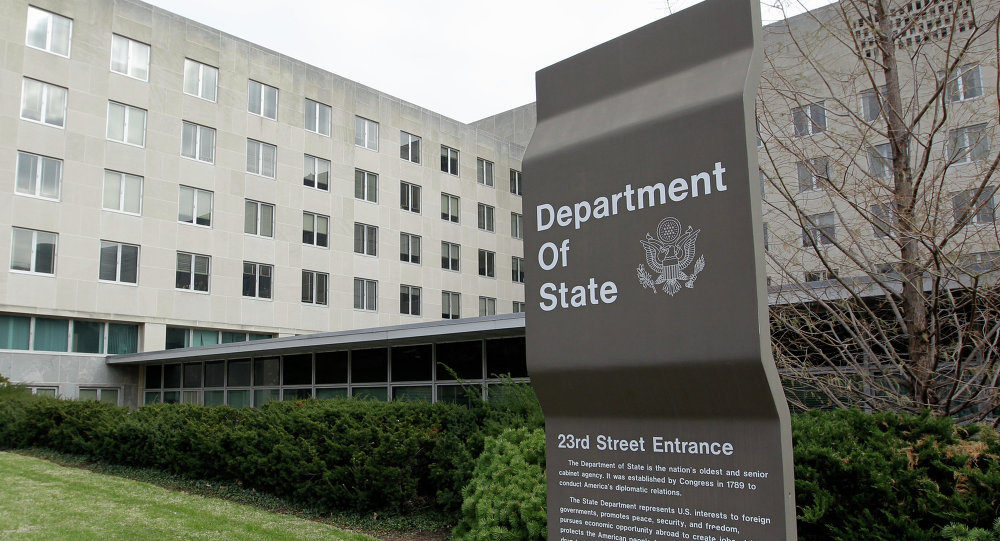
US imposes sanctions against 8 Russian companies in connection with Nonproliferation Act

US Department of State building
© AP Photo/ Luis M. Alvarez
The United States has imposed sanctions against eight Russian companies in connection with the Iran, North Korea, and Syria Nonproliferation Act (INKSNA), US State Department representative told Sputnik on Saturday.

"Penalties are being applied to eight Russian entities as a result of a regular, periodic review of specific activities as required by the Iran, North Korea, and Syria Nonproliferation Act," the representative said.

Pistol

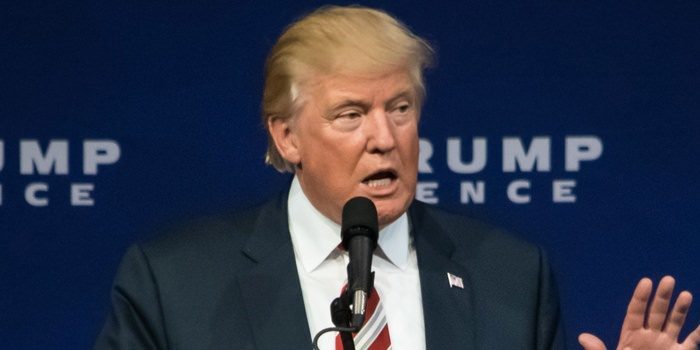
Trump at greater risk of assassination than any other President

donald trump
Conspiracy theories still abound as to who actually killed John F. Kennedy, Jr., on November 22nd, 1963. The overwhelming consensus from researchers, who do not accept the official narrative, was that JFK wasn't killed by Lee Harvey Oswald, who, himself, said, "I'm just a patsy."

Oswald denied having killed the president and said he'd been framed because he used to live in the Soviet Union. Now, many of those same researchers, who took Oswald at his word, are convinced Donald J. Trump could be heading down the same street toward assassination that JFK traveled. And they're very concerned.

While Donald Trump and JFK are not alike, they both appear to have a common enemy — the deep state. Regardless of how you feel about Trump's policies, some of which are tyrannical, the deep state that is attempting a coup against him is far more dangerous.

Evil Rays

US Political Russophobia: A Symptom of Implosion

implosion
There was a time when Russophobia served as an effective form of population control - used by the American ruling class in particular to command the general US population into patriotic loyalty. Not any longer. Now, Russophobia is a sign of weakness, of desperate implosion among the US ruling class from their own rotten, internal decay.

This propaganda technique worked adequately well during the Cold War decades when the former Soviet Union could be easily demonized as «godless communism» and an «evil empire». Such stereotypes, no matter how false, could be sustained largely because of the monopoly control of Western media by governments and official regulators.

The Soviet Union passed away more than a quarter of a century ago, but Russophobia among the US political class is more virulent than ever.

This week it was evident from Congressional hearings in Washington into alleged Russian interference in US politics that large sections of American government and establishment media are fixated by Russophobia and a belief that Russia is a malign foreign adversary.

Info

UK Parliament report: 'No hard evidence' entire Gulen movt. behind Turkey coup, only some members

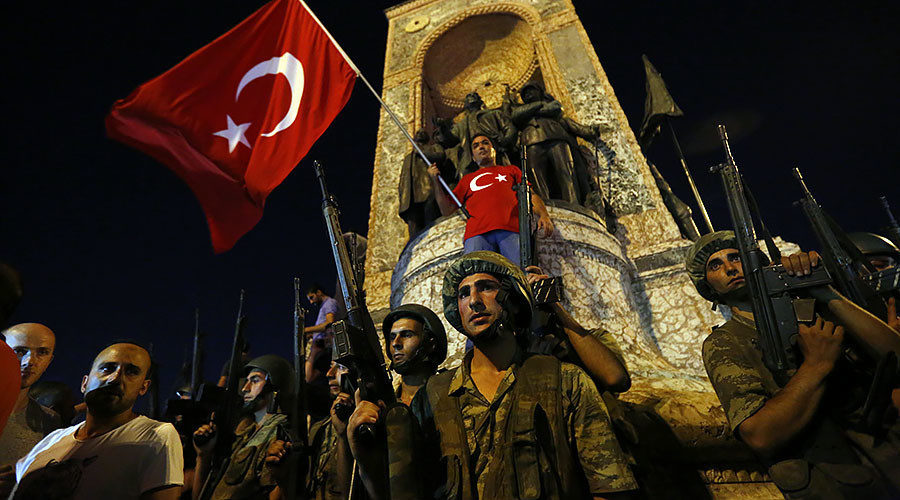
Turkish military stand guard near the the Taksim Square, Istanbul, Turkey, July 16, 2016
© Murad Sezer / ReutersTurkish military stand guard near the the Taksim Square, Istanbul, Turkey, July 16, 2016
Some followers of exiled Turkish cleric Fethullah Gulen were involved in last summer's failed coup, yet evidence to suggest the entire Gulen movement or its leader were behind the plot is "anecdotal or circumstantial," a UK Parliament report states.

"There is a relative lack of hard, publicly-available evidence to prove that the Gulenists as an organization were responsible for the coup attempt in Turkey," the UK Parliament's Foreign Affairs Committee's (FCO) report released on Saturday states.

"While there is evidence to indicate that some individual Gulenists were involved, it is mostly anecdotal or circumstantial, sometimes premised on information from confessions or informants, and is - so far - inconclusive in relation to the organization as a whole or its leadership," it added.

Prominent Muslim cleric Fethullah Gulen leads a popular Islamic transnational religious and social movement called Hizmet, believed to be funding numerous businesses, think tanks, private schools, and publishing houses around the world. The man and his group were accused by Turkish President Recep Tayyip Erdogan of masterminding the failed coup in Turkey on July 15, 2015.

Comment: Turkish President Recep Tayyip Erdogan criticized the statements of German Federal Intelligence Agency (BND) chief Bruno Kahl about Turkey's weak evidence base proving Islamic cleric Fethullah Gulen's involvement in the July 2016 coup attempt.
On March 18, Kahl said in an interview with German Der Spiegel magazine that Ankara failed to convince Berlin in Gulen's role in the July 2016 coup attempt.

"He says they don't see [Fethullah Terrorist Organization] FETÖ behind this incident. Look at them. What do you know about FETÖ being a terrorist group?... Who do you think you are? Don't cross the line," Erdogan said as quoted by Daily Sabah newspaper.


Info

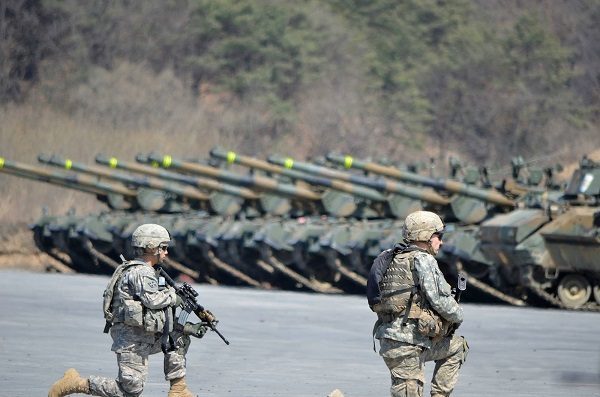
US presence in Korea drives instability

US troops
US and European interests continue to portray the government and nation of North Korea as a perpetual security threat to both Asia and the world. Allegations regarding the nation's nuclear weapon and ballistic missile programs are continuously used as justification for not only a continuous US military presence on the Korean Peninsula, but as justification for a wider continued presence across all of Asia-Pacific.

In reality, what is portrayed as an irrational and provocative posture by the North Korean government, is in fact driven by a very overt, and genuinely provocative posture by the United States and its allies within the South Korean government.

Comment: For more North Korea analysis: North Korea: The real serious options on the table


Handcuffs

Cop convicted in gruesome killing of 6-Year-Old Jeremy Mardis

Derrick Stafford and Jeremy Mardis
Sixteen months ago, one of the worst police killings ever to be recorded on video rocked the country. Jeremy Mardis, a 6-year-old boy, was gunned down in cold blood by two bad Louisiana cops — Derrick Stafford and Norris Greenhouse Jr. Now, one of those officers is finally being tried for this horrific act which was caught on a body camera.

In what the head of Louisiana State police called 'the most disturbing thing he's ever seen,' Mardis was murdered as he rode with his father, Chris Few, as he sat strapped into the front seat of the car.

"He didn't deserve to die like that," State Police Col. Mike Edmonson said as he announced the deputies' arrests, less than a week after the shooting.

Megaphone

Swiss Minister: Schengen zone protects EU states from terrorism

Parliament Square
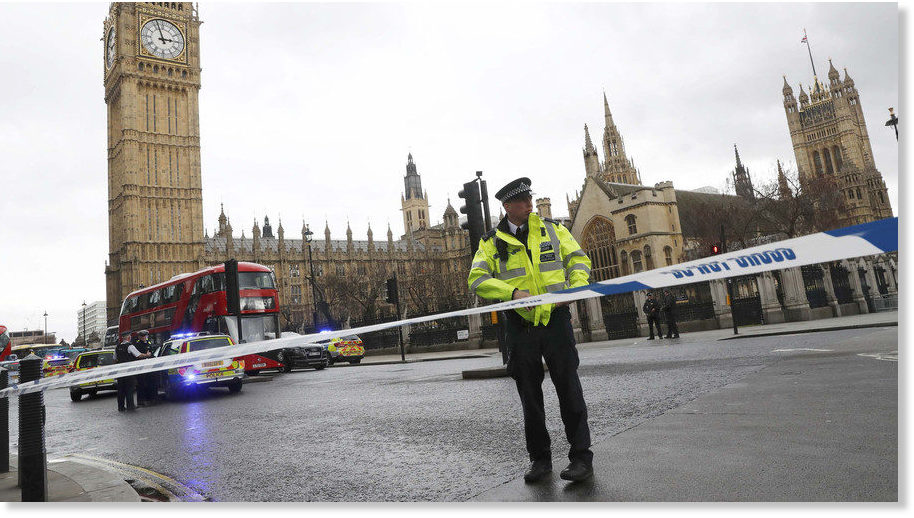
© Stefan Wermuth / ReutersParliament Square, London, Britain, March 22, 2017
Membership in the Schengen zone gives European states protection from international terrorism, Swiss Justice Minister Simonetta Sommaruga said following Wednesday's terrorist attack in London.

"Without Schengen we would be less protected from terror," Sommaruga said in an interview with Blick news outlet on Thursday, explaining that the Schengen system offers a number of instruments that help lessen the threat of terrorism.

"Try to board a plane without a passport. And without a passport you cannot easily leave the Schengen area. Today, the police can exchange information quickly across national borders. This is one of the key benefits of Schengen police cooperation...

Thanks to the Schengen system, the police can quickly and reliably check whether the suspect is on the radar of the authorities [elsewhere in the Schengen zone]. Without this information, the police have no idea who they're dealing with," the minister said, adding that due to these benefits, "anyone seeking to terminate the Schengen Agreement is irresponsible."

Sherlock

Ex-spooks seek to expose the shabby intelligence of national security state

CIA conversation
© Michael HogueThere’s a long history of skepticism among ex-spooks.
There is a perception among some of the public and within the alternative media that America's burgeoning national-security state is a monolith, a collective entity pursuing its own interests regardless of what is good for the country or its people. From both progressives and conservatives who mistrust the government, I often hear comments such as, "Once in the CIA, always in the CIA"—as if onetime employment in the agency forms an unbreakable bond.

Those familiar with both the national-security community and the peace movement are aware that something like the reverse is true. Individuals who were attracted to careers in intelligence, law enforcement, or the military are often sticklers for doing what is right rather than what is expedient. That often puts them at odds with their political masters, leading sometimes to resignations and a resulting overrepresentation of former national-security professionals in the anti-war movement.

One manifestation of this is an organization of former national-security officers, including myself, called Veteran Intelligence Professionals for Sanity, or VIPS. VIPS was founded in 2003 out of revulsion on the part of many former officials over the shabby intelligence that was driving the decision to invade Iraq. The group includes officials from the whole alphabet soup of national security—CIA, NSA, FBI, FS (Foreign Service), and DOD. VIPS's emergence and its ongoing letters of protest on national-security policy reflect a reality going back to the early debates surrounding the U.S. government's stealthy escalation of the Vietnam War and its woeful handling of that conflict, ending in a humiliating defeat.