Science & TechnologyS


Fish

'Living fossil' fish uses gills to breath but retains vestigial lung

The coelacanth, an elusive deep-sea dweller long thought extinct, had another item added Tuesday to an already-long list of unusual physical traits: an obsolete lung lurking in its abdomen.
coelacanth fossil fish lungs
© Agence France-Presse/Robert MichaelCoelacanths today use gills to extract oxygen from the water they live in, but millions of years ago, their ancestors probably breathed using a lung
Similar to the human appendix, the organ was likely rendered defunct by evolution, researchers noted in the journal Nature Communications.

Like all fish, today's coelacanths -- referred to as "living fossils" -- use gills to extract oxygen from the water they live in. But millions of years ago, coelacanth ancestors probably breathed using the lung, the team concluded.

"By the Mesozoic Era, adaptation of some coelacanths to deep marine water, an environment with very low variations of oxygen pressure, may have triggered the total loss of pulmonary respiration," co-author Paulo Brito of the Rio de Janeiro State University told AFP.

This could explain how it survived the extinction event 66 million years ago that wiped all non-avian dinosaurs and most other life from Earth -- and probably those coelacanths inhabiting shallow waters, he said. It would also account for "the marked reduction" of the lung into its shrivelled, present-day form, Brito said by email.

Galaxy

Solar system replica built by space enthusiasts in Nevada Desert - 11km (7 mi) wide

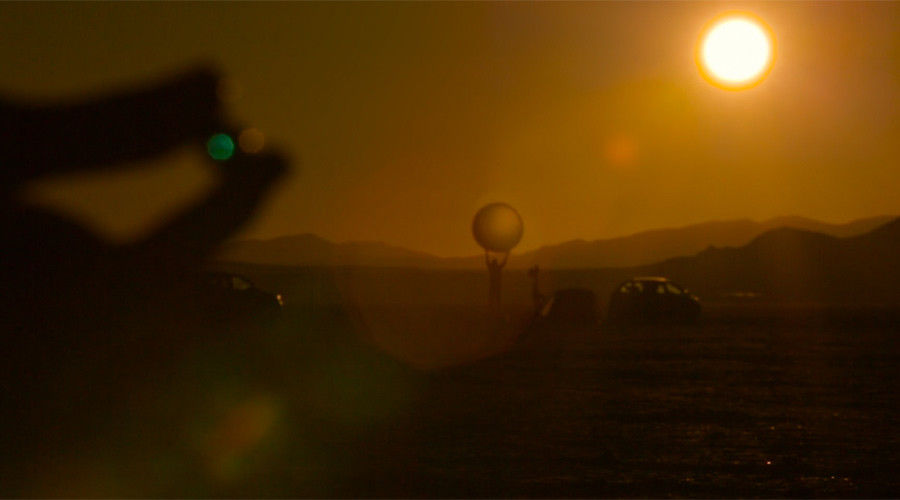
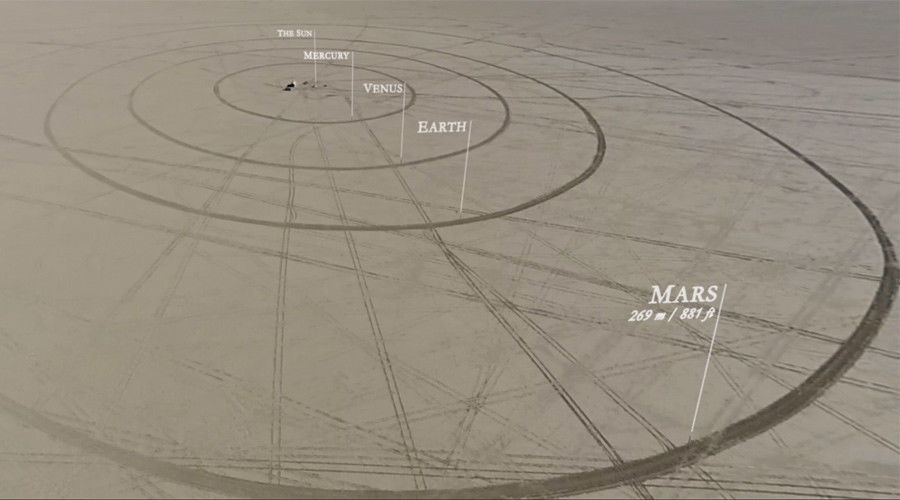
A pair of space buffs has descended on Nevada's Black Rock Desert in a bid to correctly demonstrate the size of our solar system. Pushing the boundaries of imagination, they managed to create a mesmerizing scale model using only marbles and light bulbs.
Solar System nevada
© Wylie Overstreet / VimeoSolar System modeled to scale in Nevada desert
Wylie Overstreet and Alex Gorosh and have made a short movie about their adventure. They said they were disturbed by images that portray the distances in the solar system inaccurately.

"There is literally not an image that adequately shows you what it actually looks like from out there [space]," Overstreet noted.


The only way to create an authentic model to scale was to build one themselves, the two friends decided.

When they arrived at the dry lake bed in Black Rock desert, they gave themselves only 36 hours to create a model, spiced up with the planets' orbits animated at night through lights. The idea was to create a time-lapse to show how big the Sun, Mercury, Venus, Earth, Jupiter, Saturn, Uranus, Neptune and Mars really are.
Solar System nevada
© Wylie Overstreet / Vimeo
"To create a scale model with an Earth only as big as this marble, you need seven miles [11kms] of empty space," Overstreet said in the film.

The real challenge was to capture Earth from the view of an astronaut. And they actually did it!

"That's what I really wanted to try and capture. We are on a marble floating in the middle of nothing. When you sort of come face to face with that, it's staggering," Overstreet wrapped up.

Fireball

Newfound meteor showers expand astronomical calendar

Meteor Shower
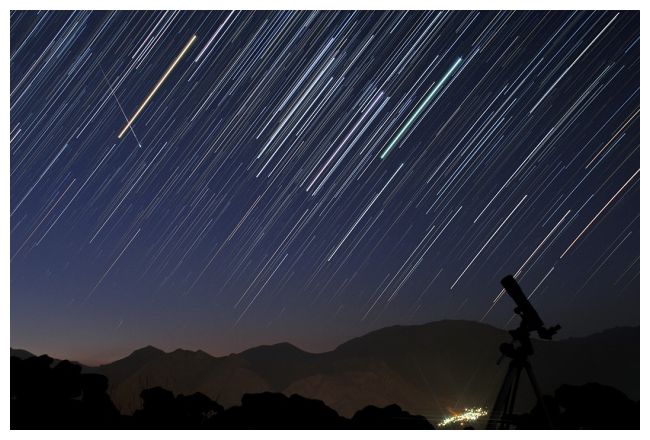
© Babak Tafreshi/National Geographic CreativeA meteor (upper left) streaks through the Orion constellation during the Perseid shower.
The list of meteor showers that occur every year has just grown longer. Eighty-six previously unknown have now joined the regular spectaculars, which include the Perseids, Leonids and Geminids. Astronomers spotted the shooting-star shows using a network of video cameras designed to watch for burglars, but repurposed to spy cosmic debris burning up in Earth's atmosphere.

The newfound showers are faint but important: each is fuelled by Earth's passage through a trail of particles left behind by a comet or asteroid, so mapping them reveals previously unknown sources of dust.

"The cool thing is, we are not just doing surveillance of meteors in the night sky," says Peter Jenniskens, an astronomer at the SETI Institute in Mountain View, California. "Now we also have a three-dimensional picture of how dust is distributed in the Solar System."

Most of the particles are the size of a sand grain, but a few are large enough to survive the searing heat of their passage through the atmosphere — and possibly do damage on Earth's surface. Jenniskens and his colleagues describe the discoveries in four papers accepted for publication in Icarus.

Astronomers have been documenting meteors for centuries, first by eye and more recently with radar and video-tracking systems. Meteors sprinkle Earth steadily throughout the year, but during a shower a significant number seem to originate from the same point in the sky. Skywatchers around the world have reported more than 750 possible meteor showers to the International Astronomical Union (IAU) — but only a small fraction of those have been confirmed as bona fide events.

Arrow Up

Facebook plans to introduce the long-demanded dislike button

Facebook, like button
© Beck Diefenbach / Reuters
Facebook has plans to introduce the long-demanded counterpart to its iconic "like" button, CEO Mark Zuckerberg revealed on Tuesday.

"I think people have asked about the 'dislike' button for many years," Zuckerberg said during a live Q&A Session at Facebook headquarters. "Today is a special day because today is the day I can say we're working on it and shipping it."

"Liking" a post, picture or comment has become the bread and butter of the Facebook user experience, but it doesn't always mesh well with certain types of comments

Zuckerberg stressed that it wouldn't work like Reddit's up- and down-vote system, which allows users to vote on posts or content that they think is good or bad. Instead, the new Facebook feature would be a built-in way for users to express sympathy.

Comment: While Zuckerberg's seeming concern about implementing a feature that might facilitate negativity seems admirable, the fact is that people are expressing their negative opinions freely in the comments anyway. Perhaps this is really 'much ado about nothing' and more about a marketing ploy?


Saturn

NASA releases new shot of Saturn at night taken by Cassini

Image
© NASA
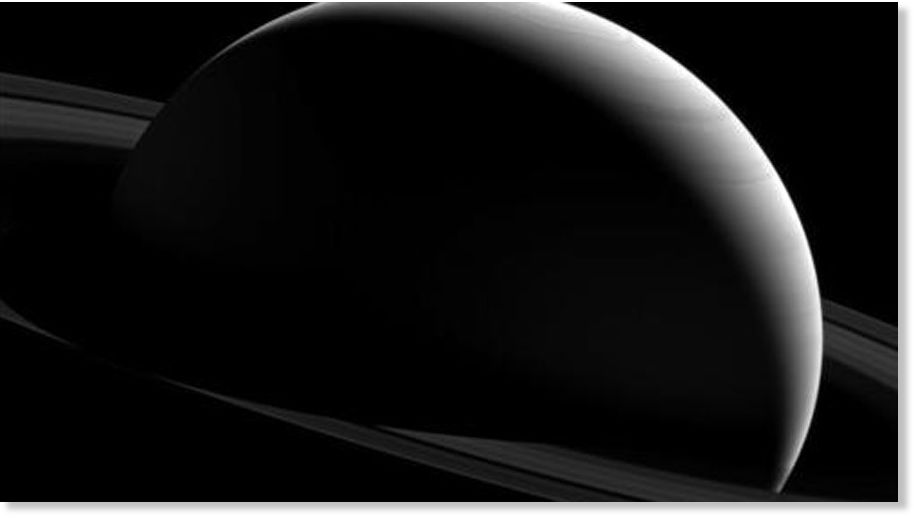
NASA has shown off Saturn from a rare dark side, as the agency has released a new shot of the ringed planet and one of its mysterious ice moons, Tethys, taken at night.

The wide-angle camera of the Cassini spacecraft captured the night footage of Saturn at a distance of approximately 1.5 million miles (2.4 million kilometers) from the planet.

The photo, at a scale of 88 miles (141 kilometers) per pixel, shows part of Saturn and its ring plane while the larger part of is totally dark. This chiaroscuro effect - an interplay of absolute darkness and bright light - is actually a completely natural phenomenon.

"We know that shadows are darker areas than sunlit areas, and in space, with no air to scatter the light, shadows can appear almost totally black," NASA said in a press release.


Satellite

Do Earth's oceans come from below? Saturn's Enceladus joins list of moons with subsurface ocean covering entire body

Enceladus
© NASA
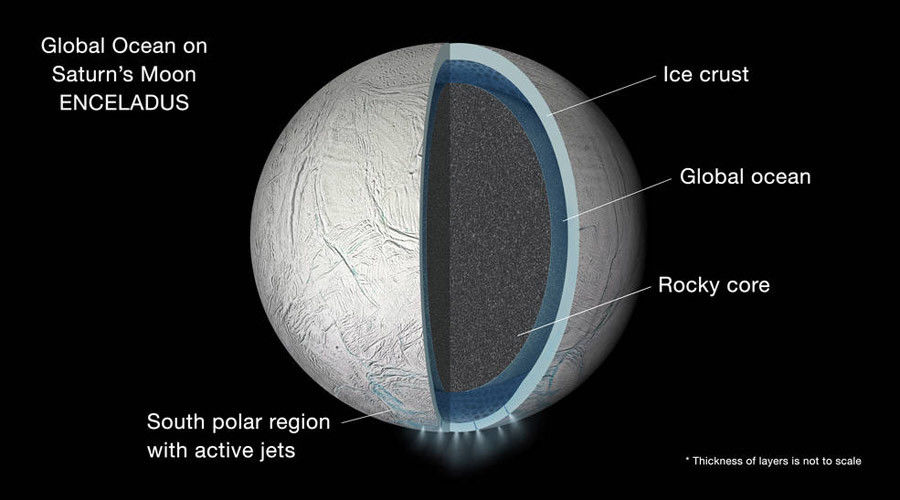
An ocean lies beneath the icy crust of Saturn's moon Enceladus, covering the entire celestial body, according to new research data from NASA's Cassini mission.

Although researchers have known about water on Enceladus, they used new images from Cassini to detect that the moon wobbles slightly as it orbited Saturn, and that could only be explained if its outer ice shell was not frozen solid to its interior. If not, that means a global ocean must be present.

"This was a hard problem that required years of observations, and calculations involving a diverse collection of disciplines, but we are confident we finally got it right," said Peter Thomas, a Cassini imaging team member at Cornell University, and lead author of the paper, in a statement.

Comment: See also:

Abiotic Petroleum and Primary Water: Are 'shortages' of oil and water 'manufactured scarcity'?


Stock Up

Bitcoin-like virtual currency planned in Russia by the private company QIWI in 2016: Authorities worried

Russian bitcoin
© Bogdan Cristel / Reuters
The Russian QIWI payment system wants to enter the $3.8 billion virtual currency market by introducing the first national crypto-currency. However, Russian authorities are concerned that the 'bit-ruble' could be used for money laundering and bankrolling of terrorism.

The launch is scheduled for 2016, but to do that QIWI needs several million dollars, CEO Sergey Solonin told Russian business daily Kommersant. The company is likely to face trouble from the Russian authorities. Only the Central Bank has the right to print money in Russia, and it will be impossible to launch the crypto-currency without its approval.

Comment: Solonin recently sold his Golden Beach mansion for $11 million. It seems he really needed the money. His company - QIWI - has its headquarters in Cyprus, a popular tax haven for the rich.


Water

Abiotic Petroleum and Primary Water: Are 'shortages' of oil and water 'manufactured scarcity'?

Image
© NaturalNews.com
What if everything you thought you knew about the nature of energy and natural resources was an elaborate lie concocted to manipulate and control the economy and human behavior? When it comes to the availability of oil and water, evidence suggests that both of these invaluable resources might actually be far more plentiful than we've all been led to believe.

In the West, the prevailing belief is that oil is a fairly limited resource that forms biotically, which means it generates through the decay of plant and animal matter over relatively long periods of time. Oil reserves are currently being used up much more quickly than they're being replenished, so if this theory is true, humanity urgently needs to invest in other forms of energy production in order to sustain life as we know it.

Comment: See also:

Petroleum: Shocking Revelations about Oil

Lab finds new method to turn biomass into gasoline

Nasca Lines May be Map of Underground Water Sources: Expert


Laptop

Coming to a surveillance state near you: Lip-reading computers

HAL
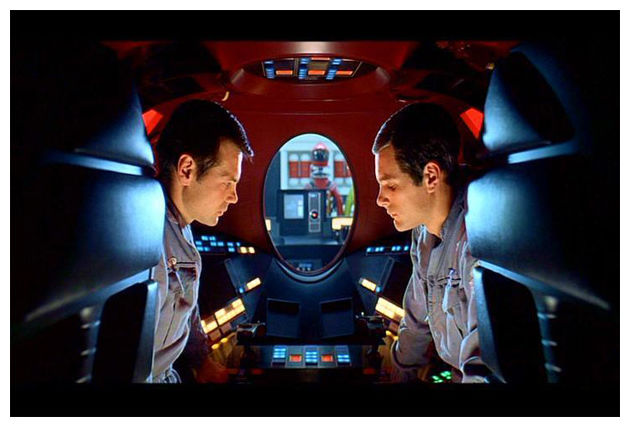
© uxpamagazine.orgA scene from Kubrick’s classic 2001: A Space Odyssey shows a lip-reading computer system eavesdropping on a conversation.
One of the most famous -- and important -- scenes in Stanley Kubrick's film 2001 is when the two astronauts sit in a space pod in order to avoid being overheard by the ship's computer, HAL, which they believe may represent a threat to their lives. Although they have prudently turned off the pod's communication system, what they don't realize is that HAL is able to follow their conversation by lip-reading, and hence is alerted to their disconnection plans.

Although it is unlikely that the Turkish authorities were inspired by the film, the following incident, reported by Politico.eu in a post on the growing censorship in the country, reminds us that the use of lip-reading for surveillance purposes is not science fiction:
Last week, at the funeral of a solider in Osmaniye, south-eastern Turkey, mourners voiced anger at the government's decision to commit troops to conflict with PKK forces in the south-east, leading to several arrests.

Veli Ağbaba, deputy president of the opposition Republican People's Party (CHP), and his colleagues visited two suspects in prison, and have stated that they were arrested on charges of "insulting the president" after footage of the funeral was scrutinized by lip-reading experts.
Calling in lip-reading experts to check whether somebody was insulting the President of Turkey at a funeral might seem a one-off product of an increasingly-paranoid security apparatus. Moreover, using humans is a surveillance technique that doesn't really scale -- unlike metadata analysis, say -- so you might hope this is unlikely to be a problem for most of us.

Beaker

Shades of the X-files? Scientists on a quest to bring 30,000 year old virus back to life

x files virus
Judging by online reactions, scientific news expressing the intentions of researchers to trudge up a 30,000-year-old "franken-virus" was met with unsurprising fear and concern.

Amanda Froelich's report perfectly summarizes the news:
A 'monster' virus which has lain dormant in the frozen wastelands of northeastern Russia is about to be resurrected by researchers curious of its potential effects.

Scientists anticipate "reanimating" a 30,000-year-old virus to learn more about it and discover if it is harmful to animals or humans. Mollivirus sibericum, which translates to soft Siberian virus, has been dubbed "Franken virus" by many who are in opposition of the quest to bring it back to life.

Comment: Just what we need -- another virus. For more on this story see: