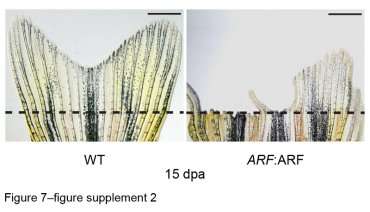
© University of CaliforniaNormally, a zebra fish’s amputated tail fin completely regrows within 15 days (left) but the human tumor suppressor ARF largely blocks this regenerative ability (right).
Regenerative medicine could one day allow physicians to correct congenital deformities, regrow damaged fingers, or even mend a broken heart. But to do it, they will have to reckon with the body's own anti-cancer security system. Now UCSF researchers have found
a human gene that may be a key mediator of this tradeoff, blocking both tumors and healthy regeneration.
As a child, UCSF's Jason Pomerantz, MD, was amazed by the fact that salamanders can regenerate limbs. Now, as a plastic surgeon and stem cell researcher, he believes that insights from creatures like zebrafish and salamanders, which routinely regrow damaged tails, limbs, jaws and even hearts, may one day endow humans with heightened regenerative abilities.
"In the last 10 to 15 years, as regenerative organisms like zebrafish have become genetically tractable to study in the lab, I became convinced that these animals might be able to teach us what is possible for human regeneration," Pomerantz said. "Why can these vertebrates regenerate highly complex structures, while we can't?"
In a study published Nov. 17, 2015, in the journal
eLife, Pomerantz and his team showed new evidence suggesting that mammals may have given up the ability to regenerate limbs partly in exchange for advanced cancer-fighting genes.















Comment: Babies have an eye for statistics
Babies And Beethoven: Infants Can Tell Happy Songs From Sad