
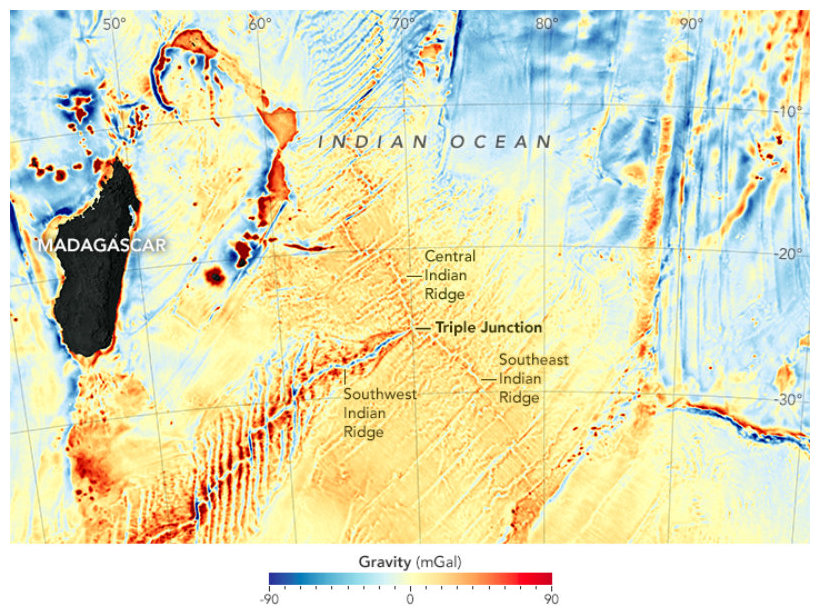
© NASA Earth ObservatoryIn areas with the deepest underwater ridges (shown in blue), the Earth’s gravity is lowest.
NASA's Earth Observatory released the map on Jan. 13, and it reveals the complex topography of the planet's seafloor. By analyzing these underwater peaks and ridges, researchers can decipher how and when the plates that made up the ancient supercontinent Pangaea tore apart about 200 million years ago, resulting in the birth of new ocean crust and the formation of mountain ranges.
The map, which is bright blue and red like a heat map, was compiled by an international team of researchers using a gravity model of the ocean, which is in turn based on altimetry data from the CryoSat-2 and Jason-1 satellites.
Altimetry measures the height of the sea surface from space by timing how long it takes a radar signal to reflect off the ocean and return to the satellite. The subtle highs and lows of the ocean surface mimic both seafloor topography and Earth's gravity field, according to NASA.


















Comment: The sound of your voice influences your emotional state, says researchers