
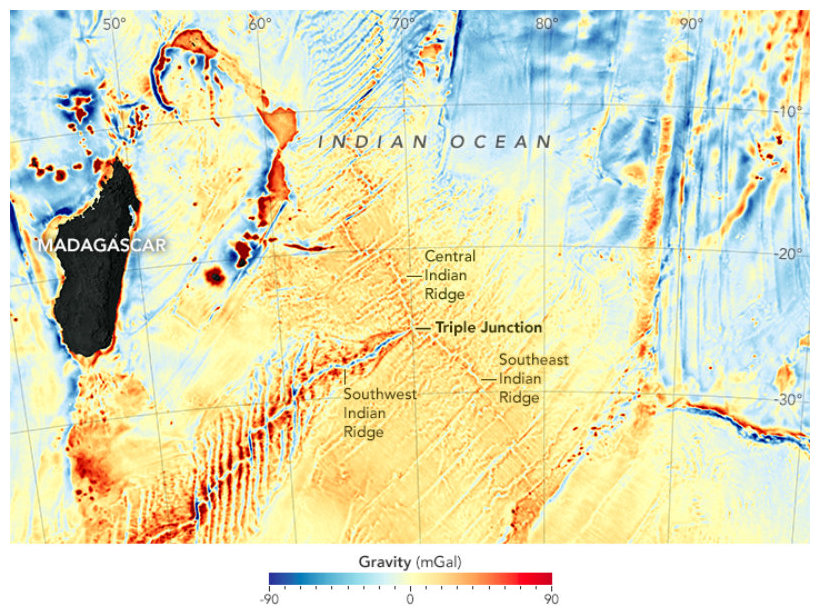
© NASA Earth ObservatoryIn areas with the deepest underwater ridges (shown in blue), the Earth’s gravity is lowest.
NASA's Earth Observatory released the map on Jan. 13, and it reveals the complex topography of the planet's seafloor. By analyzing these underwater peaks and ridges, researchers can decipher how and when the plates that made up the ancient supercontinent Pangaea tore apart about 200 million years ago, resulting in the birth of new ocean crust and the formation of mountain ranges.
The map, which is bright blue and red like a heat map, was compiled by an international team of researchers using a gravity model of the ocean, which is in turn based on altimetry data from the CryoSat-2 and Jason-1 satellites.
Altimetry measures the height of the sea surface from space by timing how long it takes a radar signal to reflect off the ocean and return to the satellite. The subtle highs and lows of the ocean surface mimic both seafloor topography and Earth's gravity field, according to NASA.
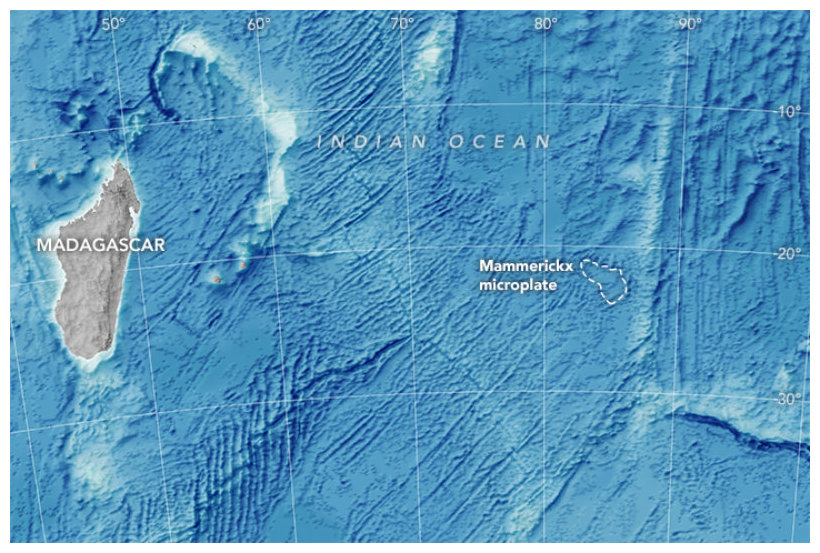
© NASA Earth ObservatoryThe newly discovered Mammerickx Microplate can be seen outlined in this image.
About 50 million years ago, the Indian plate was moving as fast as a tectonic plate can go — roughly 6 inches (15 centimeters) per year. When the Indian plate struck Eurasia, the entire plate slowed down and changed direction, which can be seen in the ridges in the seafloor to the south, where the Indian plate meets the Antarctic plate. The researchers were able to examine these seafloor ridges to recreate the stress the impact placed on the plate. That stress eventually ripped off a small piece of the Antarctic plate, resulting in the Mammerickx Microplate, spinning it like a ball bearing until it came to rest where it is today.
The researchers say that the same seafloor map can be used for further research on tectonic plates. But, submariners and ship captains can also use it for navigation. And with a resolution that captures detailed features as narrow as 3 miles (5 kilometers), it could also potentially be helpful to prospectors searching for oil, gas and mineral resources.



Reader Comments
to our Newsletter