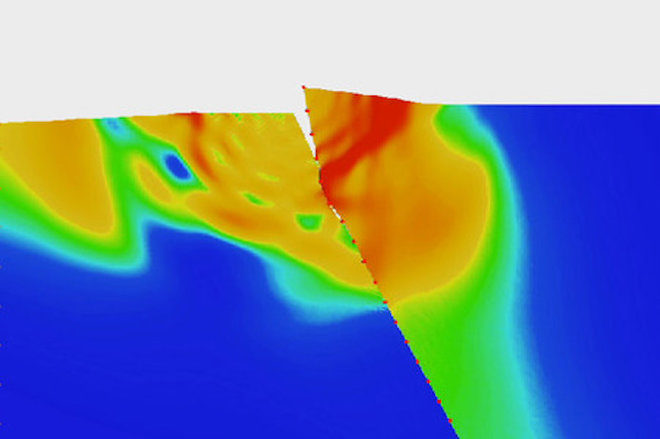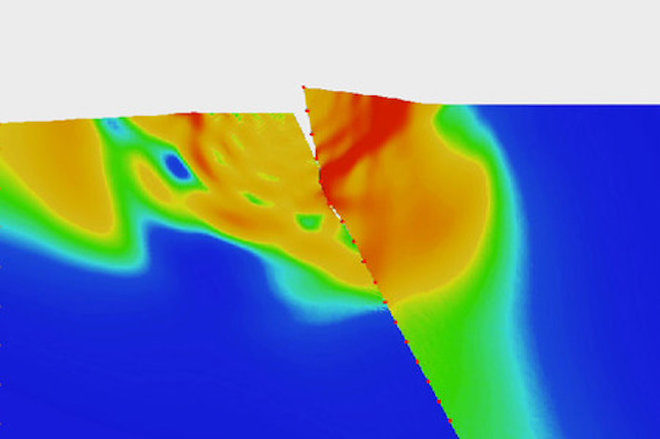
© Harsha BhatThis illustration, based on computer models, shows how the hanging wall (right) of a thrust fault can twist away from the foot wall (left) during an earthquake.
Like a crocodile's jaw opening and snapping shut, Earth's crust can rip apart and then violently close back up during an earthquake, a new study finds.The discovery refutes previous claims that this kind of phenomenon was impossible, and the new research could potentially require that current seismic maps be redrawn.
The study focused on a particular paradox associated with thrust faults, a
crack in Earth's crust, where geologic forces are slowly pushing a huge slab of continental crust up and over an oceanic layer.
"For a long time, it was assumed that
thrust faults, subduction zone faults being a class of such faults, could not have a large amount of slip close to the Earth's surface," said Harsha Bhat, a research scientist at the École Normale Supérieure (ENS) in Paris and co-author of the new study with California Institute of Technology graduate student Vahe Gabuchian.
A dormant hypothesisThe assumption was made because as the continental slab grinds over the oceanic one below, it scrapes off the soft surface clay and leaves it piled up in the subduction zone. Geologists thought that any energy generated from a seismic event within the thrust fault would peter out once it hit the soft clay and that a large slip wouldn't happen near the surface.