Science & TechnologyS


Info

Simple Artificial Cell Created From Scratch To Study Cell Complexity

A team of Penn State researchers has developed a simple artificial cell with which to investigate the organization and function of two of the most basic cell components: the cell membrane and the cytoplasm--the gelatinous fluid that surrounds the structures in living cells. The work could lead to the creation of new drugs that take advantage of properties of cell organization to prevent the development of diseases. The team's findings will be published later this month in the Journal of the American Chemical Society.

cell
©Christine Keating, Penn State
The model cell developed in the lab of Christine D. Keating at Penn State uses as the cytoplasm a solution of two different polymers, PEG and dextran (Panel A). The image in Panel B is the image in Panel A highlighted with fluorescent dyes. The blue region is PEG, which is concentrated in the outer polymer solution; the green area is the portion of the membrane that contains PEG groups, which interact with the contents of the cell; and the red area is the portion of the membrane with fewer PEG groups, which interact with the contents of the cell to a lesser extent. After exposure to a concentrated solution of sugar, the cell converted to a budded form (Panel C). A dextran-rich mixture filled the bud, while a PEG-rich mixture remained inside the body of the cell. Panel D shows the image in Panel C highlighted with fluorescent dyes. The blue area is the PEG-rich region. This new structure exhibits polarity both in the membrane and in the aqueous interior of the model cell.

Laptop

Online device checks carbon dioxide impact

A new online tool has been created to provide companies in Reading with a clear picture of the extent of their environmental impact.

Rocket

Astonishing! Rocket man flies into record books at 180mph

A Swiss rocket man has become the first person to fly with nothing but a wing and a jet engine strapped to his back, hurtling above the Alps at 300km/h.

Rocket

Europe's first crewed spaceship on the horizon

Europe's first crewed spaceship may be on the horizon. The European Space Agency may build a new spaceship - based on its recently launched cargo ship - that could transport humans to the International Space Station and possibly the Moon.

Jules Verne ATV
©ESA

Light Sabers

Flashback Gravity waves: Black holes collide in the best simulation yet

The ripples in space-time created when two black holes merge have been modelled to unprecedented accuracy, according to Einstein's equations, by a powerful new computer simulation. The "waveform" signatures produced in the simulation should help researchers identify the ripples in the data from gravitational wave detectors.

Ripples in space-time
©Henze/NASA
Simulations of the ripples in space-time produced when two black holes merge could help astronomers interpret future gravitational wave observations

Telescope

Black hole trysts revealed by ultraviolet light

Black holes can be secretive about their past, but now there may be an easy way to tell if a monster black hole was once a pair that got cosy and fused together.

Bug

Dinosaur bones reveal ancient bug bites

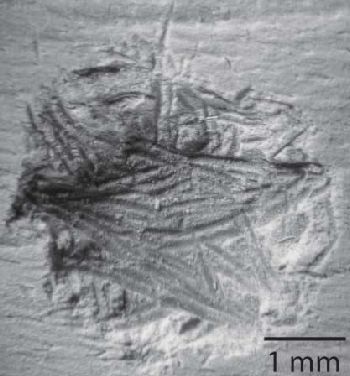
Paleontologists have long been perplexed by dinosaur fossils with missing pieces - sets of teeth without a jaw bone, bones that are pitted and grooved, even bones that are half gone. Now a Brigham Young University study identifies a culprit: ancient insects that munched on dinosaur bones.

Insect-scoured dinosaur bone
©Unknown
A pit excavated by the strong mandibles of dermestid beetle larvae while searching for soft, fat-soaked bone.

Info

Gravity-defying Bird Beak Mystery Solved: Shorebirds Benefit From Surface Tension

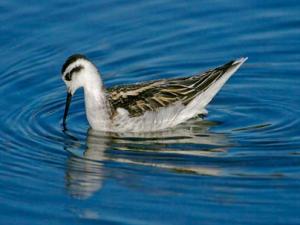
As Charles Darwin showed nearly 150 years ago, bird beaks are exquisitely adapted to the birds' feeding strategy. A team of MIT mathematicians and engineers has now explained exactly how some shorebirds use their long, thin beaks to defy gravity and transport food into their mouths.

phalarope
©Rainey Schuler
MIT researchers have figured out how the phalarope, a shorebird with a long, narrow beak, transports its food from the tip of its beak to its mouth. Here the bird feeds by pecking at the water surface.

The phalarope, commonly found in western North America, takes advantage of surface interactions between its beak and water droplets to propel bits of food from the tip of its long beak to its mouth, the research team reports in the May 16 issue of Science.

Telescope

Astronomers baffled by weird, fast-spinning pulsar

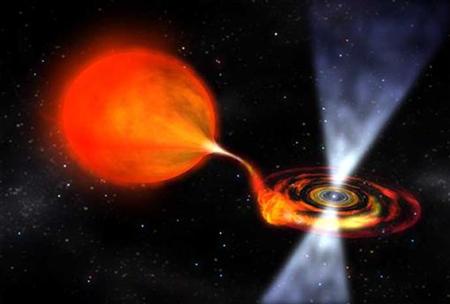
WASHINGTON - Astronomers are baffled after finding an exotic type of star called a pulsar apparently locked in an elongated orbit around a star much like the sun -- an arrangement defying what had been known about such objects.

Reckless pulsars
©REUTERS/HO/NASA
Reckless pulsars - spinning searchlights in space - might tear themselves apart if they whirled too fast, but ripples in the cosmic fabric first predicted by Albert Einstein may set a celestial speed limit. That limit is still extremely high, about 760 revolutions per second, astronomers said on July 2, 2003.

The rapidly spinning pulsar -- an extraordinarily dense object created when a massive star exploded as a supernova -- is called J1903+0327 and is located about 21,000 light years from Earth, the astronomers said.


Telescope

Bizarre Star Gets Stranger

Pulsars are like cosmic lighthouses sending out sweeping beams that blink at us across the galactic expanse. Now scientists have spotted a wacky pulsar that doesn't behave exactly like its fellows: Instead of circling a white dwarf star, this one orbits a sun-like star along an oval path.

All other known pulsars that rotate as quickly as this one seem to have picked up speed by pulling off mass from a companion star that has reached the advanced stage of red giant, when its gaseous layers bloat out prior to the end-stage of life as a very compact, dim, white dwarf.