Science & TechnologyS


Evil Rays

Data show Antarctic ice stream radiating seismically

A seismologist at Washington University in St. Louis and colleagues at Pennsylvania State University and Newcastle University in the United Kingdom have found seismic signals from a giant river of ice in Antarctica that makes California's earthquake problem seem trivial.

Douglas A. Wiens, Ph.D., Washington University professor of earth and planetary sciences in Arts & Sciences, and colleagues combined seismological and global positioning system (GPS) analyses to reveal two bursts of seismic waves from an ice stream in Antarctica every day, each one equivalent to a magnitude seven earthquake. The GPS analyses were performed by Pennsylvania State and Newcastle University researchers.

Target

Asteroid may have killed Iceman

BERGAMO, Italy -- A British scientist said a prehistoric mummy known as the Iceman may have been killed by an asteroid.

Display

Houston: data center explosion shuts down 9000 web servers

The Planet.com Internet Services Inc. hopes to have all 9,000 of its servers in its Houston data center back online later tonight following a blast that shut down the facility on Saturday afternoon.

When firefighters arrived at around 5 p.m., they could see "light smoke" at the Planet data center -- the aftermath of an explosion in a network gear room that produced enough force to move walls. Sprinklers quickly doused whatever flames erupted; the fire was attributed to an electrical problem with a transformer, according to a Houston Fire Department spokeswoman. There were no injuries.

Telescope

New Method Developed To Weigh, Resolve Distant Black Holes

Research presented to the American Astronomical Society meeting in St. Louis June 2 offers astronomers a new, simple method to learn about black holes up to eight billion light years away - thousands of times farther away than black holes can be measured today.

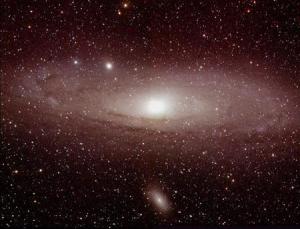
Andromeda galaxy
©Chaco Culture NHP Observatory
Andromeda galaxy.

Info

Human Control Of Earth's Radiation Belt

Charged particles within the Earth's radiation belts travel in spiral trajectories along geomagnetic field lines. The strength of the magnetic field increases as the particles approach the Earth; because charge flows perpendicular to magnetic field lines, the component of the particles' velocity parallel to the magnetic field decreases.

Usually, this causes particles to reverse direction and spiral back along the field lines, continuing until they reach the opposite hemisphere, where they reverse again. These trapped particles can be deflected by certain electromagnetic waves (whistlers) into the Earth's dense atmosphere (below 100 kilometers (60 miles)), where they cannot escape back to the magnetosphere.

Noting that whistlers can be generated by ground-based transmission signals in the very low frequency range (VLF, used for military communications), Sauvaud et al. use satellite observations to investigate how a VLF transmitter located in Australia (labeled NWC) affects the population of inner radiation belt electrons first above it and then along the electron drift path around the Earth.

Magic Wand

Study of Glacial Earthquakes Shakes Up Idea of How Ice Streams Move

New research that integrates seismic recordings with Global Positioning System (GPS) measurements indicates that a 7,000-square-mile region of the Whillians Ice Stream in West Antarctica moves more than two feet twice every day in an earthquake-like pattern equivalent to a Magnitude 7 temblor.

The findings were published in this week's edition of the journal Nature by a group of scientists that includes investigators from Washington University in St. Louis, Penn State University and the University of Newcastle in Great Britain. The National Science Foundation (NSF) funded the U.S. researchers.

Seismologists use the magnitude scale to describe the seismic energy released by an earthquake. An earthquake measured at between 7.0 and 7.9 on the scale is considered "major," and can cause serious damage over large areas in populated regions of the world. Not including the events described in the new findings, there are an estimated 20 such quakes worldwide each year.

Image
©NSF
Setting up a field camp in Antarctica.

Cow Skull

Russian mammoth skeleton could be world's most intact

The skeleton of a mammoth found in south Russia last year might be the world's most intact exhibit, local museum authorities said on Thursday.

The skeleton of the mammoth, which lived between 1 and 1.8 million years ago, is slightly over 80% intact.

Wine

Chief geneticist steps down

Washington - The government's leading geneticist announced yesterday that he is stepping down after 15 years spent paving the way for the growing role that DNA will play in medical care.

As director of the National Human Genome Research Institute, Dr. Francis S. Collins led the successful effort to sequence the human genome and helped secure a new law, signed just last week, barring discrimination based on genetic information. He also shepherded significant advances in understanding the genetic causes of common diseases, while attempting to reassure a public concerned about the ethical implications of the fast-moving developments.

Telescope

Venus Express Reveals New Details On Venusian Clouds

As ESA's Venus Express orbits our sister planet, new images of the cloud structure of one of the most enigmatic atmospheres of the Solar System reveal brand-new details.

Venus
©ESA/MPS/DLR/IDA
Southern hemisphere of Venus in the ultraviolet.

Telescope

Cassini Sees Collisions Of Moonlets On Saturn's Ring

A team of scientists led from the UK has discovered that the rapid changes in Saturn's F ring can be attributed to small moonlets causing perturbations. Their results are reported in Nature (5th June 2008). Saturn's F ring has long been of interest to scientists as its features change on timescales from hours to years and it is probably the only location in the solar system where large scale collisions happen on a daily basis. Understanding these processes helps scientists understand the early stages of planet formation.

Saturns F ring
©NASA/JPL/Space Science Institute
Saturn's F ring.