Science & TechnologyS


Bomb

Flashback Friend or Foe? Crows Never Forget a Face, It Seems

Image
© Keith Brust; Jeff WallsI KNOW YOU - John M. Marzluff, a wildlife biologist tested crows’ ability to distinguish between faces.
Crows and their relatives - among them ravens, magpies and jays - are renowned for their intelligence and for their ability to flourish in human-dominated landscapes. That ability may have to do with cross-species social skills. In the Seattle area, where rapid suburban growth has attracted a thriving crow population, researchers have found that the birds can recognize individual human faces.

The researchers used a simple hat and masks to test the animals' abilities.

Comment: Interesting that the power structures of society have nearly destroyed an analogous ability within the human population to recognize pychopathic predators and share that knowledge, particularly in women.


Cow Skull

Big fossil found in hurricane Ike-ravaged home's front yard

A homeowner whose beachfront property in Texas was destroyed during Hurricane Ike has found a football-size fossil tooth in the debris.

Dorothy Sisk asked her colleague, Lamar University paleontologist Jim Westgate, to accompany her to her Bolivar Peninsula home after Ike hit. Together they found something unusual in the remains of Sisk's front yard: a six-pound fossil tooth.

Telescope

Dark matter makes galaxy's stars live long and prosper

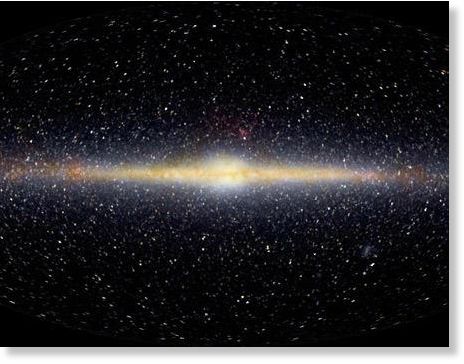
Stars at the centre of the Milky Way could gobble up enough dark matter to extend their lifetimes by a billion or more years, a new study suggests. If such stars are found, they could help reveal what the mysterious dark matter is actually made of.
Sun-like stars on tight orbits around the centre of the Milky Way
© E L Wright/UCLA/COBE/DIRBE/NASASun-like stars on tight orbits around the centre of the Milky Way may gobble up enough dark matter to appear redder and brighter than they would otherwise.

Although it constitutes roughly 90% of the Milky Way's mass, dark matter is thought to be too diffuse in most parts of the galaxy to have a large effect on stars. But close to the colossal black hole at the galactic centre, the material might be sufficiently dense that stars can capture it at high rates.

To investigate dark matter's effect on such stars, Pat Scott of Stockholm University in Sweden and colleagues modelled the evolution of stars as they gravitationally accumulated weakly interacting massive particles, or WIMPs - a popular group of dark matter candidates.

Telescope

What happened to the Kuiper Belt's smallest objects?

The hunt continues for the outer solar system's tiniest residents. A two-year search to find small objects there has turned up nothing, bolstering theories that 'all hell broke loose' in the solar system just a few hundred million years after it formed.

Astronomers have found more than 1000 objects in the Kuiper Belt, a ring of icy bodies beyond Neptune. There are fewer large Kuiper Belt Objects than smaller ones, but the exact size distribution is unknown because only a handful of KBOs smaller than 70 kilometres across have been found - they simply reflect too little sunlight to be observed.

Meteor

Meteorites From Inner Solar System Match Up To Earth's Platinum Standard

Some of the world's rarest and most precious metals, including platinum and iridium, could owe their presence in the Earth's crust to iron and stony-iron meteorites, fragments of a large number of asteroids that underwent significant geological processing in the early Solar System.
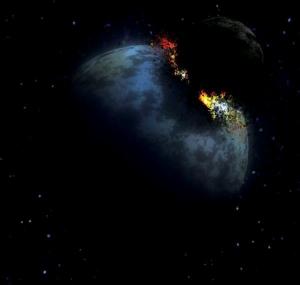
asteroid impact with early Earth
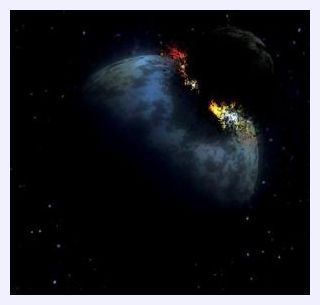
© ESAArtist's impression of asteroid impact with early Earth that led to lunar formation.

Dr Gerhard Schmidt from the University of Mainz, Germany, has calculated that about 160 metallic asteroids of about 20 kilometres in diameter would be sufficient to provide the concentrations of these metals, known as Highly Siderophile Elements (HSE), found in the Earth's crust. Dr Schmidt will be presenting his findings at the European Planetary Science Congress in Münster on Monday 22nd September.

Dr Schmidt said, "A key issue for understanding the origin of planets is the knowledge of the abundances of HSE in the crust and mantle of the Earth, Mars and the Moon. We have found remarkably uniform abundance distributions of HSE in our samples of the Earth's upper crust. A comparison of these HSE values with meteorites strongly suggests that they have a cosmochemical source."

Star

Spotless Sun: Blankest Year of the Space Age

Astronomers who count sunspots have announced that 2008 is now the "blankest year" of the Space Age.

Sherlock

Old violins reveal their secrets

Why do the violins made by Stradivari and Guarneri del Gesù sound so good? Countless theories have been proposed for the secret of these eighteenth-century Italian instrument-makers, but attempts to identify a unique acoustic signature have proved fruitless. Now a study has finally identified a measurable sound quality that distinguishes these old violins from cheap, factory-made instruments.

After spending ten years painstakingly measuring the acoustics of violins rated from "bad" to "excellent" by professional musicians, George Bissinger of East Carolina University in Greenville, North Carolina, says that the 'excellent' old Italian violins in his sample show a significantly stronger acoustic response in the lower octaves than do the 'bad' violins, whereas those rated merely 'good' have intermediate values1. The high-quality tone is caused by a single mode of vibration of air inside the body, which radiates sound strongly through the violin's f-holes.

Binoculars

Jupiter, looking sharp

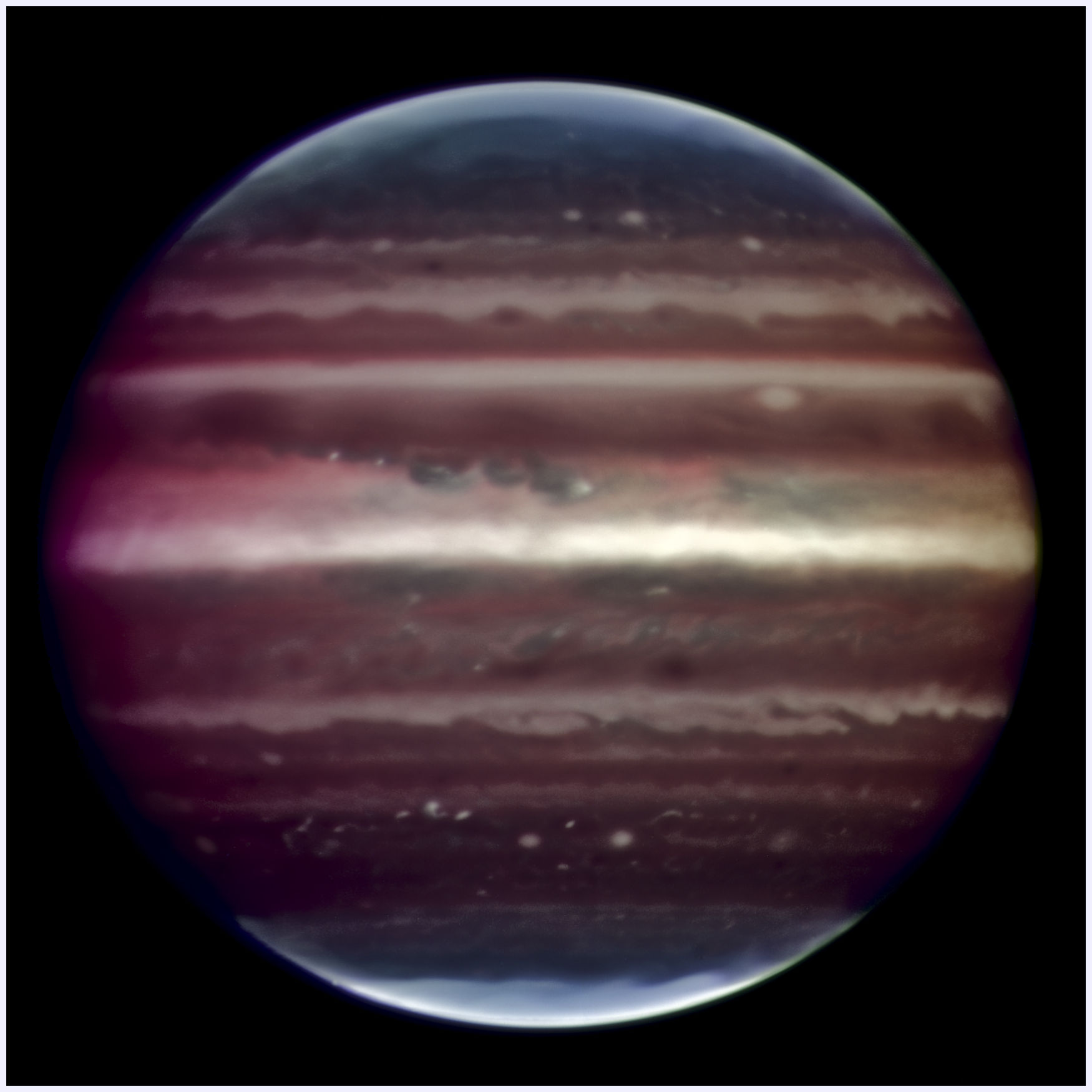
This weird-looking image
Jupiter MAD
© Discover MagazineJupiter, looking sharp and hot
is the sharpest picture of Jupiter ever taken from the ground. Taken with a device called - are you ready for this? - the Multi-Conjugate Adaptive Optics Demonstrator (or MAD, in an acronymic stretch), it has a resolution better than Hubble's!

The Earth's atmosphere roils and waves, distorting ground-based views of the sky. That's one of the reasons we launch telescopes into space, to get above all that mess. But if you can observe a point-like object such as a star at the same time you observe your target object, it's possible to compensate for the distortion by taking extremely rapid fire snapshots and measuring the way the star image changes. You then apply a correction to the image, and presto! It's cleaner. However, you can only do this for the area near the star. Distortions change across a telescope's field of view, making this technique somewhat limited.

Syringe

Australia issues first license to clone human embryos

The Australian government has issued its first license allowing scientists to create cloned human embryos to try and obtain embryonic stem cells.

Info

Was Stonehenge a Neolithic nursing home for Europe's sick and ailing?

DRUIDS, mystics, UFO enthusiasts and even the occasional rock star have converged in awe beneath its arcane structure.
Now, after its eternal mysteries have driven generations of archaeologists round in circles, a lucid new theory has suggested Stonehenge was conceived for a more prosaic purpose - as a Neolithic health centre.

The latest hypothesis surrounding one of the world's best known but least understood landmarks suggests the world heritage site was a precursor to Lourdes.

The claim follows the first dig inside Stonehenge's concentric circles for nearly half a century. The excavation this spring unearthed many fragments of bluestone, accorded healing powers in medieval folklore and literature, and seemingly taken as lucky charms by visitors to Salisbury Plain.

Comment: For those of you who would like to learn the secrets of Stonehenge, read Laura Knight-Jadczyk's The Secret History of the World.

This would probably be good advice for the above researchers, too.