Science & TechnologyS


Info

3-D Images Reveal What Happens as Brain Loses Consciousness

Anaesthetised Brain
© University of ManchesterReconstruction of the brain during the onset of anaesthesia. This particular frame shows the brain in an anaesthetised state following global conductivity changes.
New 3-D images reveal for the first time what happens inside the brain when a person loses consciousness, suggesting the mysterious sleeplike state occurs as electrical activity deep in the brain dims and connections between certain neurons suddenly break down.

"We have produced what I think is the first video in existence in the entire world of [the brain of] a patient being anesthetized," said study researcher Brian Pollard, of the University of Manchester. "We are seeing different parts of the brain, different areas, being activated and deactivated."

Loss of consciousness occurs when the brain is no longer aware of one's surroundings and so the body stops reacting to the world around it. Scientists and doctors aren't sure how this happens, but distinguish it from consciousness, or the ability to understand, be self-aware and think in the unique way that humans do.

Chalkboard

What flips on the Northern Lights?


Golden Valley, Minnesota. -- They look cool, but do you know what flips the switch on the Northern Lights?


Major solar flares from the sun have sent massive amounts of particles into the Earth's atmosphere, meaning that we may see the Northern Lights over the next few days.

These particles from the solar flare also called a solar wind are pulled into the Earth's atmosphere and then the particles glow when they interact with the gasses in the Earth's atmosphere.

The glowing particles are called the Northern Lights or Aurora Borealis. The most common color seen with the Northern Lights is green, but sometimes other colors like red and blue are visible.

Umbrella

Evaporation from Land Only Modifies Rainfall Frequency

Image
© Google
A team of researchers has found that evaporation from the land only modifies the frequency of summertime rainfall, and not its quantity.

"This is a major shift in our understanding of the coupling between the land surface and the atmosphere, and fundamental for our understanding of the prolongation of hydrological extremes like floods and droughts," said Pierre Gentine, assistant professor of Applied Mathematics at The Fu Foundation School for Engineering and Applied Science at Columbia University.

They discovered that higher evaporation increases the probability of afternoon rainfall east of the Mississippi and in Mexico, while it has no influence on rainfall over the Western U.S. The cited the difference is due to the humidity present in the atmosphere. The researchers explained that the atmosphere over the western regions is so dry that no matter what the input of moisture via evaporation is from the surface, an added source of moisture will not trigger any rain.

Chalkboard

Scientists Exploring Quake Warning Signals

Image
© Reuters
Seismologists and other scientists at eight universities in Japan are collaborating with a team of American and Russian researchers to try to devise a reliable system for predicting destructive earthquakes. This comes after the release of preliminary research following the March 11th earthquake in Japan indicating changes were detected in the atmosphere in the days before and after the destructive tremor.

When a potentially destructive earthquake strikes, the Japanese sometimes are able to receive a warning - although usually just a few seconds before the ground starts shaking.

These warnings are broadcast on radio and television and sent to mobile phones and computers. This automated alarm is triggered by the initial elastic P-wave of a tremor, which immediately precedes the slower but more destructive secondary wave, which then shakes the ground back and forth perpendicular to the direction it is moving.

Researchers around the world have been seeking a way to reliably give indications of quakes hours or days before they occur.

Info

Ducklings Following Dog Explained

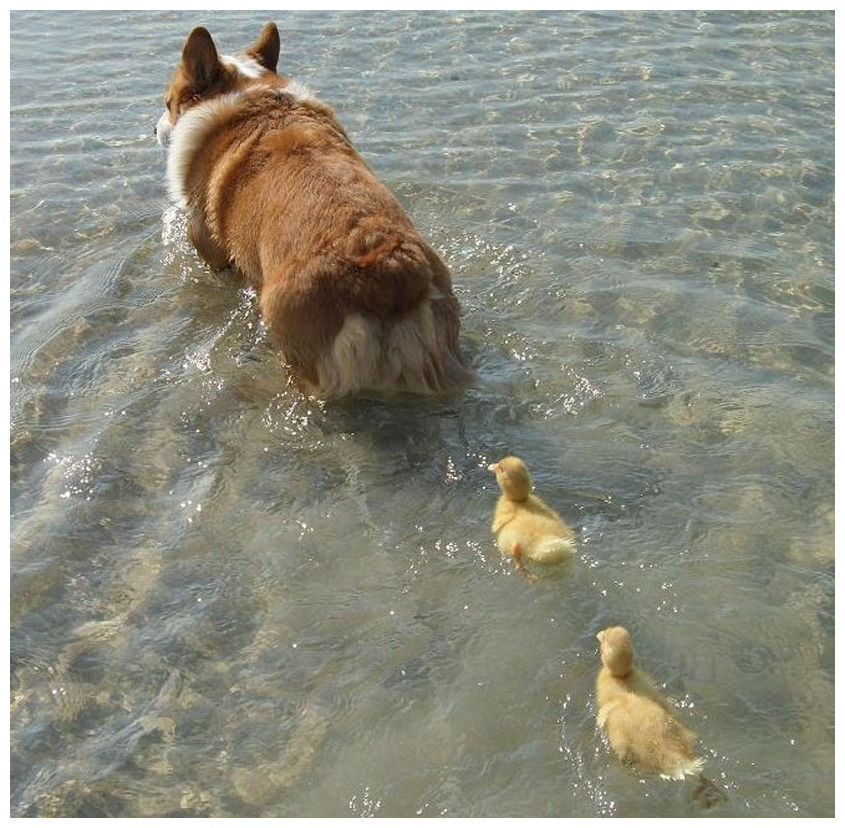
Dogs & Ducklings_1
© Frances Marsh
Ducklings following in a line behind a mother duck is enough to turn heads and elicit a few "awwws." But ducklings following a dog? Now that's worthy of Animal Planet's Wall of Fame where this photo first appeared.

While it might look like a strange friendship between two species, this adorable, multi-animal, fluffy overload is actually the byproduct of thousands of years of avian evolution.

"There's nothing unique here at work," according to Sara Hallager, a bird biologist at the National Zoo. "All baby birds, when they're born, the first thing they see, which is usually the same species, is what they imprint on."

Info

A Big Surprise from the Edge of the Solar System

NASA's Voyager probes are truly going where no one has gone before. Gliding silently toward the stars, 9 billion miles from Earth, they are beaming back news from the most distant, unexplored reaches of the solar system.

Mission scientists say the probes have just sent back some very big news indeed.

It's bubbly out there.

"The Voyager probes appear to have entered a strange realm of frothy magnetic bubbles," says astronomer Merav Opher of Boston University. "This is very surprising."


According to computer models, the bubbles are large, about 100 million miles wide, so it would take the speedy probes weeks to cross just one of them. Voyager 1 entered the "foam-zone" around 2007, and Voyager 2 followed about a year later. At first researchers didn't understand what the Voyagers were sensing--but now they have a good idea.

Bizarro Earth

Keeping an eye on Yellowstone's supervolcano

Image
© National Park ServiceYellowstone is an active volcano. Surface features such as geysers and hot springs are direct results of the region's underlying volcanism.
When next 'big one' will be is anyone's guess - but you don't want to be here

It's no mere doomsday pseudoscience: The Yellowstone supervolcano really could be the end of us all. When the Yellowstone Caldera - the name of the national park's geographic structure, which roughly translates as "caldron" - blows its lid, much of the continental United States will get covered in a blanket of ash. That ash will clog the atmosphere enough to block out the sun, disrupting the global climate enough to cause mass extinctions.

The last full-scale eruption of that kind occurred 640,000 years ago, and the ones prior to that occurred 1.3 million years and 2.1 million years ago. Interspersed with the big ones have been smaller-scale but still major eruptions, most recently 70,000 years ago.

At the Yellowstone Volcano Observatory (YVO), an outpost run by the U.S. Geological Survey in conjunction with Yellowstone National Park and the University of Utah, a team of volcanologists continuously monitors the sleeping giant's tectonic activity. They listen to its rumblings (which are streamed online in real time) for clues as to what's brewing below the surface. Jacob Lowenstern, scientist-in-charge at YVO, told us what they're listening for and what they know so far about the next "big one."

Laptop

Facebook in New Privacy Row Over Facial Recognition Feature

Facebook
© AlamyThe new Facebook feature uses facial recognition technology to speed up the process of labeling friends and acquaintances in photos.
Social network turns on new feature to automatically identify people in photos, raising questions about privacy implications of the service

Facebook has come under fire for quietly expanding the availability of technology to automatically identify people in photos, renewing concerns about its privacy practices.

The feature, which the giant social network automatically enabled for its more than 500 million users, has been expanded from the US to "most countries", Facebook said on its official blog on Tuesday.

Marc Rotenberg, president of the non-profit privacy advocacy group Electronic Privacy Information Center, said the system raised questions about which personally identifiable information, such as email addresses, would become associated with the photos in Facebook's database.

He also criticised Facebook's decision to automatically enable the facial-recognition technology for its users.

"I'm not sure that's the setting that people would want to choose. A better option would be to let people opt-in," he said.

Internet security consultancy Sophos noted that many Facebook users had seen the facial recognition option turned on without any notice in the last few days.

Magnet

Researchers discover 'superatoms' with magnetic shells

A team of Virginia Commonwealth University scientists has discovered a new class of 'superatoms' - a stable cluster of atoms that can mimic different elements of the periodic table - with unusual magnetic characteristics.

The superatom contains magnetized magnesium atoms, an element traditionally considered as non-magnetic. The metallic character of magnesium along with infused magnetism may one day be used to create molecular electronic devices for the next generation of faster processors, larger memory storage and quantum computers.

In a study published online in the Early Edition of the Proceedings of the National Academy of Sciences, the team reports that the newly discovered cluster consisting of one iron and eight magnesium atoms acts like a tiny magnet that derives its magnetic strength from the iron and magnesium atoms. The combined unit matches the magnetic strength of a single iron atom while preferentially allowing electrons of specific spin orientation to be distributed throughout the cluster.

Telescope

A planet going the wrong way

Wrong way planet
© NASA

All planets move around their stars in the same direction as the star spins - at least that's what we thought. But now Australian National University astronomer Dr. Daniel Bayliss and his colleagues have found a planet that breaks the mold.

Dr. Bayliss, from the Research School of Astronomy and Astrophysics, is one of 16 early-career scientists unveiling their research to the public at Fresh Science - a national program sponsored by the Australian Government.

Using one of the world's largest telescopes in Chile, Daniel and his collaborators discovered that a distant planet WASP-17b is moving in the opposite direction to the spin of the star around which it orbits. The discovery throws traditional theories about how planets form around stars into doubt.

Planets form from the same disk of rotating material that gives birth to the star around which they move. So until now it has been assumed that any planets orbiting a star would be moving in the same direction as the star's spin. This is certainly true in our own Solar System.

WASP-17b is quite different, Dr. Bayliss says, and its backwards motion is somewhat of a mystery to scientists.