
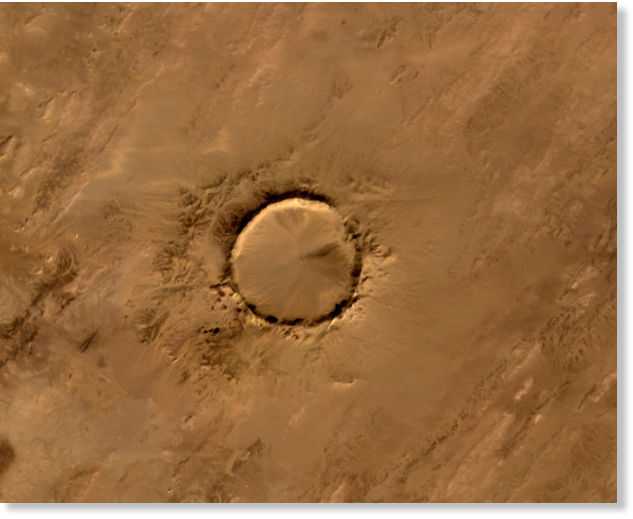
© NASA/Earth ObservatoryTenoumer Crater, Mauritania
Trying to predict how much time we have before the next asteroid or comet impact event may sound like a fool's errand. After all, how can we forecast when a rare, yet devastating, space rock will careen through the inner solar system?
For starters, we could use statistics. Looking for patterns in a number of previous impact events is a valuable tool when trying to understand how often Earth was pummeled in the past. Once we know this, projections can be made for the risk of getting hit again.
However, according to a study by scientists of the Max Planck Institute for Astronomy (MPIA), the statistics we use to make these projections may be fundamentally flawed.
Comment: The premise that one can understand impact periodicity based on a statistical study of those visible craters left in the geological record is definitely a "fool's errand." This is not because impact periodicity isn't a real possibility, but because current science doesn't take into account all the possible ways that comet encounters occur.
The recent work of Dennis Cox shows that there are many more possible impact sites around the globe than currently supposed by mainstream geology. As Dennis is wont to say, "if you can describe a beast, you can predict its footprints." As we'll see below, it's clear that the scientists working on this study at the MPIA have not yet described the beast, let alone predicted its footprints.









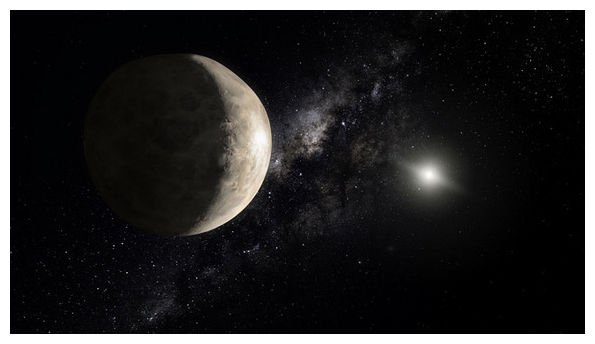






Comment: Exactly, "from the crater record" (that being the key phrase) there is no evidence for a Nemesis body. Clearly, the crater record is not the only evidence we have that comet encounters occur on a cyclical basis.
Getting WISE About Nemesis
Nemesis: Does the Sun Have a 'Companion'?
Something Wicked This Way Comes