
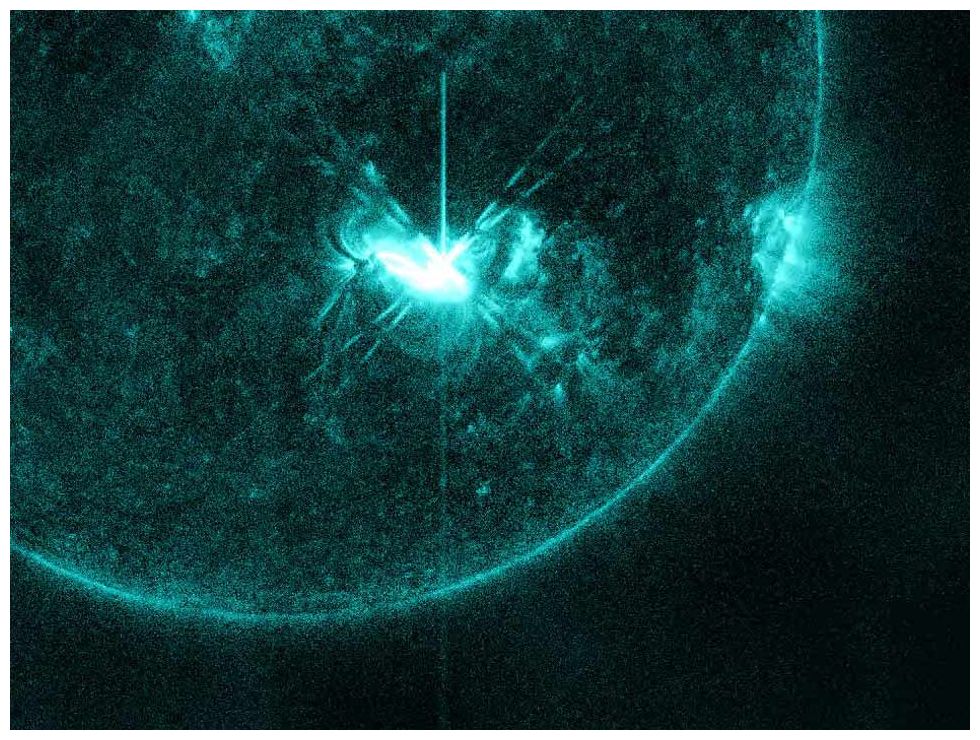
© NASA/SDO/AIA/HelioviewerFireworks. By using neutron sensors in place at the South Pole, scientists may be able to estimate the intensity of radiation produced by a solar flare (one that peaked on 4 July, shown), as well as when the radiation would arrive at Earth.
That scenario is a bit closer to reality, thanks to a team of researchers that has found a way to estimate the intensity and arrival time of charged particles spewed toward Earth by strong solar storms. Such space weather could irradiate astronauts and fry satellites, and until now there hasn't been a good way to forecast it.
Not all space storms are the same. Some of the charged particles spewed by solar flares travel exceptionally fast and thus are extremely energetic, while others travel more slowly, says John Bieber, a space physicist at the University of Delaware, Newark. The more energy a particle carries, the more damage it can do. Because the less-energetic slower particles typically far outnumber fast ones, however, they do most of the overall damage. That delay offers the opportunity for an early warning before the most intense part of the solar storm strikes, he says.
The big problem is that solar storms are hard to predict. Sun-watching satellites can help monitor solar flares, but they can't provide accurate estimates of when the radiation will arrive or how strong it will be. Now, reporting in Space Weather, Bieber and his colleagues suggest a better way: neutron sensors at the South Pole. For decades, these sensors have been used to estimate the rate at which cosmic rays and other charged particles strike Earth's atmosphere. The sensors actually detect the neutrons created in the upper atmosphere when high-speed particles slam into the nuclei of atoms of gases, knocking them apart and sending the neutrons groundward. Some of those speeding particles are protons in solar flares.










Comment: This is just a ruse to make you think the government can actually do anything about what's coming. It can't. There's no hope to be found in their system.
Reign of Fire: Meteorites, Wildfires, Planetary Chaos and the Sixth Extinction