Science & TechnologyS


Eye 1

Implant lets blind eyes "see" braille

Second Sight
© Medical Daily
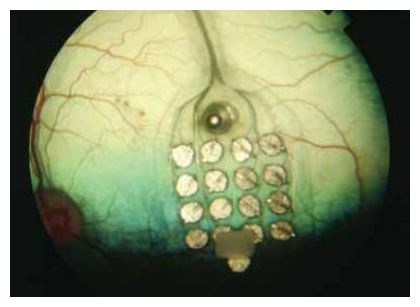
For the first time, blind people could read street signs with a device that translates letters into Braille and beams the results directly onto a person's eye.

The technology is a modification of a previous device, Argus II developed by Second Sight, which has been implanted on 50 patients, many of whom can now see colors, shapes, and movements. The complicated device uses a camera attached to a pair of glasses, a small processor to convert the signal of the camera into electrical stimulation, and a microchip with electrodes attached directly to the person's retina.

The technology, used primarily for patients with retinal pigmentosis which causes patients to lose the use of their retina but to still have working neurons, can take up to 10 seconds to convert a single letter and minutes to read a single word, and can only be used with words that are printed in a large font and held up close to a person's face. Street signs, for example, cannot be read. The new technology, a modification of the Argus II, should take just seconds to read words, by contrast.

"In this clinical test with a single blind patient, we bypassed the camera that is the usual input for the implant and directly stimulated the retina. Instead of feeling the Braille on the tips of his fingers, the patient could see the patterns we projected and then read individual letters in less than a second with up to 89% accuracy," lead author of the paper Thomas Lauritzen said in a press release.


Display

Windows 8 criticized for its part in ailing PC growth

Image
© Microsoft
Analysts brands operating system as confusing.

Analysts have criticized Microsoft's latest operating system Windows 8 by calling it confusing and for playing its part in slow PC growth.

In a research note from analyst Chris Whitmore, the first reason Deutsche Bank attributed for decreasing its PC estimates this quarter was a "lackluster initial uptake of Windows 8." In addition to referring to the impact of "macro weakness" and the "fiscal cliff", he continues:

"As in past cycles we expect the introduction of a new Microsoft OS to spur an increase in PC demand. However...we believe Win8 will have a more muted impact than prior cycles for a several reasons: 1) Win8 reviews are mixed due to a confusing UI; 2) there is a lack of Enterprise interest in Window 8; 3) tablet form factor complicates positioning (Win8 vs. Windows RT), 4) continued substitution of PCs by iPads/tablets 4)."

Igloo

Another reason to eat meat: Vegetarian cave bear 'starved to death' during Ice Age

Image
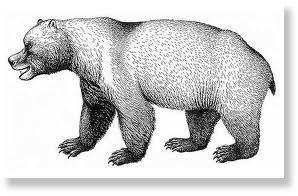
© N. Frotzler European cave bear: It is thought Neanderthals revered the animal and treated it as a god
The mainly-vegetarian bear is likely to have starved during the Ice Age when its main source of food disappeared. Carbon dating of cave bear bones suggests its extinction almost 30,000 years ago, coincided with major changes in the environment.

Professor Anthony Stuart, a Natural History Museum palaeontologist, and a colleague from the University of Vienna, used new radiocarbon dating of fossil remains from sites across Europe, to accurately establish the timing of the bear's disappearance.

The cave bear (Ursus spelaeus) was found across much of Europe from Spain to the Urals but no further east suggesting it was unsuited to areas of extreme temperatures.

Despite weighing up to 1,000lbs the cave bear, unlike its modern day counterpart which eats fish, was entirely vegetarian and probably ran out of food as the climate cooled and vegetation disappeared.

Info

No more jet lag: Researchers invent a device that resets sleep

Re-Timer
© Medical Daily
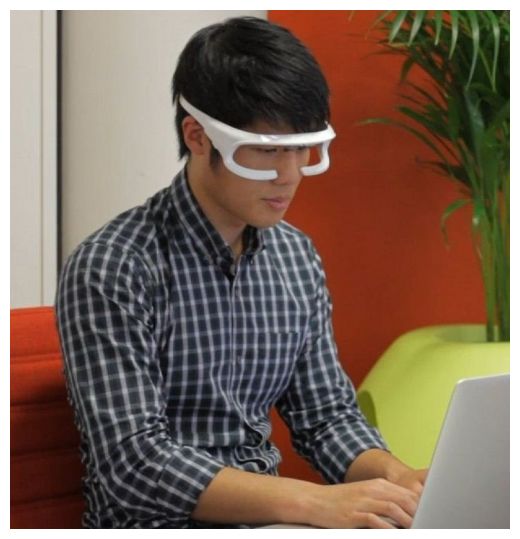
Australian researchers have invented a device that can reset the body's clock and help people get a proper sleep even after a flying to a different time zone.

The device called Re-Timer works by stimulating the part of brain that regulates 24-hour sleep cycle in the body.

The device has been developed and launched by sleep researchers at Flinders University, Australia.

"Body clocks or circadian rhythms influence the timing of all our sleeping and waking patterns, alertness, performance levels and metabolism," said Psychologist Professor Leon Lack from Flinders University.

People who wish to reset their body clocks to fit their sleep schedule must prepare in advance. The device must be used three days for 50 minutes each day. To advance body clock, the user must wear the device after awakening in the morning while wearing it before bed time delays the body clock.

Blackbox

Mars Mystery: Has Curiosity rover made a big discovery?

Image
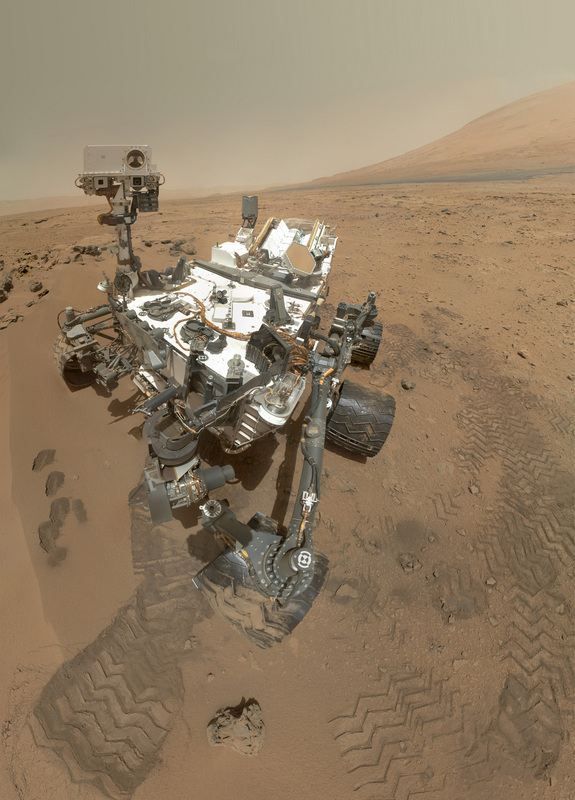
© NASANASA's Mars rover Curiosity used its Mars Hand Lens Imager (MAHLI) to snap a set of 55 high-resolution images on Oct. 31, 2012. Researchers stitched the pictures together to create this full-color self-portrait.
NASA's Mars rover Curiosity has apparently made a discovery "for the history books," but we'll have to wait a few weeks to learn what the new Red Planet find may be, media reports suggest.

The discovery was made by Curiosity's Sample Analysis at Mars instrument, NPR reported today (Nov. 20). SAM is the rover's onboard chemistry lab, and it's capable of identifying organic compounds - the carbon-containing building blocks of life as we know it.

SAM apparently spotted something interesting in a soil sample Curiosity's huge robotic arm delivered to the instrument recently.

"This data is gonna be one for the history books," Curiosity chief scientist John Grotzinger, of Caltech in Pasadena, told NPR. "It's looking really good."

The rover team won't be ready to announce just what SAM found for several weeks, NPR reported, as scientists want to check and double-check the results. Indeed, Grotzinger confirmed to SPACE.com that the news will come out at the fall meeting of the American Geophysical Union, which takes place Dec. 3-7 in San Francisco.

Robot

Rise of the Machines: Autonomous killer robots 'could be developed in 20 years'

  • 
    Raytheon's Phalanx gun
    © RaytheonAutomatic firing: Raytheon's Phalanx gun system, which searches for enemy missiles and automatically destroys incoming projectiles
    Militaries around the world 'very excited' about replacing soldiers with robots that can act independently
  • U.S. leads the way with automated weapons systems, but drones still need remote control operator authorisation to open fire
  • Human Rights Watch calls for worldwide ban on autonomous killing machines before governments start using them
  • Fully autonomous robots that decide for themselves when to kill could be developed within 20 to 30 years, or 'even sooner', a report has warned.

    Militaries across the world are said to be 'very excited' about machines that could deployed alone in battle, sparing human troops from dangerous situations.

    The U.S. is leading development in such 'killer robots', notably unmanned drones often used to attack suspected militants in Pakistan, Yemen and elsewhere.


    Comment: The truth of the matter is that US drones have been terrorizing and killing innocent civilians, women and children, in these countries.


    Comment: It is no surprise that the psychopaths in power are seeking to create autonomous killing machines, lest a soldier needs to sleep or eat and the murder spree is interrupted. In fact, that will be a creation exactly in their image! Indeed, the Autonomous Killer Robots are already among us.

    Read also: The Case Against Autonomous Killing Machines


    Satellite

    Gravity-mapping satellite swoops in for closer look

    Image
    © ESA/HPF/DLRESA's GOCE mission has delivered the most accurate model of the 'geoid' ever produced. Red corresponds to points with higher gravity, and blue to points with lower gravity.
    It's already made the most detailed map yet of Earth's gravity fields, but the GOCE satellite isn't done yet: Now it's lowering its orbit and coming closer and closer to Earth to make an even better map.

    The data from the GOCE satellite, which is run by the European Space Agency, is enormously useful to scientists such as geologists and climatologists and to oil companies and government officials. Measurements from the satellite have been used to visualize what is going on beneath the Earth's surface. The satellite has helped track the underground movement of lava and detect changes in gravity caused by melting glaciers, and it has produced the first high-resolution map of the boundary between Earth's crust and mantle.

    But by lowering its orbit from 158 miles (255 kilometers) high to 146 miles (235 km) - which is about 310 miles (500 km) lower than most Earth observation satellites - the satellite is likely to produce an even more accurate map, the ESA says. The satellite is descending by about 980 feet (300 meters) a day and is slated to reach its new orbit in February.

    The maps produced by the satellite show the "geoid" of the Earth, a hypothetical surface around the planet at which the planet's gravitational pull is the same everywhere. Anything with mass has a gravity field that attracts objects toward it. The strength of this gravity field depends on the mass of the body. Since Earth's mass isn't spread out evenly, its gravity field is stronger in certain areas than in others. The strength of Earth's gravity varies depending on the depth of an ocean trench or height of a mountain, as well as the density of material.

    Over dense areas, where gravity is stronger, the geoid moves away from the real surface of the planet, and where gravity is weaker, the geoid moves closer to the real surface. Mapping this geoid helps to conduct precise measurements of ocean circulation, sea-level changes and the mass of polar ice sheets, according to an ESA news release.

    Info

    Study reveals genetic variations occur at the cellular level

    DNA
    © Chepko Danil Vitalevich / Shutterstock
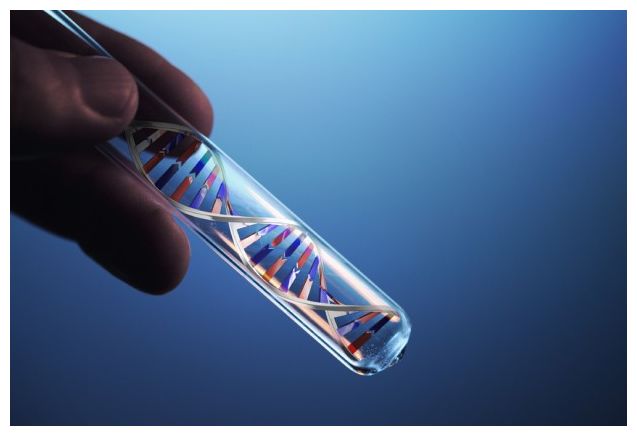
    A new study of stem cells derived from skin tissue has challenged the commonly held notion that a person's cells all share the same DNA sequence, arguing instead that genetic variation may occur to a greater extent than experts had previously believed.

    Researchers at the Yale School of Medicine set out to challenge the theory that human cells are comprised of identical genetic material, and that a body's functions are governed by that blueprint. They set out to test a competing hypothesis - that as DNA is copied from mother to daughter cells, deletions, duplications, and alternations to the sequence of the DNA could occur, and could affect entire groups of genes.

    According to the university, that notion has been "incredibly difficult to test," but Dr. Flora Vaccarino, a professor of child psychology at Yale, and colleagues did so by using whole genome sequencing to analyze induced pluripotent stem cells (iPS) taken from the upper, inner arms of a pair of different families.

    They spent 24 months characterizing those iPS cell lines and comparing them to the skin cells from which they originated, and while the genomes of each cell group were similar, Dr. Vaccarino's team was able to pinpoint multiple deletions or duplications that involved thousands of base pairs of DNA, the university explained.

    Sun

    Giant Sun eruption captured in NASA video

    Image
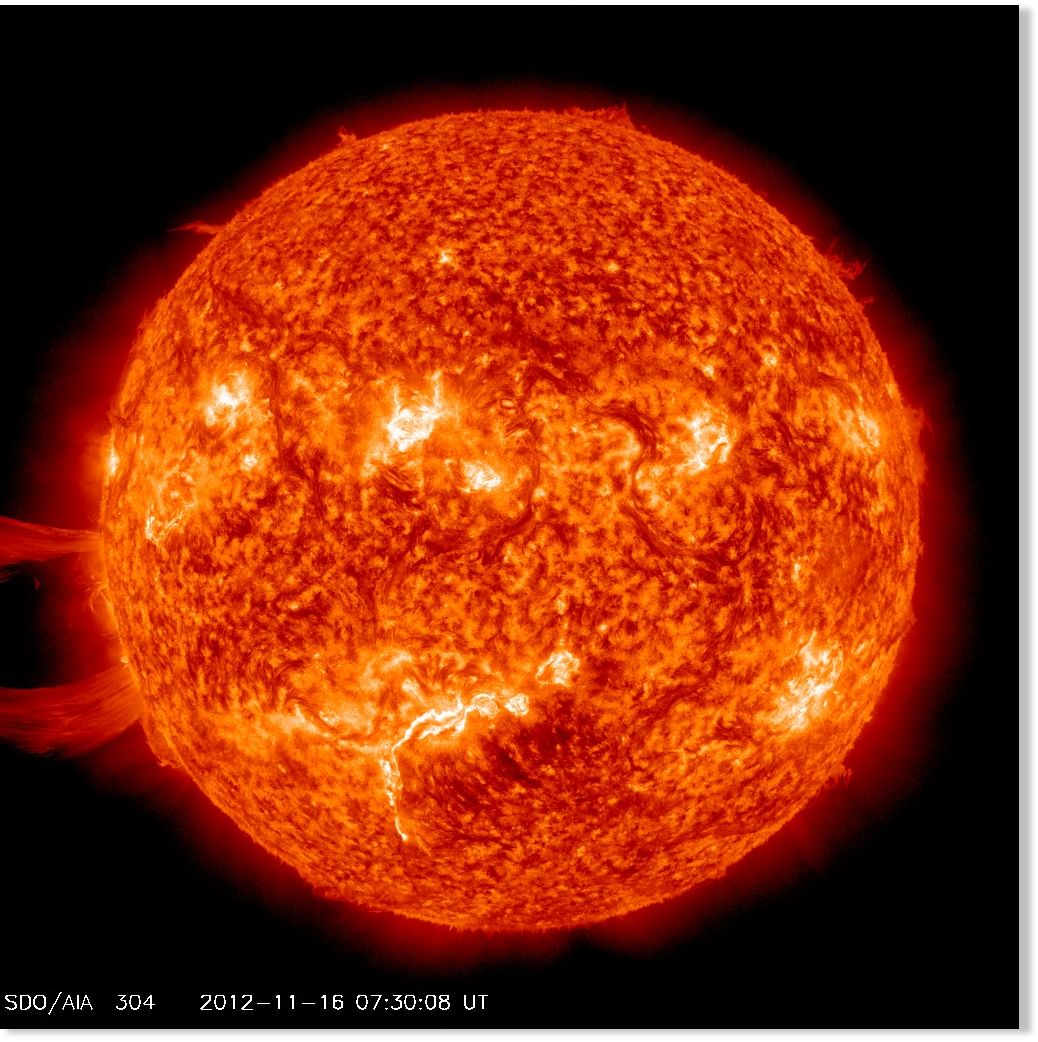
    © NASA/SDOA giant solar prominence erupts from the sun on Nov. 16, 2012, in this image captured by NASA's sun-watching Solar Dynamics Observatory. The solar eruption was not aimed at Earth.
    The sun unleashed a monster eruption of super-hot plasma Friday (Nov. 16) in back-to-back solar storms captured on camera by a NASA spacecraft.

    The giant sun eruption, called a solar prominence, occurred at 1 a.m. EST (0600 GMT), with another event flaring up four hours later. The prominences was so large, it expanded beyond the camera view of NASA's Solar Dynamics Observatory (SDO), which captured high-definition video of the solar eruption.

    In the video, a colossal loop of glowing red plasma erupts from the lower left of the sun, arcing up and out of frame as it blasts away from the star.

    "The red-glowing looped material is plasma, a hot gas made of electrically charged hydrogen and helium," officials with NASA's Goddard Space Flight Center, which oversees the SDO mission, explained in a description. "The prominence plasma flows along a tangled and twisted structure of magnetic fields generated by the sun's internal dynamo. An erupting prominence occurs when such a structure becomes unstable and bursts outward, releasing the plasma."

    People 2

    Hormone may help protect monogamous relationships

    Hormone monogamous
    © Jerome Favre / European Pressphoto AgencyOxytocin is a brain chemical known to promote trust and bonding.

    Study shows that monogamous men given the hormone oxytocin will put extra space between themselves and an attractive woman they've just met.

    If retired Army Gen. David H. Petraeus had gotten an occasional dose of supplemental oxytocin, a brain chemical known to promote trust and bonding, he might still be director of the Central Intelligence Agency, new research suggests.

    A study published Tuesday in the Journal of Neuroscience has uncovered a surprising new property of oxytocin, finding that when men in monogamous relationships got a sniff of the stuff, they subsequently put a little extra space between themselves and an attractive woman they'd just met.

    Oxytocin didn't have the same effect on single heterosexual men, who comfortably parked themselves between 21 and 24 inches from the comely female stranger. The men who declared themselves in "stable, monogamous" relationships and got a dose of the hormone chose to stand, on average, about 6 1/2 inches farther away.