Science & TechnologyS


Meteor

Comets in ancient cultures

comets
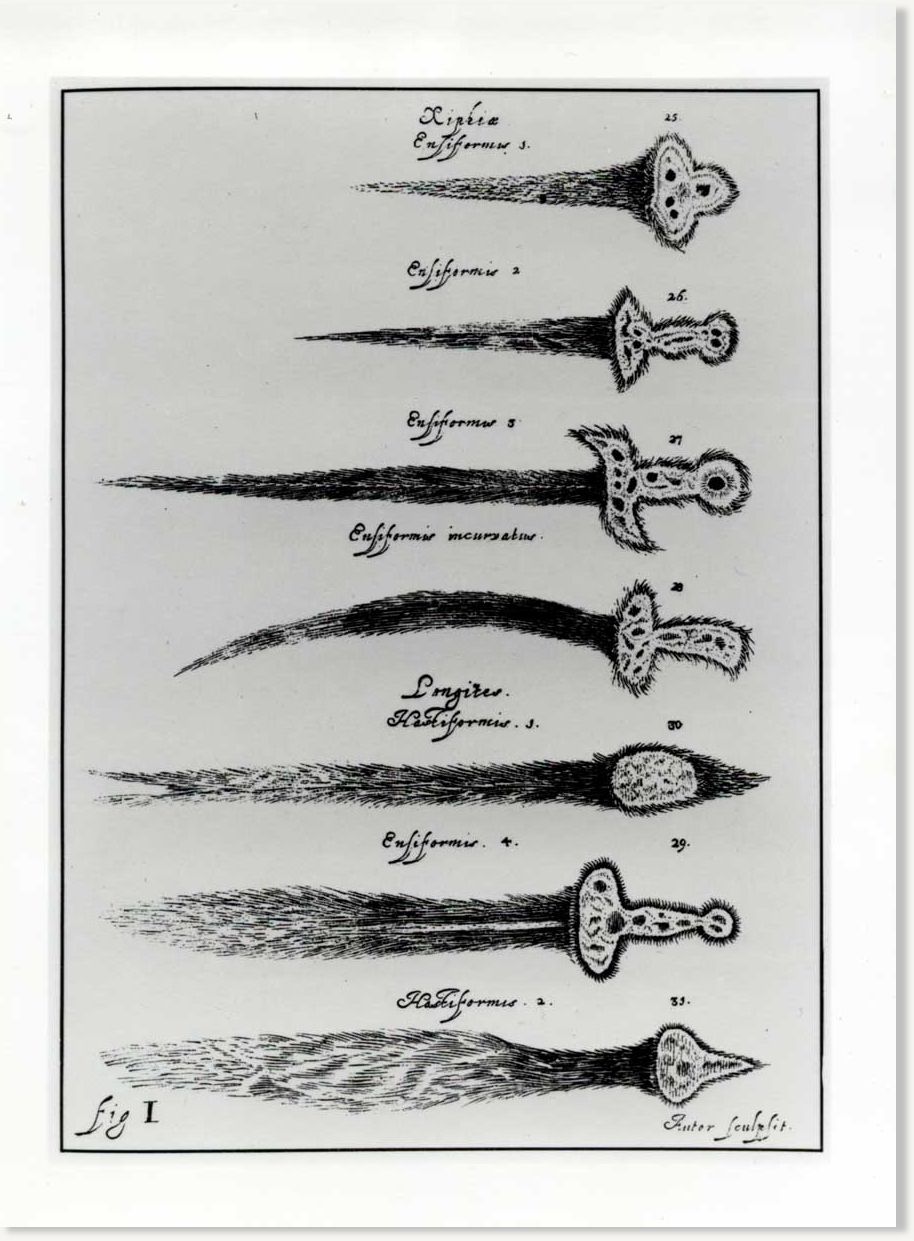
© UnknownFigure 1
Comets have inspired dread, fear, and awe in many different cultures and societies around the world and throughout time. They have been branded with such titles as "the Harbinger of Doom" and "the Menace of the Universe." They have been regarded both as omens of disaster and messengers of the gods. Why is it that comets are some of the most feared and venerated objects in the night sky? Why did so many cultures cringe at the sight of a comet?

When people living in ancient cultures looked up, comets were the most remarkable objects in the night sky. Comets were unlike any other object in the night sky. Whereas most celestial bodies travel across the skies at regular, predictable intervals, so regular that constellations could be mapped and predicted, comets' movements have always seemed very erratic and unpredictable. This led people in many cultures to believe that the gods dictated their motions and were sending them as a message. What were the gods trying to say? Some cultures read the message by the images that they saw upon looking at the comet. For example, to some cultures the tail of the comet gave it the appearance of the head of a woman, with long flowing hair behind her. This sorrowful symbol of mourning was understood to mean the gods that had sent the comet to earth were displeased. Others thought that the elongated comet looked like a fiery sword blazing across the night sky, a traditional sign of war and death. Such a message from the gods could only mean that their wrath would soon be unleashed onto the people of the land. Such ideas struck fear into those who saw comets dart across the sky. The likeness of the comet, though, was not the only thing that inspired fear.

Info

Caves reveal picture of ancient winters

Oregon Caves
© Vasile Ersek, University of OxfordThe Oregon caves where the stalagmite that recorded some 13,000 winters was discovered.
Scientists have found a stalagmite in an Oregon cave that tells the story of thousands of winters in the Pacific Northwest.

"Most other ways of estimating past climate, like tree ring data, only tell us about summers, when plants are growing," Oxford researcher Vasile Ersek said in a statement. But understanding ancient winters is also important for regions like western North America, where chilly conditions are critical for determining water resources.

For their study, Ersek and his colleagues examined a stalagmite that started forming 13,000 years ago in a cavern in what is now Oregon Caves National Monument. During the region's damp winters, water from the ground seeped through the cave's ceiling and trickled onto the floor, with the drips slowly forming the stalagmite over time.

Control Panel

Iran's hydropower production capacity hits 9,500 megawatts

Image
© UnknownIranian hydroelectric plants.
Iran's hydropower plant capacity reached 9,500 megawatts, the latest energy ministry reports said, adding that the country's hydroelectric power plants have generated more than 9bln Megawatt hours of electricity since the beginning of current Iranian year (started March 20).

The country's hydroelectric power generation showed an eight percent increase from March 20 to November 20 as compared with last year's corresponding period, the Iranian Energy Ministry's website reported.

Earlier this year, Managing Director of the Iranian Water & Power Resources Development Company Mohammad Reza Rezazadeh said the nominal capacity of Iran's hydropower plants "stands at 9.246 MW, adding that the country has generated 6.025 Gigawatt hours of hydropower in the 1st five months of current Iranian year".

He noted that six new hydropower plants would go on stream by the end of the current Iranian calendar year (to end March 20, 2013), and added that two units of Gotvand Dam power plant as well as four units of Siah Bisheh pumping storage plant with a total capacity of 1,500 MW will be put into operation by March 20.

Fireball 4

Nine radar images of near-Earth asteroid 2007 PA8 obtained between October 31 and November 13, 2012

A collage shows nine radar images of near-Earth asteroid 2007 PA8 that were obtained between Oct. 31 and Nov. 13, 2012, with data collected by NASA's 230-foot-wide (70-meter) Deep Space Network antenna at Goldstone, Calif. On Nov. 5 at 8:42 a.m. PST (11:42 a.m. EST/16:42 UTC), the object came about 4 million miles (6.5 million kilometers) from Earth, or 17 times the distance between Earth and the moon.

The images of 2007 PA8 reveal possible craters, boulders, an irregular, asymmetric shape, and very slow rotation. The asteroid measures approximately one mile wide (about 1.6 kilometers).

Each panel shows one image per day, and all of them are oriented so rotation is counterclockwise. Each image is shown at the same scale and covers 1.1 miles (1.7 kilometers) from top to bottom. The resolution of the images varies from day to day as the asteroid's distance changed. The images achieve resolutions as fine as 12 feet (3.75 meters) per pixel on Nov. 5 and 6, when the asteroid was closest. The resolution was 25 feet (7.5 meters) per pixel on Nov. 2, 3 and 8, and 62 feet (18.75 meters) per pixel on Oct. 31 and Nov. 11 to 13.

Image
© NASA/JPL-Caltech Nine new radar images of near-Earth asteroid 2012 PA8 were obtained between Oct. 31 and Nov. 13, 2012, with data collected by NASA's 230-foot-wide (70-meter) Deep Space Network antenna at Goldstone, Calif.

Comet

Nemesis - The Sun's Evil Twin Brother

The following episode explores the Nemesis theory, that our sun has a companion star whose passages through the Oort cloud periodically knocks comets into the inner solar system which results in cyclic extinction level events here on Earth.


Comment: Something wicked this way comes...


Info

Three-Quarters of mutations in human protein-coding genes occurred only recently

DNA
© PreventDisease
A new study found that nearly three-quarters of mutations in genes that code for proteins occurred fairly recently in the past 5,000 to 10,000 years.

Researchers said that the study, published in the journal Nature, shows that "recent" events have a powerful effect on the human genome, and reveals that the amount of variation or mutation identified in protein-coding genes is very different than the variation that would have been seen 5,000 years ago.

"One of the most interesting points is that Europeans have more new deleterious (potentially disease-causing) mutations than Africans," researcher Dr. Suzanne Leal, professor of molecular and human genetics at Baylor College of Medicine said in a statement.

"Having so many of these new variants can be partially explained by the population explosion in the European population," she said. "However, variation that occur in genes that are involved in Mendelian traits and in those that affect genes essential to the proper functioning of the cell tend to be much older."

Comet 2

Astronomers spot massive comet belts in nearby systems

Image
Astronomers using the European Space Agency's (ESA) Herschel space observatory have discovered massive comet belts orbiting two nearby planetary systems. The systems, named GJ 581 and 61 Vir, are known to host planets that range in mass from Earth-sized to Neptune-sized.

Neither of the systems shows evidence of planets that are close to Jupiter's or Saturn's mass. Scientists believe that Jupiter is responsible for disrupting our own Kuiper Belt in the past, sending comets raining toward the inner planets millions of years.

"The new observations are giving us a clue: they're saying that in the Solar System we have giant planets and a relatively sparse Kuiper Belt, but systems with only low-mass planets often have much denser Kuiper belts," said Mark Wyatt, lead author of a paper describing observations of the debris disc around 61 Vir and an Astronomer at the University of Cambridge. "We think that may be because the absence of a Jupiter in the low-mass planet systems allows them to avoid a dramatic heavy bombardment event, and instead experience a gradual rain of comets over billions of years."

Ice Cube

Ancient microbes found in buried Antarctic lake

Antarctica bacteria
© Christian H. Fritsen, DRI Research Professor, and Clinton Davis DRI graduate studentThis image shows a scanning electron micrograph of very small (about 0.2 micron) and numerous bacterial cells found inhabiting icy brine channels in Antarctica's Lake Vida, which lies in the Victoria Valley, one of the northernmost of the Antarctic dry valleys.
Beneath the icy surface of a buried Antarctic lake, in super-salty water devoid of light and oxygen that is also cold enough to freeze seawater, researchers have now discovered that a diverse community of bacteria has survived for millennia.

The findings shed light on the extreme limits at which life can live not just on Earth, but possibly alien worlds, scientists added.

Researchers analyzed Lake Vida, which lies encapsulated within ice at least 60 feet (18 meters) beneath Antarctica's surface. Past studies revealed the brine in the lake has been isolated from the surface for at least 2,800 years.

Bulb

Funneling the sun's energy: New way of harnessing photons for electricity proposed

Image
© Yan LiangA visualization of the broad-spectrum solar energy funnel.
The quest to harness a broader spectrum of sunlight's energy to produce electricity has taken a radically new turn, with the proposal of a "solar energy funnel" that takes advantage of materials under elastic strain.

"We're trying to use elastic strains to produce unprecedented properties," says Ju Li, an MIT professor and corresponding author of a paper describing the new solar-funnel concept that was published this week in the journal Nature Photonics.

In this case, the "funnel" is a metaphor: Electrons and their counterparts, holes -- which are split off from atoms by the energy of photons -- are driven to the center of the structure by electronic forces, not by gravity as in a household funnel. And yet, as it happens, the material actually does assume the shape of a funnel: It is a stretched sheet of vanishingly thin material, poked down at its center by a microscopic needle that indents the surface and produces a curved, funnel-like shape.

The pressure exerted by the needle imparts elastic strain, which increases toward the sheet's center. The varying strain changes the atomic structure just enough to "tune" different sections to different wavelengths of light -- including not just visible light, but also some of the invisible spectrum, which accounts for much of sunlight's energy.

Comet 2

Too little, too late? Strategic Defense of Earth - Hypervelocity Asteroid Deflection

Asteroids and comets will strike the Earth in the future, so what can mankind do to defend itself? Benjamin Deniston interviews professor Bong Wie (Iowa St. U.) and Brent Barbee (NASA Goddard) about their "Hypervelocity Asteroid Intercept Vehicle" concept, designed to utilize a thermonuclear explosive device at very high speeds for scenarios with little warning time before an asteroid impact. The interview was conducted at the Fall 2012 NASA Innovative Advanced Concepts (NIAC) symposium, held Nov. 14-15, 2012 in Virginia. NIAC examines early stage concepts that may lead to advanced and innovative space technologies critical for NASA missions in the next 10 to 100 years.